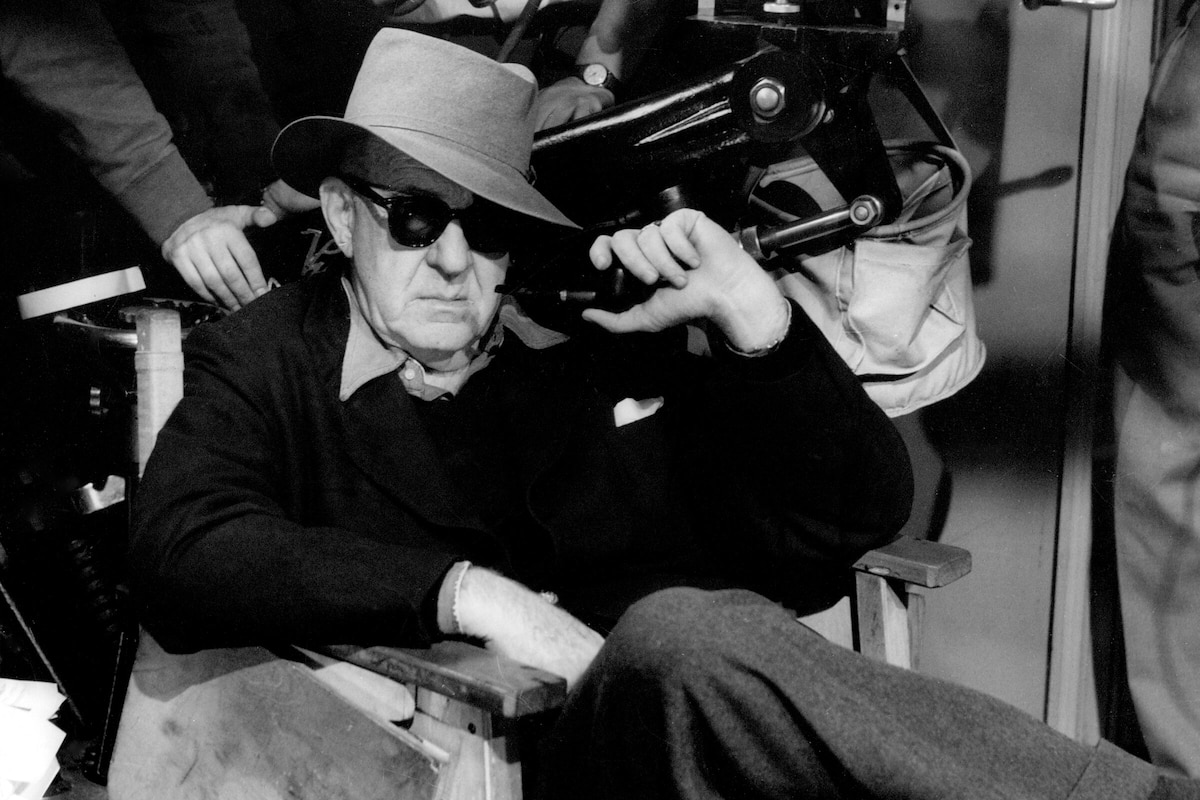
As one of the most influential directors in Hollywood history, John Ford was as famous for defining the Western genre as he was for his collaborations with screen icon John Wayne. Having started his career in the silent era, Ford honed his craft making scores of short films before becoming one of Hollywood's most decorated directors, winning a total of four Best Director Academy Awards. His first came with The Informer (1935), but it was his second for the seminal Stagecoach (1939) that cemented his place in cinema history. The film marked the true beginning of his collaboration with Wayne, even though Ford had developed a reputation as being harsh with his actors and was once accused of being the only person who could make Wayne cry. But his ability to blend art and commerce in films like The Grapes of Wrath (1940), How Green Was My Valley (1941), She Wore a Yellow Ribbon (1949) and The Quiet Man (1952) assured performers of a platform for displaying their finest work. Ford was also a pioneer of location shooting and often shot in Utah's Monument Valley, a virtually prehistoric landscape that he helped make famous in The Searchers (1956), widely considered the best Western ever made. With The Man Who Shot Liberty Valance (1962), his last great film, Ford capped a career that influenced generations of directors while offering audiences some of cinema's most important films.
Born John Martin Feeney on February 1, 1895, in Cape Elizabeth, Maine, Ford was raised by his Irish immigrant parents, John Augustine, a saloon owner and odd-job laborer, and Barbara, who birthed 11 children, three of whom died as infants. After attending Portland High School, he moved to Los Angeles in 1914, following in the footsteps of his older brother, Francis, who was working in Hollywood as an actor and director. Ford changed his name to his more famous moniker and began appearing as a bit player in his brother's movies, as well as performing a number of jobs behind the scenes including assistant director, laborer, prop assistant, stuntman and camera operator. He made his onscreen debut in Francis's silent short The Mysterious Rose (1914), and the following year played an unnamed Klansman in D.W. Griffith's notorious Birth of a Nation (1915). Though argument would remain as to what movie was his true debut as a director, most consider the two-reel Western, The Tornado (1917), as his directorial debut.
Throughout the silent era, Ford was an incredibly prolific director who made some 60-odd films, most of which have been lost to time. After The Tornado, he moved swiftly to make several silent shorts, including The Trial of Hate (1917), The Scrapper (1917) and Cheyenne's Pal (1917), all while under contract at Universal Pictures. That same year, he began a brief, but fruitful collaboration with veteran actor, Harry Carey, which spanned four years and 25 films, starting with The Soul Herder (1917) and included Ford's first feature-length film, Straight Shooting (1917). After some three dozen more films for Universal, Ford left the studio to join the Fox Film Corporation—later to become 20th Century-Fox—where he made his debut for the studio with another Western, Just Pals (1920). He had his first major success there with The Iron Horse (1924), a spectacular, albeit idealized epic centered around the building of the transcontinental railroad. Ford waged a constant battle with the studio throughout production and faced numerous threats of shut down, due largely to uncertainty brought on by him writing the script as he shot the film. In the end, Fox stuck with him, and The Iron Horse became one of the highest-grossing pictures of the decade.
In his silent films, Ford composed images with a formality and a symmetry that valued order; even at this stage, he had acquired the mantle of a Hollywood master. Most of his work to that point had been in Westerns, the genre for which he was indelibly tied, but in the late 1920s, Hollywood began losing interest in making them. After making 3 Bad Men (1926), Ford left the Western behind and would not make another for 13 years. He was a pioneering director when the sound era came into bloom, helming the silent drama, Mother Machree (1928), which featured the first-ever song sung on camera in a Fox film. The movie was also notable for being the first collaboration with actor John Wayne, who had an uncredited role. Ford went on to make several more partial-sound pictures like Four Sons (1928) and The Black Witch (1929), both of which again featured Wayne in uncredited roles. Ford made his first entry into full-fledged talkies with Napoleon's Brother (1928), a short-subject drama that was later lost, and he finished out the decade with Strong Boy (1929) and Salute (1929).
Having forgone the Western, Ford opened up his palette to include comedies, dramas, crime thrillers and action films. He maintained his prolific output with Men Without Women (1930) and the comedy Up the River (1930), which marked the film debuts of both Spencer Tracy and Humphrey Bogart. With his adaptation of Sinclair Lewis's novel, Arrowsmith (1931), starring Ronald Colman and Helen Hayes, Ford earned his first Academy Award recognition when the movie received a nod for Best Picture. In the early 1930s, he was rapidly developing as one of Hollywood's most sought-after directors, whose ability to craft artful pictures that were also commercial successes earned him a strong reputation and a staggeringly high salary. Ford directed Will Rogers in the well-received comedy Doctor Bull (1933), steered Victor McLaglen and Boris Karloff through The Lost Patrol (1934), and helmed the comedy The Whole Town's Talking (1935), starring Edward G. Robinson as a law-abiding citizen who looks just like a wanted killer. After Steamboat Around the Bend (1935), his third and final film with Rogers, Ford won the Academy Award for Best Director for The Informer (1935), which starred McLaglen as an Irishman who, after informing on his best friend who is a member of the IRA, suffers from the weight on his conscience.
After directing The Prisoner of Shark Island (1936), a film loosely based on John Wilkes Booth conspirator Samuel Mudd (Warner Baxter), Ford shifted gears to helm the South Seas-based melodrama The Hurricane (1937), the lighthearted Shirley Temple adventure Wee Willie Winkle (1937) and the costly adventure The Adventures of Marco Polo (1938), starring Gary Cooper. Thirteen years after making his last Western, Ford returned to the genre with Stagecoach (1939), one of most imitated and influential movies of all time. The film stars John Wayne in his breakthrough role, playing a falsely accused outlaw who climbs aboard a stagecoach heading deep into dangerous Apache territory with thoughts of settling a score. At the time, Hollywood had fallen out of love with Westerns and considered them to be nothing more than cheap B pictures at best. But Ford's artful and thrilling film revitalized the genre and proved that they could indeed be profitable. Stagecoach was also notable for being the first of numerous movies that he shot at Monument Valley in Utah. The film earned a number of Academy Award nominations, including Best Picture and Best Director.
From there, Ford entered into a highly fruitful period that saw the director produce some of his best work. He followed with Young Mr. Lincoln (1939), starring Henry Fonda as the titular future president, and Drums Along the Mohawk (1939), his first movie shot in Technicolor and with a big box-office success. He went on to make one of his best films, an adaptation of John Steinbeck's The Grapes of Wrath (1940), a critical and financial hit starring Fonda as the moralistic Tom Joad, who helps his impoverished family escape the dust bowl and find new life in California. Though some critics were afraid that it would be nothing more than pro-Communist propaganda, The Grapes of Wrath struck a chord with audiences and earned Ford his second Oscar for Best Director. Following with The Long Voyage Home (1940) and Tobacco Road (1941), Ford helmed How Green Was My Valley (1941), a decades-spanning epic that focuses on generations of a hard-working Welch mining family, starring Walter Pidgeon, Maureen O'Hara and a young Roddy McDowall. The film was another giant hit for Ford and was nominated for 10 Academy Awards, winning five including statues for Best Picture and Best Director.
How Green Was My Valley was the last movie Ford made before the end of World War II, during which he directed acclaimed propaganda documentaries as part of his contributions to the war effort. He served in the United States Navy under the rank of commander and headed the photographic unit for the Office of Strategic Services, for whom he made documentaries for the Navy, including short-subject films “Torpedo Squadron” (1942), “Sex Hygiene” (1942) and “The Battle of Midway” (1942), which Ford shot on 16mm himself while present for the battle. He was wounded in the arm by shrapnel—an injury that brought about complications for the remainder of his life—and later won an Academy Award for Best Documentary. He went on to win another Oscar, this time for Best Documentary Short Subject, for December 7th (1943), a propaganda film about the Pearl Harbor attack in 1941. Ford was also at Omaha Beach for the Invasion of Normandy with camera in hand, but the color footage he shot of the first wave of the landing was deemed to be too gruesome for audiences to see and was put into storage, only to become lost decades later.
Wrapping up his wartime efforts, Ford directed Robert Montgomery and John Wayne in They Were Expendable (1945), a stirringly patriotic look at two PT boat officers rebounding from America's defeat in the Philippines. He returned to his regular Hollywood duties with My Darling Clementine (1946), a highly fictional portrayal of Wyatt Earp (Henry Fonda) and his adventures with his brothers and Doc Holliday (Victor Mature). After teaming with Fonda again for The Fugitive (1947), Ford directed Wayne in the first of the so-called cavalry trilogy: Fort Apache (1948), She Wore a Yellow Ribbon (1949)—widely considered to be one of Wayne's finest performances—and Rio Grande (1950). Following the workman-like Western Wagon Master (1950) and the dismissible comedy When Willie Comes Marching Home (1950), Ford directed Wayne in his most uncharacteristic role in The Quiet Man. In the director's affecting romantic comedy, The Duke played an American boxer who accidentally kills a man in the ring and flees to Ireland to escape the trauma, where he meets and falls for a spirited Irish woman (Maureen O'Hara) whose father refuses to consent to their marriage. Understated and underappreciated, The Quiet Man was a pet project of Ford's decades in the making, and it earned him his fourth and final Academy Award for Best Director.
Following the rather poorly received Western comedy The Sun Shines Bright (1953), Ford had one of the biggest commercial hits of his career with Mogambo (1953), a lavish romantic adventure that follows a big game hunter (Clark Gable), a good-time playgirl (Ava Gardner) and a sheltered English couple (Donald Sinden and Grace Kelly) as they go on safari in Africa, only to face dissention among their ranks born from unrequited lust. Ford next directed Mister Roberts (1955), his masterful comedy about a cargo officer (Hendry Fonda) forced to deal with a tyrannical ship captain and a zany crew of misfits while awaiting a reassignment. The film marked a return to the screen for Fonda after an eight-year absence, as well as the last film he made with Ford, who became so irate with the actor for questioning his work, Ford punched him in the jaw. The event triggered Ford to embark on a serious drinking binge that shut down production for days. He eventually returned, only to suffer a ruptured gallbladder that required emergency surgery. Ford was replaced by Mervyn LeRoy, who received shared credit for finishing the film.
Having recovered from his surgery, Ford went about directing his most famous film, The Searchers (1956), widely considered to be one of the best—if not the best—Westerns ever made. Highly regarded by critics, historians, and such contemporary directors as Steven Spielberg, Martin Scorsese and George Lucas, The Searchers is not only a rousing adventure tale, but also a melancholy examination of the contradictions of settling the Old West. At the center is Ethan Edwards (John Wayne), a ruthless and bitter veteran of the Civil War who engages in an obsessive quest to retrieve an orphaned niece (Natalie Wood) abducted by a Comanche raiding party. Shot entirely in Monument Valley, on fine display in vivid Technicolor, The Searchers was later a major influence on filmmakers throughout the decades. David Lean repeatedly watched it while preparing to shoot Lawrence of Arabia (1962), while Sam Peckinpah paid homage to the film in several of his own works. But despite its widespread influence and its commercial success, The Searchers received zero Academy Award nominations.
Ford departed from his previous films over the next couple of years, starting with The Wings of Eagles (1957), a fictionalized biopic on the director's own friend, Frank Spig Wead (Wayne), a Navy man and World War II veteran who breaks his neck in a fall down the stairs and overcomes his depression by becoming a screenwriter. Ford followed with the Irish-set anthology The Rising of the Moon (1957) and the British-made crime drama Gideon's Day (1958), before making The Last Hurrah (1958) with Spencer Tracy, who stars as a tough Irish-American mayor of an unnamed city, willing to do whatever is necessary to win re-election. After directing Wayne in the Civil War-era Western The Horse Soldiers (1959) and Jeffrey Hunter in Sergeant Rutledge (1960), Ford had a brief and rocky working relationship with James Stewart, starting with Two Rode Together (1962), one of the director's least favorite films. His second film with Stewart, The Man Who Shot Liberty Valance (1962), was a return to form as well as his last truly great film. Filmed in stark black and white, Valance stars Stewart as a powerful U.S. Senator who recounts his tale of vengeance for being robbed as a young lawyer by a ruthless outlaw (Lee Marvin) with the help of a local cowboy (Wayne). Ford's dark vision of a West plagued by lies and deceit was hailed by critics and became an instant hit based on the popularity of its two stars.
From there, Ford directed the Civil War segment of the anthology Western How the West Was Won (1962) and moved on to make his last film with Wayne, Donovan's Reef (1963), a comedy about two buddies (Wayne and Marvin) on leave in the South Pacific that was an unworthy end point to the pair's highly successful collaboration. By this time, Ford's health was in serious decline from decades of heavy drinking, smoking and the residual effects of the wounds he suffered at the Battle of Midway. He directed only a few more films—the epic Western Cheyenne Autumn (1964) with James Stewart and Edward G. Robinson, the fictionalized biopic Young Cassidy (1965) and the period drama Seven Women (1966), starring Anne Bancroft and Margaret Leighton—before succumbing to his various ailments.
In 1970, he suffered a broken hip that required moving about in a wheelchair and moving out of his Bel Air home. He received a number of honors in his final years, including a promotion to full admiral by President Richard Nixon, before he died on August 31, 1973, after being treated for cancer. Ford left behind an incalculable legacy that included influencing countless filmmakers from Sergio Leone to Akira Kurosawa, who were among the many that have counted Ford as their inspiration.
(Edited: August 2026 by Quatoyiah Murray)
