Cinematographer Peverell Marley faced an unusual challenge with the 1946
remake of Of Human Bondage. After decades of making Hollywood stars
like Loretta Young (The House of Rothschild, 1934), Merle Oberon
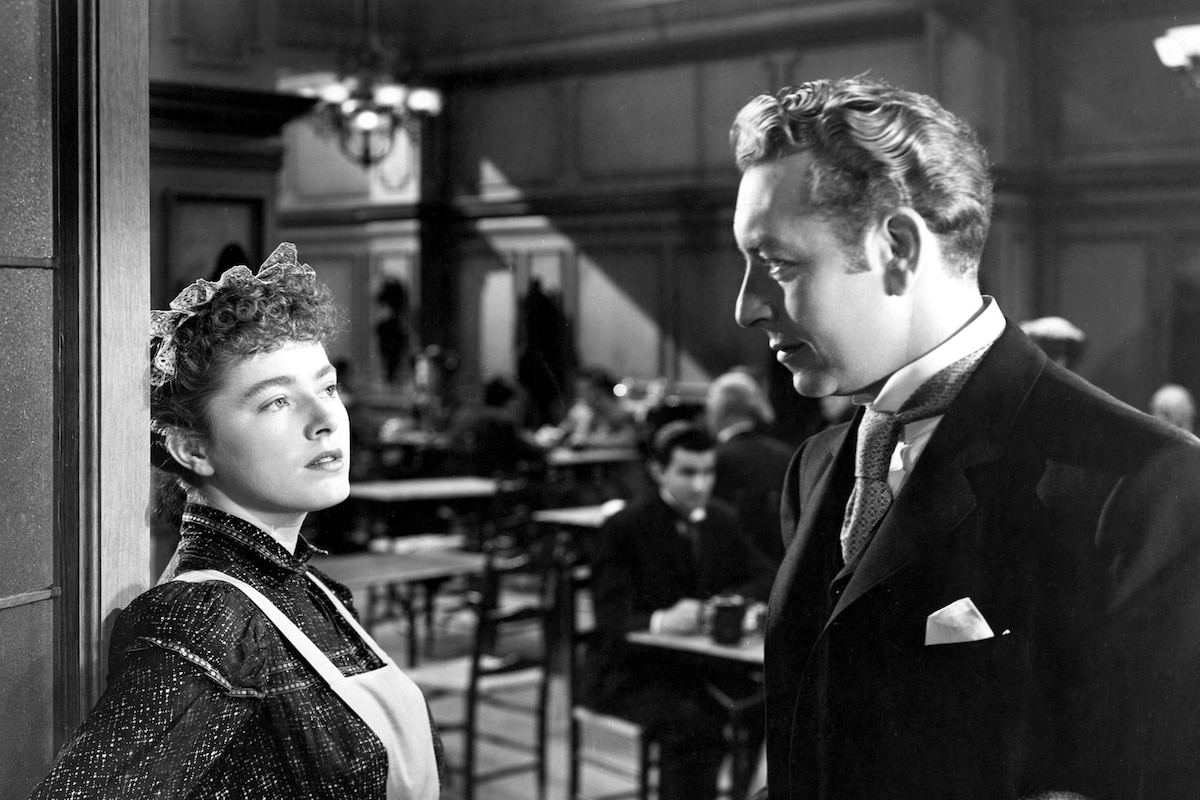
(Folies-Bergere de Paris, 1935) and wife Linda Darnell (Star Dust, 1940) look glamorous, he had to turn Eleanor Parker into the slatternly waitress
formerly played by Bette Davis. To do so, he adopted a film noir approach
with director Edmund Goulding, though, as it would turn out, their work
would only reach audiences in a highly altered form.
Of Human Bondage had originally been filmed at RKO Pictures in 1934,
with Davis performing on loan-out from her home studio, Warner Bros. That
performance and picture were already legends in the '40s, when Warner's
studio head Jack L. Warner decided to try another version of the tale of a
young doctor obsessed with a low-class waitress. Hoping he could do for
one of his contract stars what the first film had done for Davis, he
decided to give the part of Mildred to the young Eleanor Parker, more known
at the time for her sweet young leading lady roles. Ida Lupino, also under
contract, would have been the perfect choice, as she was British and had
triumphed with a similar role in The Light That Failed (1939), but
she didn't want to be identified with British parts any more.
Director Edmund Goulding was far from convinced that Parker could handle
the role, so he demanded three screen tests. After the second, he decided
she could pull it off. To prepare, Parker studied the Cockney dialect with
character actress Doris Lloyd, who played a minor role in the film. "I wrote every word out phonetically and memorized the role that way," Parker later remarked.
Working with the wardrobe department, she pieced together a set of late
19th century costumes from what she would call the studio's "rag bag." She
even agreed to play the role without makeup. Her transformation was so
complete that British extras on the film thought she was the real thing,
losing several bets when she revealed that she was just a small-town girl from
Ohio. Unfortunately, a final death scene showing Parker ravaged by illness was considered too grim for audiences of that era and cut from the film. Another deleted segment was a heated sidewalk argument between Paul Henreid, Richard Nugent and Parker.
Yet, had the rest of the film come up to Parker's level, Of Human Bondage could have been a
hit to rival the original. Unfortunately, the studio cut corners on
casting, putting the Viennese actor Paul Henreid into the role of the young
British doctor. They revised the novel's original storyline to give him an Austrian mother and
put him in a blond wig to disguise his age, but it didn't really work. Nor
did inserting dialogue at regular intervals about how young he was.
Yet in another way, Henreid helped the picture tremendously. The actor was
concerned about Goulding's filming methods. The director would spend two days
rehearsing a scene and then shoot it in one long take, which usually
required going back and doing additional takes days later to add in
close-ups and two-shots. When producer Henry Blanke was reluctant to
confront Goulding on the issue, Henreid simply blew his lines whenever he
thought a take was lasting too long. Goulding had to go back and pick the
scene up from just before the mistake, which allowed Marley to switch the
camera angle subtly.
Unfortunately, that wasn't enough. The film was finished in 1944, after
which it had a disastrous preview screening. The long takes had destroyed
the film's rhythm. Having learned about a new optical bench that allowed
editors to create close-ups out of wider shots, Henreid suggested to his
agent, Lew Wasserman, that they could re-edit the film. Wasserman
suggested that the producer would be more receptive to suggestions from an
agent than one of the stars, so Henreid stayed up all night marking
close-ups and other shot changes in his script, then taught the changes to
Wasserman. He, in turn, gave his notes to Blanke, who later called Henreid and said, "Paul, I've slept on this disaster, and I have some excellent ideas on how to salvage it. Trust me, I'll save the picture." Of course, he was unaware that Wasserman's suggestions had come from his leading man!
Due to a glut of product during the later years of World War II, Of Human
Bondage sat on the shelf for two years, during which time it was cut
further by the studio. Parker lost some of her best scenes, and Alexis
Smith, though given co-star billing as the writer who almost saves Henreid
from Parker's bad influence, was reduced to a supporting role. Despite
some good reviews for Parker's performance, particularly in England, the
picture was condemned by critics and ignored by the public. Worse yet,
when MGM remade the story in 1964 (with Kim Novak and Laurence Harvey), the
studio bought up Warner's 1946 version and withdrew it from television
distribution until recently. Finally available for viewing again, Parker's
performance compares favorably with Davis' and far overshadows Novak's
interpretation of the part.
Producer: Henry Blanke
Director: Edmund Goulding
Screenplay: Catherine Turney
Based on the novel by W. Somerset Maugham
Cinematography: Peverell Marley
Art Direction: Hugh Reticker, Harry Kelso
Music: Erich Wolfgang Korngold
Principal Cast: Eleanor Parker (Mildred Rogers), Paul Henreid (Philip
Carey), Alexis Smith (Nora Nesbitt), Edmund Gwenn (Athelny), Janis Paige
(Sally Athelny), Patric Knowles (Griffiths), Henry Stephenson (Dr.
Tyrrell), Isobel Elsom (Mrs. Athelny), Una O'Connor (Mrs. Foreman).
BW-106m. Closed captioning.
by Frank Miller
Of Human Bondage (1946)
by Frank Miller | September 24, 2008
SIGN UP FOR OUR NEWSLETTERS

CONNECT WITH TCM