This article was originally written for the TCM Spotlight programming in the TCM Now Playing newsletter in June 2026.
Disasters of all sorts—natural, man-made, Biblical, science fiction—have been fodder for the movies since the silent era. Every generation or so sees a cycle of disaster movies, often prompted by the unexpected success of one film that captures the fervent imaginations of audiences and filmmakers alike, and often reflecting social anxieties specific to that era. Wednesdays in June, TCM pays tribute to the genre with notable titles from three of those cycles: the mid-1930s, the late 1950s to early 1960s, and the genre’s golden age of the 1970s.
King Kong (1933) may not be typically thought of as a “disaster movie,” but its climactic scenes of Kong rampaging through Manhattan, capturing Fay Wray and sending scores of innocent New Yorkers to their deaths is actually one of the most memorable such spectacles in any disaster film. Producer-directors Merian C. Cooper and Ernest B. Schoedsack, working with special effects pioneer Willis O’Brien, created a giant ape character out of an eighteen-inch puppet made of cloth, rubber and metal (with a larger mechanical head and arm used for some shots). Thanks to a combination of stop-motion animation, back projection, miniatures and matte paintings, Kong appears to be 40 feet high and commands an astonishing range of emotion that terrified audiences, drew their sympathy and turned King Kong into one of the great landmarks of filmmaking.

Two years later, Cooper, Schoedsack and O’Brien reunited for The Last Days of Pompeii (1935), the Roman-era story of a humble yet embittered blacksmith (Preston Foster) who becomes a gladiator and amasses great wealth. The story scales melodramatic heights before Mt. Vesuvius erupts, forcing Foster to make a moral choice. Something of a nod to the disaster films of the silent era, which were often set in the ancient world, The Last Days of Pompeii features another impressive O’Brien spectacle in the volcano sequence, with collapsing buildings and flowing lava having the last word over fleeing Romans.
Meanwhile, MGM was producing its own disaster movie, San Francisco (1936), with the even starrier cast of Clark Gable, Jeanette MacDonald and Spencer Tracy. Here, the 1906 San Francisco earthquake provides the spectacle in a film that garnered six Oscar nominations. While the film overall was directed by W.S. “Woody” Van Dyke, the thrilling earthquake sequence, innovative in its use of rolling sets, was written, directed and edited by John Hoffman, who later ran the montage department at MGM with fellow montage artist Slavko Vorkapich.

“Disaster movie” is a term that has been applied to films retroactively. Not until the 1970s did the phrase start popping up in reviews and the trade press. Variety’s review of San Francisco, for instance, called it a “meller,” or melodrama, and the other ‘30s films were simply referred to as action-adventure or the like. The same was true in the 1950s. The Japanese-made Godzilla (1954), released in the U.S. in 1956, is as iconic as King Kong. The giant, prehistoric lizard Godzilla is awakened by atom-bomb testing in the ocean and proceeds to destroy ships and ultimately terrorize Tokyo as military men and scientists try to intervene.
Endlessly remade and spun off, the original Godzilla was made as a cautionary tale about the modern world and its unsettled future. Similar themes drove other disaster movies of the era. On the Beach, based on a novel by Nevil Shute, imagines a world that has been destroyed by nuclear war, with only Australia remaining habitable for the few Americans and Australians that survived. For decades the film stood as the definitive dramatic portrayal of the aftermath of a nuclear war. The World, the Flesh, and the Devil applied this idea to a New York City that is completely deserted except for three survivors: a Black man (Harry Belafonte), a white woman (Inger Stevens) and a white man (Mel Ferrer). Racism and sexual competition drive the conflicts that ensue. While the film was a box-office disappointment, it stands as an interesting variation on the doomsday movies of the period, as does the sci-fi Crack in the World (1965), which imagines a nuclear missile fired into the earth by scientists, only for the entire planet to become at risk of breaking in two.

Other titles from this period anticipated the many ship and plane disaster spectacles to come over a decade later. A Night to Remember (1958) is one of the finest screen versions of the Titanic disaster, while The Last Voyage (1960) finds a family trying to stay alive on a slowly sinking passenger ship—a concept that clearly paved the way for The Poseidon Adventure (1972). Producers Andrew and Virginia Stone, always sticklers for realism, filmed The Last Voyage on a real ocean liner, the retired S.S. Ile de France, rather than using miniatures and back projection. The film was very well received (“pure excitement,” declared Variety) and deserves more recognition.
Also underrated was The Crowded Sky (1960), starring Dana Andrews and Rhonda Fleming, which dramatizes a midair collision. Another aviation tale, Zero Hour! (1957), would prove even more influential. Based on a script that Arthur Hailey originally wrote for a 1956 Canadian TV movie, it imagines a scenario in which the pilot and co-pilot of a commercial flight come down with food poisoning, leaving a former fighter pilot on board to take over. The story was adapted to the big screen with Andrews, Sterling Hayden and Linda Darnell, and was later remade several times. It was also a precursor to Airport (1970), based on Hailey’s bestselling novel.

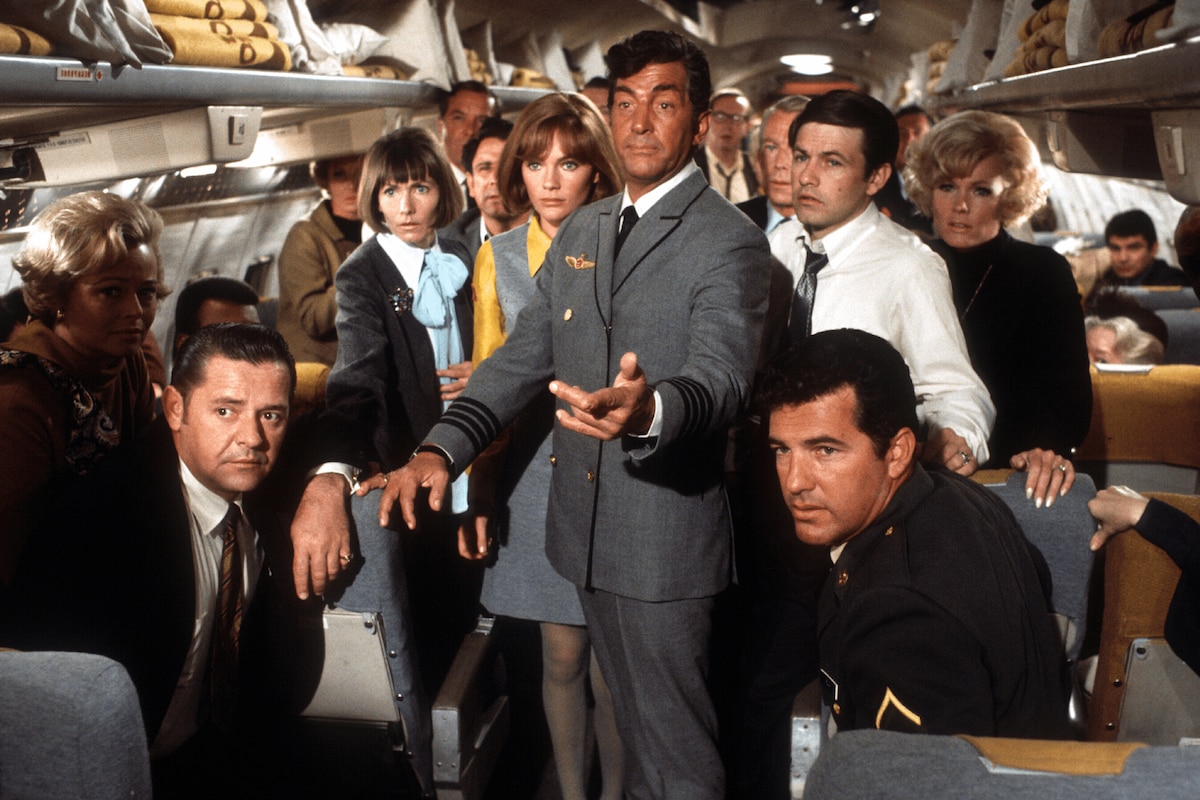
Considered in retrospect to be the first great disaster film of the 1970s, at the time of release, Airport was received more as a soapy melodrama with its intersecting story threads and all-star cast—albeit a massively successful one. (Despite many poor reviews, it was the second-highest-grossing picture of the year.) The film is really an “almost-disaster” story, with most of the running time laying out the multiple plotlines and backstories, in the airplane and on the ground, until a depressed passenger (Van Heflin) sets off a bomb in the plane’s lavatory. Pilots Dean Martin and Barry Nelson must now land the torn-open plane safely despite a raging snowstorm at the Chicago airport managed by Burt Lancaster. Airport’s financial success certainly prompted the production of more disaster films, but they would employ grander scales with higher body counts.
The next year’s The Omega Man (1971), a suspenseful box-office hit based on Richard Matheson’s dystopian novel “I Am Legend,” stars Charlton Heston as the (possibly) last human on earth after germ warfare has wiped out most of humanity. Meanwhile, The Andromeda Strain (1971), a box-office disappointment based on a Michael Crichton novel, concerns the discovery of microscopic alien organisms that turn human blood into powder and mutate to threaten all life on Earth.

In 1972, Heston appeared again as an airplane captain in Skyjacked, which capitalized on both the success of Airport and a recent spate of real airplane hijackings, but it was The Poseidon Adventure that did more than any film to establish the narrative model for the modern disaster picture. Producer Irwin Allen assembled an all-star cast to play characters fighting to find daylight when their luxury ocean liner is overturned by a tsunami caused by an undersea earthquake. The disaster comprises most of the running time, and top-drawer special effects generate spectacle on a grand scale. The advertising tagline declared “Hell, Upside Down” in such big print that some mistook it as the title of the movie. Distributed by 20th Century-Fox, the $5 million Poseidon Adventure grossed over $160 million and drew eight Academy Award nominations, winning a special Oscar for its visual effects. That success opened the floodgates to more such epics, including Allen’s next production, The Towering Inferno (1974)—an undertaking so massive that it took two studios working together (Fox and Warner Bros.) to make it.
The Towering Inferno is perhaps the pinnacle of the genre. In San Francisco, the world’s tallest skyscraper catches fire due to electrical short circuits as partygoers revel on the 135th floor. The term “all-star cast” has never been more apt: William Holden, Jennifer Jones and Fred Astaire are technically in the supporting cast, which is toplined by Steve McQueen as the fire chief, Paul Newman as the building’s architect and Faye Dunaway as Newman’s fiancée. Written by Poseidon’s Stirling Silliphant and directed by Skyjacked’s John Guillermin, the production boasted 57 sets, including five floors of the building constructed at full scale on the Fox lot. A “miniature” of the entire building was itself 70 feet tall. Most of the sets were destroyed during filming of the climax as one million gallons of water rushed through them.

Dozens of firefighters oversaw the filming, and each cast member was assigned a firefighter to protect them if needed. Stunt coordinator Paul Stader later recalled, “In most films, if something goes wrong a stuntman would get hurt. In The Towering Inferno, if something had gone wrong a stuntman could have been killed.” The final film clocked in at a mesmerizing 165 minutes. Produced for $14 million, it grossed over $200 million and won three Oscars. Irwin Allen was christened “the master of disaster” and told The New York Times, “People are observers of the macabre. It is a trait of all of us, to one degree or another.”
In theaters at the same time was the huge Universal production Earthquake (1974), with Charlton Heston and Ava Gardner leading a large cast who must survive a 9.9 magnitude earthquake that all but destroys Los Angeles. To make the film even more of an event, Universal’s sound department developed a system christened “Sensurround” to be installed in select theaters: low-frequency sound vibrations were emitted from special speakers around the theater to create an ominous, low rumble that audiences could feel. Ho-hum reviews didn’t stop the film from grossing about $170 million on a $7 million budget and drawing five Oscar nominations, of which it took home two, for sound and visual effects.

Yet, Earthquake would be the last massively successful disaster movie of the era. The Hindenburg (1975), despite meticulous craftsmanship, made only a slight profit and marked the beginning of the genre’s downturn. In telling the tale of the fated German airship’s 1937 crash in New Jersey, it deviated from the new disaster formula too much by forgoing a truly star-laden cast and saving the actual disaster for the very end of the film. “If it’s possible to violate the disaster genre, The Hindenburg has done it,” wrote critic Pauline Kael.
The end of the decade brought such flops as Gray Lady Down (1978), Meteor (1979) and Beyond the Poseidon Adventure (1979). They are notable for how they show the genre to be running out of ideas and becoming increasingly formulaic and campy—though they are beloved by some for just that reason. Even Irwin Allen couldn’t save things: his eco-horror The Swarm, inspired by the African bee scare of the time, was a spectacular failure and the first of these films to enter the realm of camp. As The New York Times declared, “It could be argued that The Swarm is the surprise comedy hit of the season.” Two years later, an intentional comedy put the final nail in the coffin: Airplane! (1980), a scene-by-scene broad comedy remake of Zero Hour!, still stands as one of the funniest movies ever made.
