Rashomon (1950) and Ikiru (1952) may be cinematic poetry, but Akira
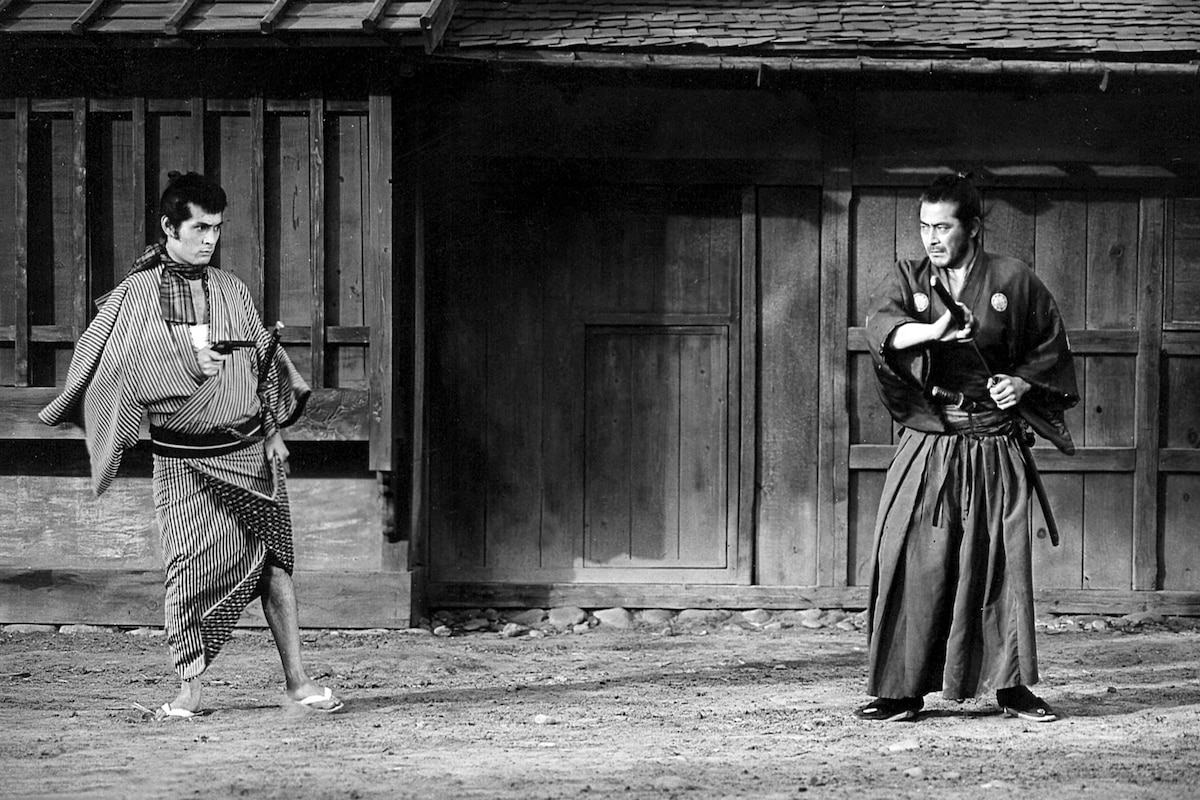
Kurosawa's most financially successful film was Yojimbo (1961), an
unexpectedly witty samurai yarn that owes a great deal to classic Hollywood
Westerns. Its dusty streets and man-to-man standoffs echo everything from
Shane (1953) to High Noon (1952) while retaining the evocative Old World flavor of Kurosawa's more emotionally sophisticated films. Yojimbo
is so steeped in Westerns, it was eventually recycled by Italy's Sergio
Leone as A Fistful of Dollars (1964), proving yet again that genre pictures,
with a little bit of cultural retooling, translate smoothly into all
languages.
Kurosawa regular Toshiro Mifune (he starred in 16 of the director's films
before they had an unfortunate falling out) plays Sanjuro Kuwabatake, a traveling
samurai who happens upon a town that's in the midst of a mini civil war.
The town's factions are lead by Fujiwara, a silk merchant, and Shimura, a
sake merchant, both of whom are brutal tyrants who will stop at nothing to
gain complete power. Sanjuro, a warrior who's seen it all, takes advantage
of the situation by hiring himself out to Fujiwara as a bodyguard (or
"yojimbo.") After studying how the two men operate, Sanjuro accepts
work with Shimura, then shrewdly orchestrates a situation that leads to a
violent showdown. The townspeople, of course, are saved in the process,
just as they would have been had John Wayne galloped in on
horseback.
Kurosawa was entirely forthcoming about his influences. "Good Westerns," he
once said, "are liked by everyone. Since humans are weak, they want to see
good people and great heroes. Westerns have been done over and over again,
and in the process a kind of grammar has evolved. I have learned from this
grammar of the Western." What he added to the mix was an amused cynicism
about the human condition.
Surely, Kurosawa's tradition-based melancholy can be traced to the tragic figure of
his older brother, Heigo: "He was artistic, and he loved films. During the
end of the silent film period, he was benshi (film
narrator-commentator) appearing under the name Teimi Tsuda at the Musaschino
Cinema. He specialized in foreign silent films and used to fascinate his
listeners with his detailed psychological descriptions. In father's eyes
Heigo was always wrong. His way of life was too much for him because father
was a former soldier and retained a soldier's outlook. Heigo liked to play
around with art and it looked frivolous- that is why father always had it in
for him."
"He would take me to yose (traditional Japanese vaudeville) and to
kodan (a story-telling entertainment where traditional samurai tales
were told) and to the movies. He had a pass since he worked for a theater,
and I used to go to the movies for free. We used to talk a lot too...then
one day he went into the mountains of Yugashima and killed himself. He had
taken me to a movie in the Yamate district and afterwards he said that that
was all for today, that I should go home. We parted at Shin Okubu station.
He started up the stairs and I had started to walk off, then he stopped and
called me back. He looked at me, looked into my eyes, and then we parted.
I know now what he must have been feeling. He was a brother whom I loved
very much and I have never gotten over this feeling of loss."
One can imagine Heigo being very proud of his younger brother's
world-renowned career.
Producer: Ryuzo Kikushima, Akira Kurosawa, Tomoyuki Tanaka
Director: Akira Kurosawa
Screenplay: Ryuzo Kikushima, Akira Kurosawa, Dashiell Hammett (novel)
Cinematography: Kazuo Miyagawa
Film Editing: Akira Kurosawa
Art Direction: Yoshiro Muraki
Music: Masaru Sato
Cast: Toshiro Mifune (Sanjuro Kuwabatake), Tatsuya Nakadai (Unosuke), Yoko Tsukasa (Nui), Isuzu Yamada (Orin), Daisuke Kato (Inokichi), Seizaburo Kawazu (Seibei).
BW-111m. Letterboxed. Closed captioning.
by Paul Tatara
Yojimbo
by Paul Tatara | October 30, 2003
SIGN UP FOR OUR NEWSLETTERS

CONNECT WITH TCM