This article was originally written about programming for the TCM Now Playing newsletter in January 2026.
January 26 at 8pm ET | 3 Movies
Artist Michael Kalish started his career as a baseball player before he turned his attention to his first love: art. Influenced by Andy Warhol and Jean-Michel Basquiat, Kalish began contributing to the art world by fusing elements of Americana into pop art. Using old license plates as the materials for his early artwork, Kalish’s oeuvre of abstract art, outdoor installations and dimensional art is largely built from recycled car parts, old scraps of aluminum and repurposed material. In Kalish’s most recent work, he sorts through collections of acquired film reels to identify film strips and frames that he then turns into portraits of classic Hollywood figures, like Humphrey Bogart, Vivien Leigh and Hattie McDaniel. On January 26 at 8pm ET, Kalish takes his turn as a TCM guest programmer with Dave Karger to highlight three films—each a defining classic of its decade and each representing a piece of artwork he’s made.
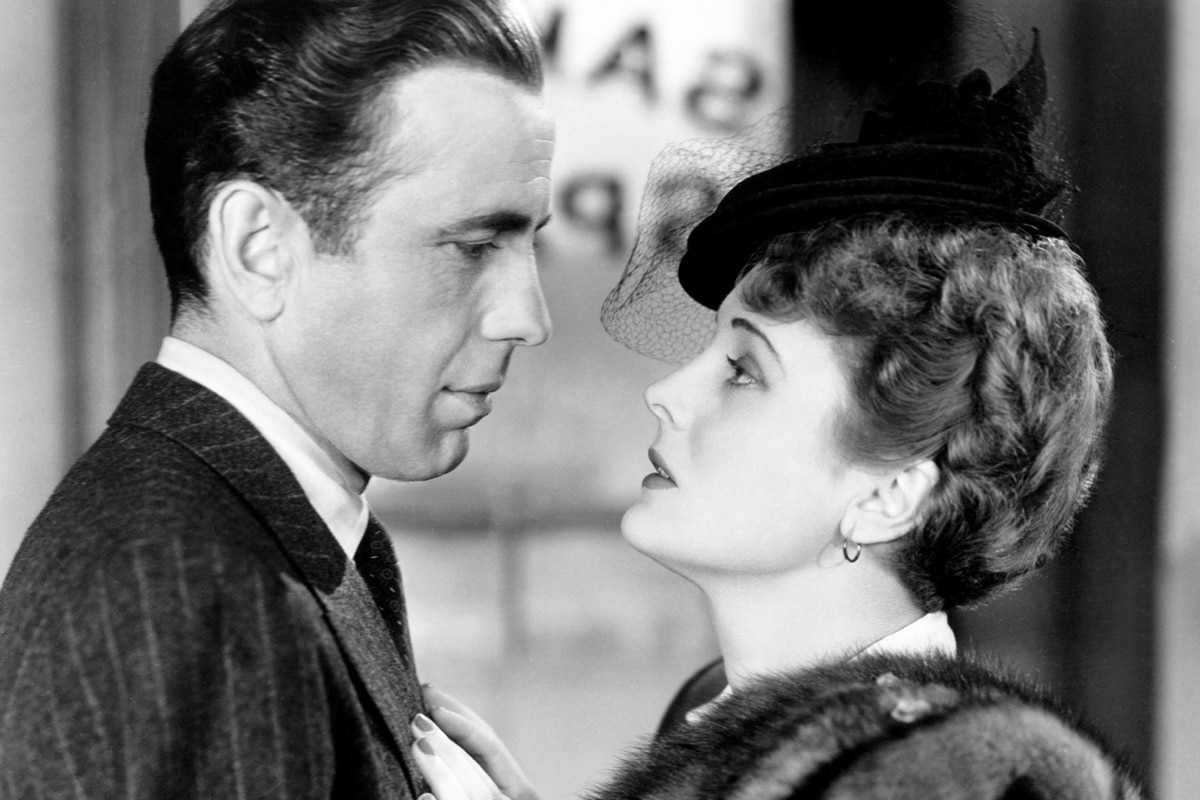
The Maltese Falcon (1941) not only launched John Huston’s directing career and catapulted Humphrey Bogart to stardom, but it was also one of the first full-fledged examples of film noir, the stylistic movement that would spread around Hollywood through the 1940s. Dashiell Hammett’s 1930 novel had already been brought to the screen twice—first in 1931, in a good but relatively forgotten version, and then in 1936, as Satan Met a Lady, which is otherwise better left unmentioned. Warner Bros. wasn’t planning to give the story a third go-around, but when their contract writer John Huston finally got the chance to direct, he asked to do a new version of Hammett’s tale. Since Warners already owned the underlying property, and this was to be simply a B-film opportunity for Huston, they figured they had little to lose and gave him the green light to write and direct. Little did anyone realize that this “little B film” would become a runaway sleeper hit, garner three Oscar nods and permanently enter American popular culture for its dialogue, characters, ending and the “black bird” itself.
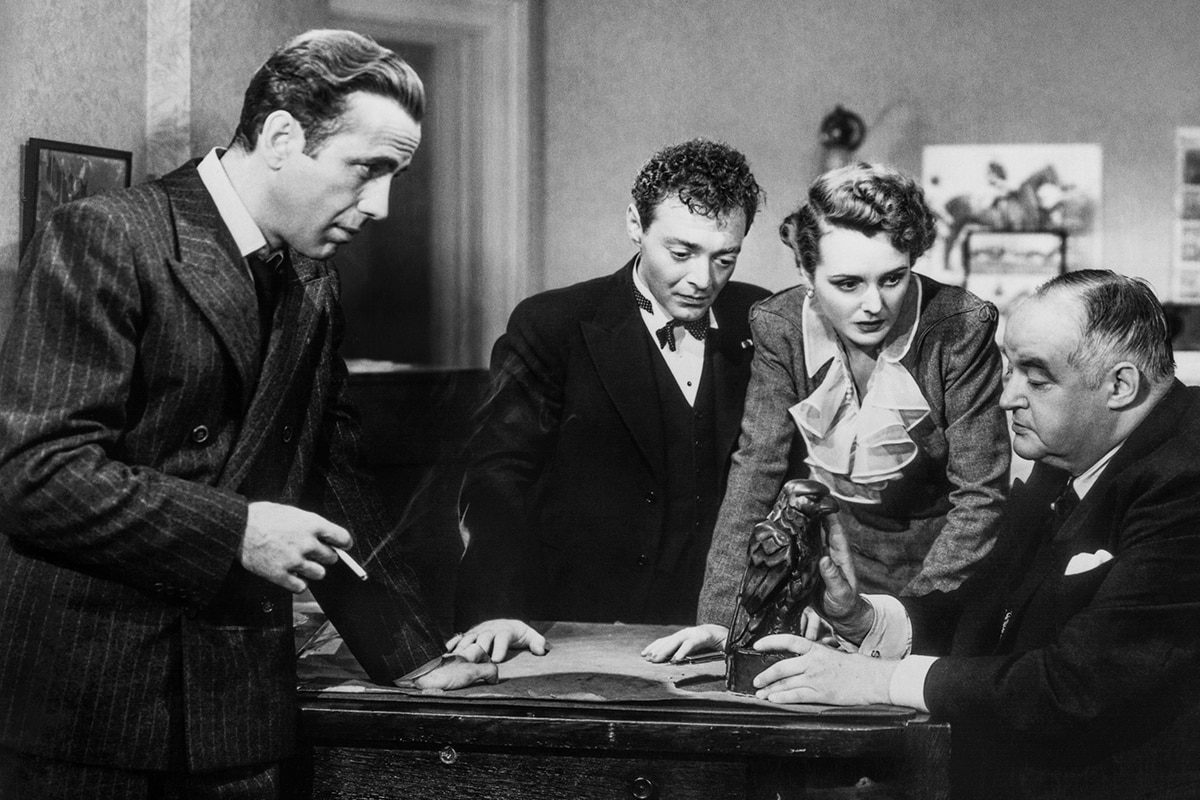
In setting a new template for private-eye films, The Maltese Falcon focused much more on the characters than on the mechanics of the plot, and it depicted Sam Spade as a cynical detective perhaps not entirely on the side of the law—all of which amounted to a significant reset for the genre. The film’s storyline becomes quite convoluted, but it doesn’t matter; it’s clear that these characters are after the elusive, priceless statuette of a black falcon and will do whatever is needed to acquire it. Enjoyment comes from watching them scheme, outwit and double-cross each other, while delivering sharp, still-quotable dialogue that comes largely from the novel itself.
Sam Spade was a perfect role for Bogart to transition from playing heels and gangsters to complex antiheroes. Sam is still a bit of a heel, but deep down, he does have a moral core. The rest of the ensemble—Mary Astor, Sydney Greenstreet in his screen debut, Peter Lorre and Elisha Cook Jr.—are so perfectly cast that one would be forgiven for thinking that Hammett had specifically written the characters for them.
Released smack in the middle of the following decade, Rebel Without a Cause (1955) came to epitomize a key Hollywood trend of its era: movies about disaffected teens. It would also become the quintessential James Dean film, emanating a mystique before it even opened due to Dean’s death in a car accident four weeks prior to release. While Dean had already made a huge splash in East of Eden (1955), his first starring role, and would appear in another posthumous release, Giant (1956), it is Rebel, with his performance as angst-ridden Jim Stark, clad in blue jeans, white t-shirt and red jacket, that is by far the most iconic.
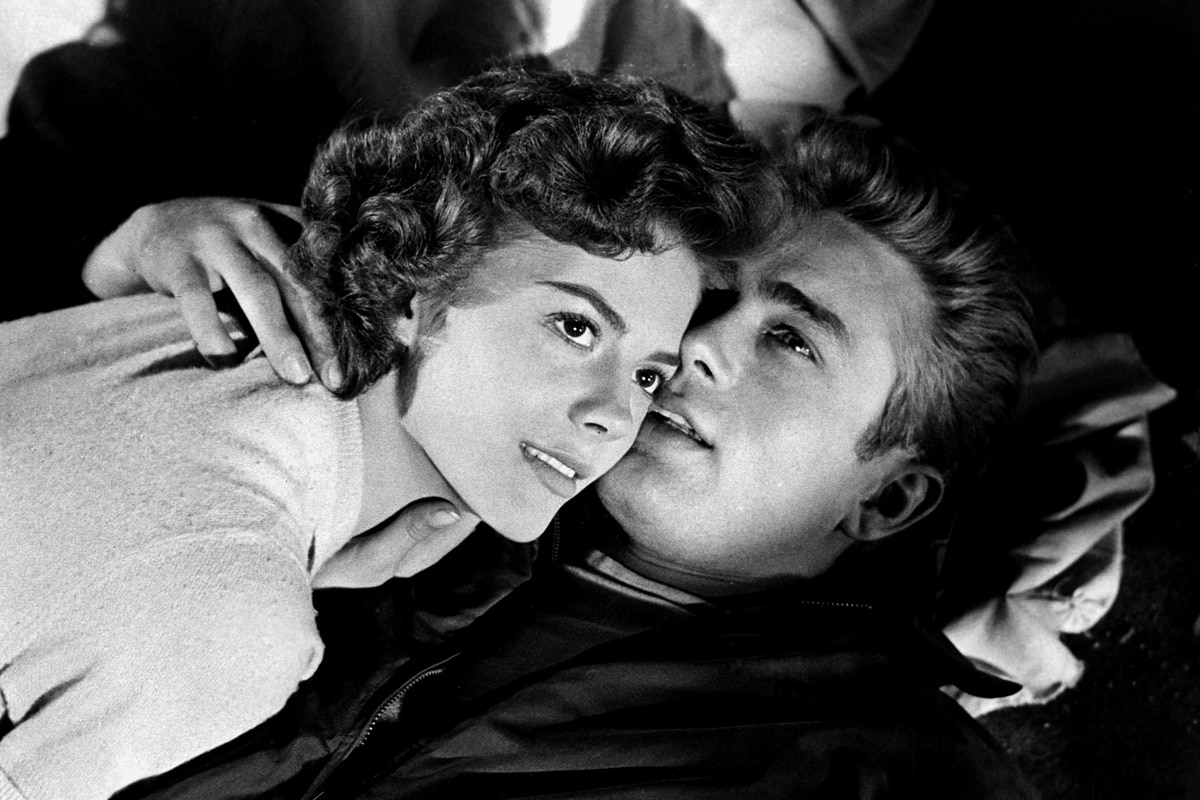
Dean applied all of his Method training to the character, a teen from a middle-class family in Los Angeles who struggles to fit in, connect, handle his emotions and figure out how toughness and gentleness blend into masculinity. His alienation speaks to just about every teenager—then and now—in some way. The screenplay has him wail to his parents, “You’re tearing me apart!” but just as affecting are moments where Jim struggles to find any words at all to express what he’s feeling, as in his scenes with Judy, played by Natalie Wood.
Wood was 16 when filming began and proved that she could successfully transition out of child roles, a rarity throughout Hollywood history. She fought hard to get the part and later said, “It kind of opened the door for me to be thought of as a serious actress.” As Jim and Judy fall for each other, they are joined by another sensitive teen, Plato (Sal Mineo), who latches onto them to form a sort of make-believe family in a crumbling mansion. (That mansion, torn down soon after filming, had previously been used for Norma Desmond’s mansion exteriors in Sunset Blvd. [1950], and the swimming pool in which William Holden had floated is the same one seen here—empty, and the site of a tense confrontation.) Mineo played his role with an undercurrent of romantic desire for Dean’s character, which is all the more poignant for never being explicitly stated.
Director Nicholas Ray, interested in making a film from the point of view of troubled teenagers, had written a treatment called The Blind Run and pitched it to Warner Bros. With so-called “youth films” in vogue, the studio welcomed Ray’s idea but insisted on using the title of a nonfiction book they had optioned, “Rebel Without a Cause.” Production began in black-and-white; after three days, Jack Warner was so happy with the footage—and aware of the tremendous buzz surrounding Dean’s newly released East of Eden—that he elevated Rebel’s stature and ordered Ray to start over in color and CinemaScope. That anamorphic widescreen process, devised to lure moviegoers away from their televisions, was still quite new, and it would usher in a slew of other widescreen formats that would visually define much of the cinema of the rest of the decade and beyond.
Rebel Without a Cause is also one of the quintessential Los Angeles-location films, with the Griffith Observatory playing such a prominent role that it is still connected to the film in the popular imagination, with a bust of James Dean standing on its grounds even today. But even while the film is very much a product of the 1950s, it remains timeless because jeans, fast cars, bullying, family dysfunction and adolescent alienation have never gone away.
Blue Hawaii (1961) is certainly not in the same all-time-great company as The Maltese Falcon and Rebel Without a Cause, but in 1961, it was nonetheless a huge hit that came to epitomize the screen popularity of Elvis Presley and set the mold for his screen persona going forward. By 1961, Elvis had acted in seven films. He dreamed of being a serious actor rather than only showcasing his singing, but two recent attempts to do just that, Flaming Star (1960) and Wild in the Country (1961), had failed at the box office.

Screenwriter Hal Kanter, who had collaborated with producer Hal B. Wallis on one of Elvis’s best films, Loving You (1957), now returned to help resuscitate Presley’s screen career. The serious Elvis was out, and the frothy, buoyant Elvis, with lots of songs, girls and romantic settings (here the Hawaiian Islands of Oahu and Kauai) was in.
Kanter based his script on a book entitled “Beach Boy” by Allan Weiss, a former journalist who would go on to write five more Elvis films. Weiss had been in the room when Elvis made his first screen test for Wallis in March 1956, and he later recounted, “No one had any expectations. He was such a strange, quiet fellow—so completely foreign. But he sang, and read a scene from The Rainmaker, and answered questions asked from offscreen—and it was phenomenal. It was an amazing experience to be there.” Hal Kanter, who was also in the room, said that Elvis was “charming and witty and completely unafraid of the camera.”
Weiss also said, “In viewing the test, one thing was clear. It would be a mistake to try to force this strong personality into a preconceived role. His parts must be tailored for him, designed to exploit the thing he did best—sing.” And that’s exactly the principle that the team returned to with Blue Hawaii, whose title was taken from a 1937 song first performed by Bing Crosby in Waikiki Wedding (1937). It is one of 14 in the film, among them the ballad “Can’t Help Falling in Love,” which would become Elvis’s signature song. The soundtrack sold over five million copies, with two million in just the first six months, more than any Elvis album to date. The album sat at #1 on the Billboard charts for 20 consecutive weeks, a record that lasted until 1977, when it was dislodged by Fleetwood Mac’s “Rumors.”
Among Blue Hawaii’s supporting cast is Angela Lansbury, who plays Elvis’s wealthy, possessive mother—and the first mother she ever played on screen. Lansbury did not look back fondly on the film, deeming it “ridiculous, but quite charming.” She said, “Elvis was 26. It’s a jolt for a woman of 35 to be asked to play his mother. But I did it. I was desperate! Elvis was unfailingly polite. He was into karate at the time. Between takes he would break bricks with his hand.” Lansbury would play another mother—Warren Beatty’s—in her next film, All Fall Down (1962), whose director, John Frankenheimer, then cast her as yet another mom in The Manchurian Candidate (1962)—one of her finest and most acclaimed performances.
Blue Hawaii, meanwhile, became the biggest hit of Presley’s movie career. As Variety observed, “Blue Hawaii restores Elvis Presley to his natural screen element—the romantic, noncerebral film musical.” Indeed, the film was too successful for Hollywood to offer him anything different anytime soon. Elvis would mostly make light musical comedies from here on out, with Blue Hawaii setting the formula for their success.
