This article was originally written about programming for the TCM Now Playing newsletter in November 2025.
November 17 & 24 | 11 Films
With the recent publication of “Corpses, Fools and Monsters: The History and Future of Transness in Cinema,” Turner Classic Movies sheds light on the various perspectives surrounding the subject of trans identity with two nights of films devoted to the subject on November 17th and 24th. The book’s authors, trans critics Caden Mark Gardner and Willow Catelyn Maclay, discuss the first two films each night with TCM host Dave Karger, who will then introduce the remaining films.
Gardner and Maclay use the term “trans” to refer to both transvestites and transgender individuals, tracing the earliest images to silent films like Sidney Drew’s A Florida Enchantment (1914), in which a magic seed temporarily turns leading lady Edith Storey into a man and her boyfriend (Drew) into a woman. The results are played for comedy, with Drew’s female persona a broad caricature of femininity. That trope would persist for decades, with trans women portrayed, usually for laughs, as though they were just men in dresses. Trans characters continued into the sound era, sometimes just as background figures—the cabaret performers dressed as maids in John Francis Dillon’s Call Her Savage (1932), for example. When Katharine Hepburn masqueraded convincingly as a boy in George Cukor’s Sylvia Scarlett (1935), it was too much for contemporary audiences, and the film failed at the box office. More successful was Cary Grant’s unconvincing female impersonation in Howard Hawks’ I Was a Male War Bride (1949), a major hit.
Transgender issues first made headlines with the 1952 reports on Christine Jorgensen’s gender confirmation surgery in Sweden. Although the Production Code prevented Hollywood films from handling the subject, independent writer-director Ed Wood dealt with both transgender and transvestite lives in his pioneering Glen or Glenda (1953). Often derided as one of the worst films ever made, Wood’s picture nonetheless can be viewed as a time capsule of contemporary attitudes about gender. Jorgensen refused to cooperate with Wood on the picture, but later took part in a picture based, albeit somewhat loosely, on her own life, Irving Rapper’s The Christine Jorgensen Story (1970). Depicting the young George Jorgensen as an effeminate child who wants to play with dolls set the tone for the sympathetic treatment of trans lives in later films like John Dexter’s I Want What I Want (1972).
When trans characters became more prominent on screen, their depiction was far from sympathetic. Both Alfred Hitchcock’s Psycho (1960) and William Castle’s Psycho-inspired Homicidal (1961) featured trans serial killers who would be followed by a line of murderous trans characters menacing everyone from Doris Day in Frank Tashlin’s Caprice (1967) to Angie Dickinson and Nancy Allen in Brian De Palma’s Dressed to Kill (1980) and the entire casts of the Sleepaway Camp franchise (1983-2003). Others have historically turned up as a quick joke at the expense of a leading man who thinks he’s found a female date, as in Paul Brickman’s Risky Business (1983), in which high-school student Tom Cruise accidentally hires a cross-dresser (Bruce A. Young) thinking she’s a female prostitute.
Breakthroughs for representation came in independent and international films. Andy Warhol’s productions turned trans actors like Candy Darling and Holly Woodlawn into underground stars, giving them a chance to show off their dramatic and comedic talents in films like Paul Morrissey’s Flesh (1968) and Trash (1970). Both Warhol stars would turn up in other producers’ films, with Darling playing a sympathetic cross-dresser in Mervyn Nelson’s Some of My Best Friends Are… (1971), a depiction of Christmas Eve in a gay bar filled with hustlers, effeminate queens, closeted men and their female friends. Although more conventional than her Warhol films, it captures her beauty and femininity for future generations. John Waters used his friend Divine, a drag performer, to play ciswomen (women who identify with their birth-assigned sex) in films like Pink Flamingos (1972), Polyester (1981) and Hairspray (1988). In Japan, Toshio Matsumoto focused on trans entertainers in his loose adaptation of “Oedipus Rex,” Funeral Parade of Roses (1969). Although the story itself has sensational elements, the trans characters are treated with respect, while those who find them offensive are the outliers. Almost three decades later, Belgian director Alain Berliner tackled the still-controversial subject of trans youth in Ma Vie En Rose (1997), using magical realism to tell the story of a boy (Georges Du Fresne) who runs into social and parental opposition because he wishes to live as a girl.
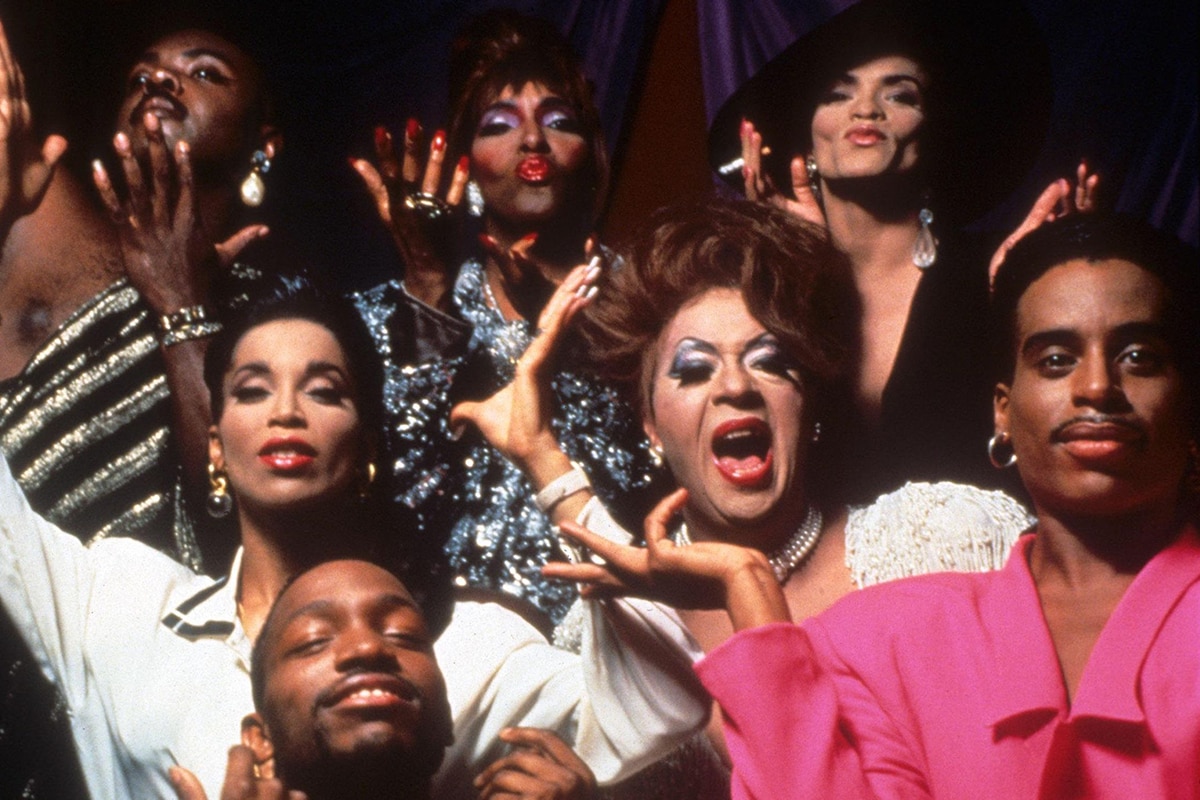
Documentaries have also opened the door to more sympathetic trans representation. One of the earliest was The Queen (1968), in which director Frank Simon follows a group of drag queens through the 1967 Miss All-American Camp Beauty Pageant. It offered a very human portrait that also captures the unique performance styles of the legendary performers Mario Montez and Sabrina Flawless, as well as candid conversations about gender identity. Antonio Gimenez Rico’s recently rediscovered Dressed in Blue (1983) offers a non-judgmental portrait of six trans women. It brings together a cross-generational group with different attitudes toward gender, their homeland and the sex work many of them must do to survive. One of the most entertaining documentaries on trans issues is Paris Is Burning (1990), Jennie Livingston’s pioneering look at New York’s ballroom culture, a direct influence on such popular TV series as “Pose” and “RuPaul’s Drag Race.” While acknowledging the larger-than-life qualities of her subjects and their racial identities, Livingston also captures their humanity.
Where documentaries have shown trans people going about their lives, mainstream films, particularly from Hollywood, still mostly cast cisgender actors in such roles, part of the reason for this is financial. Trans actress Alexandra Billings was offered the lead in Duncan Tucker’s Transamerica (2005) but was eventually replaced by the more marketable Felicity Huffman, star of the hit TV series “Desperate Housewives.” Trans critics argued against the casting of Jared Leto as a trans woman in Jean-Marc Vallee’s Dallas Buyer’s Club (2013) and Eddie Redmayne as pioneering trans woman Lili Elbe in Tom Hooper’s The Danish Girl (2015), with Redmayne later saying he never should have accepted the role. Chris Sarandon’s casting in Sidney Lumet’s Dog Day Afternoon (1975) is considered particularly problematic. Although based on fact, the film is highly fictionalized in its depiction of a man (Al Pacino) who robs a bank to pay for his lover’s gender confirmation surgery. Where the robber’s real trans lover was able to pass as a ciswoman until outed by the film, Sarandon is clearly a man, further perpetuating negative stereotypes of trans women.
Much more successful is Karen Black’s performance as Joanne, the trans woman in Robert Altman’s Come Back to the 5 and Dime Jimmy Dean, Jimmy Dean (1982). She plays a woman who was once the only male member of a group of James Dean fans celebrating their 20th anniversary reunion. After persecution for effeminacy in their little Texas small town, she ran off, returning years later after gender confirmation surgery to re-enter the space she had once known in her youth, a recurring trope in the lives of trans people. The portrait of transness Altman created with Black and actor Mark Patton, who plays the same character at a younger age, is one of the most sympathetic on screen.
With the scarcity of films dealing realistically with their issues, trans audiences have often looked for reflections of their lives in films without trans characters. TCM’s lineup includes three examples of this. Kim Novak’s forced transformation from everyday shopgirl Judy to the glamorous Madeleine in Alfred Hitchcock’s Vertigo (1958) echoes the transformation of trans people when finally allowed to live as the gender with which they identify. The film has a special cachet because Novak was a role model for trans icon Candy Darling, who wrote to the star as a child and received a reply she felt reaffirmed her gender identity.
Body horror is one genre with special appeal for trans audiences. Films in which human anatomy is seen as malleable also destabilize the social construction of identity and gender. With his parade of mutations, David Cronenberg has emerged as a master of the subgenre. In his horror drama The Brood (1979), Oliver Reed is a psychiatrist practicing “psychoplasmatics,” a treatment in which patients manifest traumas in their bodies. In some cases, this leads to boils or even cancer, but his star patient (Samantha Eggar) manifests her rage over having been abused by her mother in ways that uses her body as a tool for vengeance. For earlier audiences, body horror meant transformation into a monster, whether the werewolf of Universal horror films, the various irradiated monsters of the 1950s or Jacques Tourneur’s exquisitely erudite Cat People (1942), in which fashion illustrator Simone Simon releases sexual frustration by turning into a panther, another instance of the malleable body destabilizing societal norms.
From destructive stereotypes to more affirming characterizations, the cinema of the past has provided a wide range of perspectives on trans lives. In recent years, the arrival of trans director-writers like Alice Maio Mackay (2023’s T Blockers) and Jane Schoenbrun (2021’s We’re All Going to the World’s Fair and 2024’s I Saw the TV Glow) points to a future in which trans lives will be presented with more accuracy and sensitivity.
