This article was originally written about programming in the TCM Now Playing newsletter in September 2025.
Seeing biracial families consisting of one white and one Black parent feels like a normal element of media today, but families defined by their multiracial and cultural diversity are a relatively new aspect in the history of movies. Throughout two nights, on September 5 and 12, author and film historian Donald Bogle will join TCM host Ben Mankiewicz to present 10 riveting films that explore interracial relationships on screen and examine how cultural attitudes have shifted over the years. Bogle is the foremost authority on Black film history and the author of such books as “Toms, Coons, Mulattoes, Mammies, and Bucks: An Interpretive History of Blacks in American Film,” “Bright Boulevards, Bold Dreams: The Story of Black Hollywood,” “Lena Horne: Goddess Reclaimed,” and “Dorothy Dandridge, A Biography.” His most recent book, “Hollywood Black,” was adapted into an Emmy-nominated documentary series, which won an Independent Spirit Award for Best New Non-Scripted or Documentary Series.
The mixing of races in interracial marriages had been illegal in America since the country’s infancy, when English settlers colonized the land and forcibly enslaved Africans to provide free labor. Laws began to spring into place prohibiting whites and Blacks from engaging in marriage or sexual relationships with one another. As Hollywood developed in the early half of the 1900s, calls for industry censorship and regulation rang out. The Motion Picture Producers and Distributors of America verbally agreed to abide by the Production Code set up by the Hays Office in 1930. The list included a set of “Don’ts” and “Be Carefuls.” Among the “don’ts” was “Miscegenation: sex relationship between the white and black races is forbidden.” When Joseph Breen took over as the chief of the Production Code Administration, he enforced the office's rules from 1934 to 1954.
While some films in the independent circuit, particularly race films made for Black audiences, used interracial relationships as a taboo plot point, Hollywood stayed away from the topic, often changing scripts to ensure that white characters were not romantically involved with characters of another race. This largely impacted the careers of such Black talent as Nina Mae McKinney, Dorothy Dandridge, Harry Belafonte, Paul Robeson and Lena Horne, all of whom were prevented from ascending to leading performer status because Hollywood would not write love stories that allowed them to engage romantically with white leads, the default race in mainstream media.
One of the first prominent Hollywood films to highlight the topic of interracial romance was Show Boat (1936). Based on Edna Ferber’s 1926 novel, the story follows three generations of theater performers on a floating steamboat theater, The Cotton Blossom, which travels the Mississippi River, docking in small towns on the coast during the 1880s into the Roaring Twenties. One of the actors on the boat is Julie Dozier (Helen Morgan), a white-passing biracial woman married to a fellow actor, Steve Baker. A rival of Steve’s reveals Julie’s secret to a local sheriff, who threatens to arrest the two for their illegal marriage, since Julie is Black and Steve is white. The married couple is forced to leave their careers, friends and comforts behind when they are kicked off the boat because of Julie’s biracial existence. Years later, Julie resurfaces having resorted to life in a brothel.
Ferber’s story was adapted into a Broadway musical in 1927 by Jerome Kern and Oscar Hammerstein II, becoming the first racially integrated musical in America. The musical spawned two notable standards, “Bill” and “Can’t Help Lovin’ Dat Man,” both sung by singer Helen Morgan as Julie on stage and in the 1936 version, starring alongside Irene Dunne, Hattie McDaniel and Paul Robeson. Show Boat got around the miscegenation rule by having Morgan, a white woman, play the role of Julie. Two years later, MGM bought the rights from Universal, and they remade the film in 1951 with Kathryn Grayson, Howard Keel and Ava Gardner in the role of Julie. Gardner had been cast over Lena Horne, who instead sang on that film’s soundtrack as Julie.
Civil Rights activist, singer and actor Harry Belafonte became the first Black actor to challenge the rules forbidding interracial romances on screen with a pair of controversial films in the late 1950s. The first of these is Robert Rossen’s daring 1957 drama Island in the Sun. Set on the fictional island of Santa Marta, racial politics and social class serve as the central forces affecting four different couples on the West Indian island. Belafonte stars as a union leader with ambitions to become a politician when he falls for a widow played by Joan Fontaine. The kiss intended to be shared between the couple would have made the moment the first interracial onscreen kiss, but the studio denied it. Dorothy Dandridge co-stars as a West Indian woman pursued by a white government worker played by John Justin. The film served as Dandridge’s first since her hiatus after her Oscar-nominated performance in Carmen Jones (1954).
Two years later, Belafonte starred in the science fiction drama produced by MGM and Belafonte’s production company Harbel Productions, The World, the Flesh and the Devil (1959). Belafonte plays a miner who has survived a nuclear blast, discovering that he’s alone until he meets two survivors, a man (Mel Ferrer) and a woman (Inger Stevens). While the end of the world has seemingly come, the trio must confront their primal, base nature as racism and sexual tension threaten the small chance they have at a prosperous future. Like his previous film, Belafonte and Stevens’ sexual tension is denied an onscreen resolution due to studio interference. The reconstruction of the censorship office as the Motion Picture Association of America, led by its new president Eric Johnston, had taken place in 1956, with Johnston boasting of looser code restrictions for the first time since 1930; however, he also announced tighter restrictions in other areas.
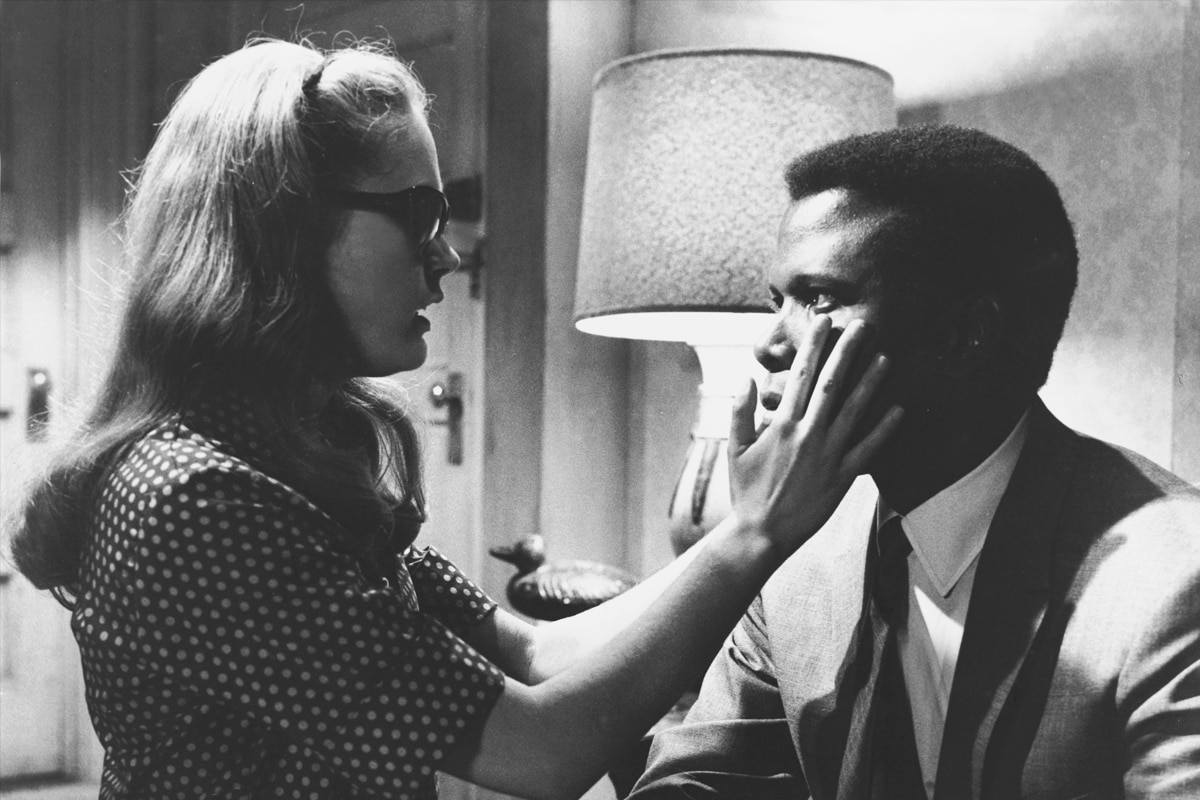
The resistance of interracial romance onscreen continued in 1965 in the Sidney Poitier drama A Patch of Blue. The film concerns a budding friendship between a Black man and a blind white teenager. Shelley Winters stars as the girl’s abusive, racist mother, and she won an Oscar for Best Supporting Actress for the role. Poitier and Elizabeth Hartman share a brief kiss that was cut from the film when shown in Southern theaters and later on some television screens. Poitier later recalled that his presence as a love interest up until that point had either "no women or there was a woman, but she was blind, or the relationship was of a nature that satisfied the taboos. I was at my wit's end when I finished A Patch of Blue."
Nevertheless, a major shift in the United States took place in 1967 with the Loving v. Virginia case. Richard Loving, a white man, and his wife of color, Mildred, were convicted of violating a Virginia law prohibiting interracial marriage, forcing the couple to leave the state to avoid being jailed. They decided to sue with the help of the American Civil Liberties Union (ACLU) and won with the Supreme Court ruling that anti-miscegenation laws across the country were unconstitutional and violated the 14th Amendment. Three years later, Jaqueline Bisset and Jim Brown starred in the independent film The Grasshopper, playing an interracial couple who meet and marry in Vegas. The relationship is only a minor element of the film, as the focus is on Christine’s journey through drugs and men.
Interracial romances continue as the focus of Bogle’s second night of films, but this time with a more centralized focus. In One Potato, Two Potato, a white woman and Black man must navigate the negative attitudes of their peers and family while their marriage causes authorities to intervene in their lives. The film’s focus on racial tensions spurred by an interracial romance predated Stanley Kramer’s groundbreaking 1967 drama Guess Who’s Coming to Dinner (1967), which features the first Hollywood onscreen kiss between a Black man and white a white woman. (Dorothy Dandridge had perhaps the first Hollywood interracial kiss in The Decks Ran Red, 1958.) Poitier stars as the newlywed husband to Katharine Houghton. Both are preparing to undergo the stressful task of meeting each other’s parents for the first time. Spencer Tracy and Katharine Hepburn play the parents of the bride, confronting their own emotions and feelings about their daughter’s new husband, while Beah Richards and Roy E. Glenn Sr. portray Poitier’s parents, who struggle to hide their own complicated and frustrated feelings about the marriage. The film was a box-office smash in the United States, earning 10 Oscar nominations, including Best Picture and Best Actor for Tracy in his final film before his death. William Rose’s screenplay and Katharine Hepburn’s performance both won.
In its TCM premiere is Spike Lee’s 1991 drama Jungle Fever, starring Wesley Snipes and Annabella Sciorra as co-workers who embark on a torrid affair to the ire of those close to them who are more critical of the racial dynamics of their relationship rather than their infidelity. The couple attempts to build a relationship despite the racial discrimination they face in various instances. The film was dedicated to Yusaf Hawkins, a 16-year-old boy attacked by a group of white youths in an Italian American neighborhood. One of the attackers shot Hawkins twice in the chest. Though Hawkins was only in the neighborhood to purchase a car for sale, the attackers reportedly attacked the young boy because they thought he was there to attend the party of a white girl in the neighborhood.
The evening wraps up with two foreign-based films that tackle the topic of interracial romance. Basil Dearden’s All Night Long (1962) centers on an anniversary party for a Black jazz pianist and his white wife. While the party is meant to be a celebration of their first year married, lies and deceit begin to rise to the surface. Inspired by William Shakespeare’s “Othello,” the film features appearances from jazz legends Charles Mingus, Dave Brubeck and John Dankworth. Paul Jarrico co-wrote the script using the pseudonym Peter Achilles, and Betsy Blair stars in a supporting role. Both had recently been blacklisted as communist sympathizers by the American film industry. In Germany, director Rainer Werner Fassbinder tackled interracial romance in his 1974 drama Ali: Fear Eats Soul, which tells the story of a lonely widower whose friendship with a young Moroccan man develops into a romance, with the couple eventually marrying. However, as social pressures and racist attitudes increase from her friends, Emmi finds herself treating Ali like those around him.
