Dance director Busby Berkeley appears briefly as the "Call Boy," a backstage worker who gives the cast their calls to go on stage.
A top choreographer and dance director on Broadway in the 1920s, Berkeley came to Hollywood with the onset of sound to work in the popular musical genre. But he was used to more creative latitude than Hollywood dance directors were afforded and was ready to return to the stage when Darryl F. Zanuck, head of production at Warner Bros. in the early 1930s, hired him to create and direct the musical numbers for 42nd Street. His great success with that production got him the assignment on Gold Diggers of 1933 and subsequent Warners musicals. He was also given full directing chores on the sequel Gold Diggers of 1935 and several minor productions. It wasn't until he moved to MGM in 1939 that he was allowed to direct top productions, primarily on Judy Garland's movies, although she often complained bitterly about his demanding work methods and the exhaustion it caused her. A tough taskmaster who frequently had run-ins with his stars, Berkeley's directing career was over by the end of the 1940s. He continued to work as a dance director for several more years, but was nearly forgotten until revivals of his films in the 1960s found a new audience for his distinctively surreal and geometric musical style.
Songwriters Harry Warren and Al Dubin each had long and successful careers on their own. Together they were responsible for the tunes in many of the early Warner Bros. hit musicals, including 42nd Street, Footlight Parade (1933), Wonder Bar (1934), and Dames (1934). They won a Best Original Song Academy Award for "Lullaby of Broadway" from the musical Gold Diggers of 1935. They were each nominated for other Oscars® (Warren more than Dubin), and Warren won twice more for work with other lyricists. During their collaboration throughout the 1930s, they were said to have written as many as 60 songs per year. Warren wrote more than 800 songs between 1918 and 1981, most of them for 56 feature films (and used in countless others). His catalogue comprises some of the most memorable American standards of all time, many of which are still played today. He died in 1981 at the age of 87. Al Dubin, who wrote lyrics for a number of other composers, including Jimmy McHugh and Duke Ellington, was given to excessive eating, drinking, and drug use, resulting in his death at the age of 54 in 1945 from barbiturate poisoning and pneumonia.
Etta Moten, the singer who appears uncredited in the Forgotten Man number, was the first African-American entertainer invited to sing for a U.S. president (Franklin D. Roosevelt) at the White House. After her appearance in Gold Diggers of 1933, she was touted as "The New Negro Woman" by the African-American press. Her only screen credit was in Flying Down to Rio (1933), where she played a Brazilian singing "The Carioca" while Fred Astaire and Ginger Rogers danced. She made only one more movie, again uncredited, A Day at the Races (1937), but she achieved great fame off screen, particularly in her 1942 appearance in the Gershwin opera Porgy and Bess. Later, she became a radio interviewer and journalist at WMAQ Chicago, reporting on the birth of the civil rights movement in the 1950s. By the time of her death in 2004, at the age of 102, she had been honored with a Living Legend Award from the National Black Arts Festival and a place in the Black Film-Makers Hall of Fame. Of her appearance in this movie, the Times of London noted in her obituary that although she didn't have a solo in the film, "she shared the song with a number of white singers but that was the point: until then black actresses had been largely restricted to background roles as maids and eye-rolling, overweight nannies. Now here was a black woman presented on an equal footing with whites, and a sexy, sophisticated black woman at that."
Sol Polito was one of Warner Bros. most versatile and talented cinematographers, and he was an important creator of the studio's distinctive visual style in the 1930s and 1940s. He worked on crime movies (Angels with Dirty Faces, 1938), period action epics (The Adventures of Robin Hood, 1938), war movies (Captains of the Clouds, 1942), prestigious dramas adapted from the stage (Old Acquaintance, 1943), westerns (Dodge City, 1939), melodramas (Now, Voyager, 1942), and many of the great Depression-era musicals. He was nominated for Academy Awards three times, in both the color and black-and-white categories.
This was the second time Dick Powell and Ruby Keeler appeared together. The first was 42nd Street. They made five more films together after this and were so identified in the public mind as on-screen sweethearts that fans were angry when Joan Blondell married Powell, believing she had stolen him away from Keeler, who had actually been married for several years to entertainer Al Jolson.
Dick Powell and Joan Blondell married three years after making this picture together. They were divorced in 1944. They made a total of nine movies together (ten, if you count Big City Blues, 1932, in which he was the voice of an off-screen radio announcer).
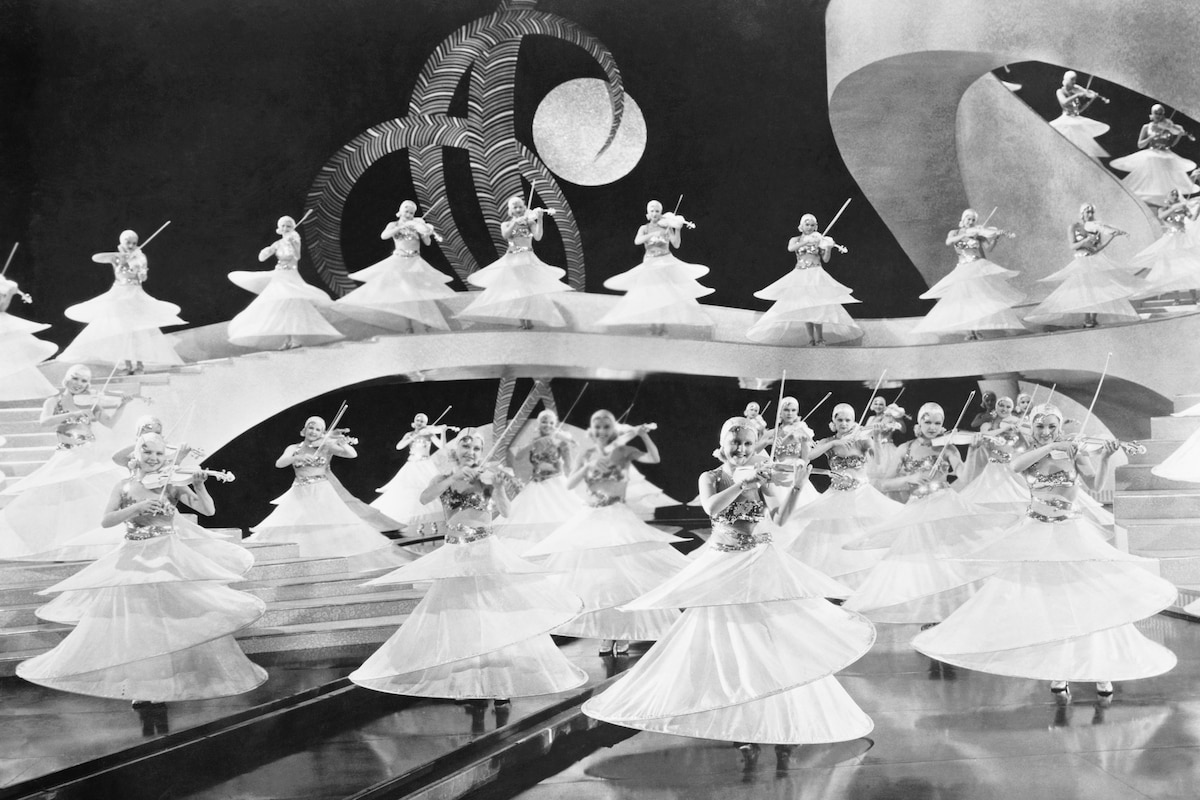
One of the neon-outlined violins used in the "Shadow Waltz" number is on display in the Smithsonian's National Museum of American History in Washington, DC.
This is the first producing credit for Robert Lord, who went on to produce many notable films for Warner Bros. through 1941. In 1948, Lord went into partnership with Humphrey Bogart in the actor's Santana Productions, which released several Bogart pictures through Columbia, including Knock on Any Door (1949) and In a Lonely Place (1950). Lord was also a writer who received an Academy Award for his original story for One Way Passage (1932) and a nomination for Black Legion (1937).
Although he was very involved in the initial planning and production of Gold Diggers of 1933, Warner Bros. production chief Darryl F. Zanuck left the studio before the film was released in May 1933. He had become embroiled in a heated conflict with Harry Warner over temporary pay cuts for all studio employees in support of President Franklin Roosevelt's National Recovery Administration policies for alleviating some of the nation's worst economic problems. Zanuck tried to reinstate original pay levels, and Warner countered by extending the cuts beyond their original agreed-upon dates. On April 15, two days after principal photography ended on the picture, Zanuck resigned. Less than a week later, he launched the independent company Twentieth Century Pictures, which later merged with Fox.
Some sources list Jane Wyman in an uncredited role as a chorus girl, although she would have been only about 16 during production. Wyman didn't sign a contract with Warner Bros. until 1936.
The "baby" in the "Pettin' in the Park" number is played by Billy Barty (1924-2000), who had one of the longest and most prolific careers of any Hollywood character actor despite, or because of, his diminutive size (3' 9" at his most developed). Barty was only eight when he appeared in this film but was already the veteran of nearly 50 films, most of them as Mickey Rooney's little brother in the series of Mickey McGuire shorts. He continued to work in comic shorts as well as parts in such major productions as The Bride of Frankenstein (1935), A Midsummer Night's Dream (1935), and Nothing Sacred (1937). He was not, as many mistakenly believe, one of the Munchkins in The Wizard of Oz (1939), but he worked steadily for the rest of his life and was an important advocate for raising awareness about people of short stature, including founding Little People of America, a non-profit that provides support and information for those with one of the more than 200 medical conditions known as dwarfism.
by Rob Nixon
Trivia - Gold Diggers of 1933 - Trivia & Fun Facts About GOLD DIGGERS OF 1933
by Rob Nixon | February 27, 2013
SIGN UP FOR OUR NEWSLETTERS

CONNECT WITH TCM