Filming on Giant started in Los Angeles in May 1955. The first scenes Hudson shot were his reactions as an outsider at the Maryland home where he meets Leslie. To get the right "fish-out-of-water" sense, George Stevens shot Hudson's reactions independent of the other actors, with the camera far away from him and Stevens feeding him the other characters' lines.
James Dean's rebellious behavior started with the press luncheon announcing the start of production. Not only did he arrive late, but also when a photographer asked him to remove his glasses, he responded by putting a set of clip-on sunglasses over them. He also refused to take a bow when Stevens introduced him. Later he tried to rationalize his behavior by claiming he had come directly from the set of Rebel Without a Cause (1955) and was concerned about being seen unshaven and tired. In fact, he had finished work on the film the night before and was exhausted. With the earlier filming running over schedule, he was shooting wardrobe and make-up tests for Giant while finishing Rebel Without a Cause and did not get a promised vacation between the two pictures.
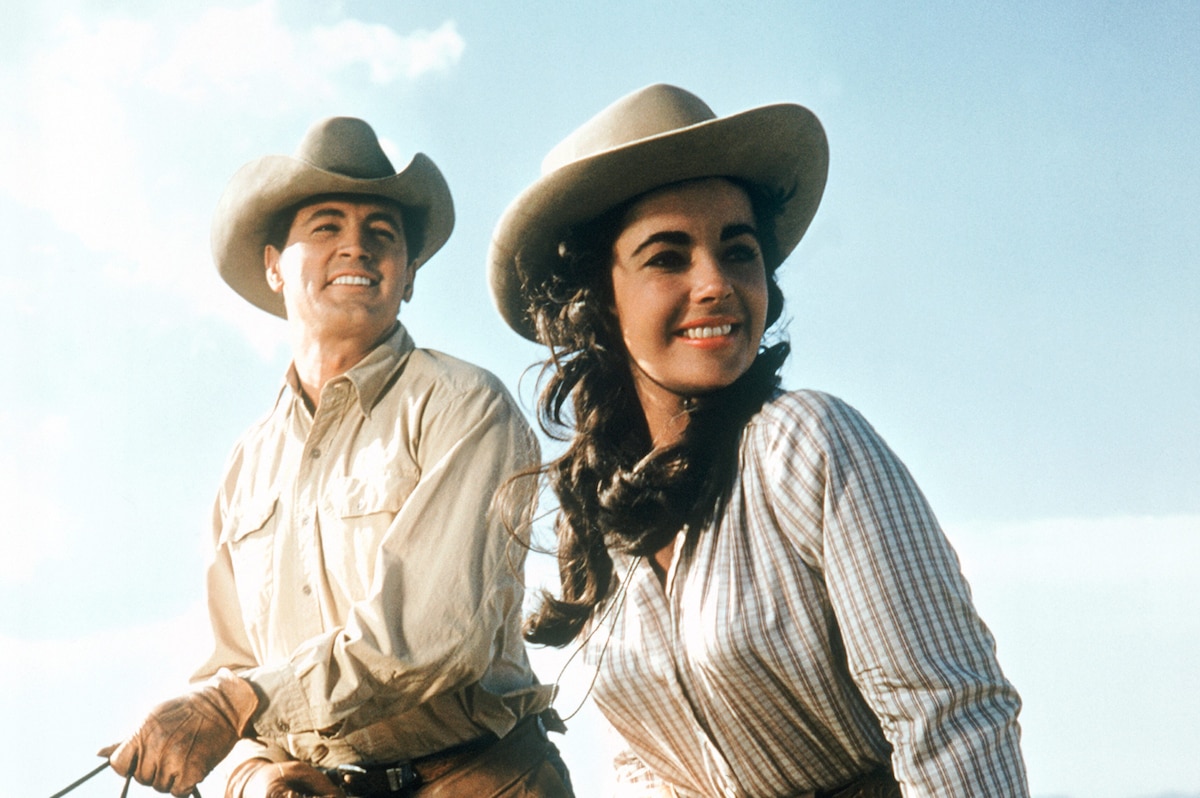
Before they shot their first scene, Elizabeth Taylor invited Hudson to dinner at her home with husband Michael Wilding. The two stars stayed up drinking and talking until four in the morning and then had to be on the set at six. Their first scene together, the Maryland wedding at which he reclaims her after she leaves him to return home, had no lines, which was fortunate as they were both too hung over to remember anything. In between takes, the two were running outside to throw up. The concentrated effort they made to keep from vomiting on camera came across as deep love for each other on screen.
Although they had enjoyed a congenial relationship making A Place in the Sun (1951), Taylor and director Stevens quarreled a good deal during filming. Most of their fights stemmed from his practice of demanding multiple takes without explaining why or offering additional direction to the actors.
When the production moved to Marfa, Texas, on June 6 for location filming, the Victorian mansion set was shipped from California on six train cars. The set was built on the Evans Ranch, 21 miles outside Marfa, and lashed to four telephone poles to hold it upright. It was really just a façade -- three walls with no back, no roof and no interior. Interiors at the mansion and other Texas locations were filmed at Warner Bros. in Burbank.
Shooting in Texas during the summer was far from comfortable, with temperatures rising as high as 120 degrees in the shade. Hudson and Taylor bolstered each other's spirits as much as possible, often staying up late drinking together.
Taylor also forged a close bond with Dean. Some nights they would sit up late as he vented his frustrations with his life as an actor, the restrictions of Hollywood life and past traumas. Unlike Hudson, however, he rarely acknowledged their closeness on set, often ignoring her completely after a night of baring his soul to her.
With Taylor spending time with her two co-stars, rumors flew that she was involved with one or both. Amazingly, one person who claimed to believe it was Phyllis Gates, Rock Hudson's future wife, who never acknowledged her ex-husband's homosexuality. Far from squelching the rumors, a visit from her husband and children just fanned the flames, with gossips claiming Wilding had come to win her back. In truth, she had asked him to visit for moral support because the role and location filming were so difficult.
Stevens maintained an open set during the location shooting on Giant. He also made extensive use of locals as extras, crew members and dialect coaches.
Stevens had a hard time directing Dean. The problem started with Stevens's ordering Dean to get rid of mannerisms like moving his head from side to side or hopping while walking. The two argued constantly, and at one point the actor went on strike for three days. Dean even ordered his agent to come to the location to help him deal with the director. He also referred to Stevens as "Fatso" behind his back.
Dean also objected to being kept waiting for his scenes. After being called to the set three days in a row without being used at all, he skipped his next call. When Stevens objected, he argued that with the amount of preparation he did to create his character's emotional life, it was grueling to be kept waiting that long. Although not really sympathetic to the Method Acting Dean had learned at the Actor's Studio, Stevens tried to keep him on a more reasonable schedule after that.
Hudson and Dean did not get along either. Although later rumors would suggest that Dean had rejected a pass from the actor, most sources reported that each had little respect for the other's approach to acting, and Hudson resented Dean's unprofessional behavior.
During breaks in the shooting of Giant, Dean got the local cowboys to teach him how to handle a lariat and his hat until he could act as if he had been working with them his entire life.
Except for Taylor and Hudson, who stayed in rented houses, everybody else in the cast and crew stayed at Marfa's one hotel. Although conditions on the set were grueling, the days actors weren't working were worse, as the small town (population 3,600) offered almost nothing to do.
Stevens had the Palace, an old movie theatre that had been boarded up two years earlier, reopened so he could screen the daily rushes there.
The heat was so great that during one day of shooting, Mercedes McCambridge's make-up melted into her skin, creating a serious infection that left her neck scarred.
Dean refused to undergo a lengthy make-up process for his later scenes in Giant, claiming "a man of forty-five shows his age in thoughts and actions, not in wrinkles." He only allowed them to gray his temples and put a few lines on his forehead.
Production returned to Hollywood June 9, but Dean stayed in Texas for another three days for second-unit shots on the property Jett inherits from Luz. The mansion set remained in Texas as well, where parts of it still stand.
Dean refused to show up for one Saturday call because he had planned to move that day. A week later, he arrived late on a day when McCambridge had shown up on time, even though the night before she was sent to the hospital for stitches after a bad fall. Stevens dressed him down in front of the entire cast and crew, then walked off the set and left an assistant to direct the actor's scenes.
Although appalled by his lack of professionalism, Stevens was always highly complimentary about Dean's acting abilities. He even conceded that some of his lateness was a result of his intense work getting into character before shooting.
On September 27, the day he completed his last scene, Dean had a new Porsche Spyder delivered to the set at the end of his work day. McCambridge was the first person to ride in it with him. When he sped across the Warner's lot to drive her to her dressing room, studio police barred him from speeding there.
Dean was killed in an auto accident on September 30 while the film was still in post-production. When Stevens realized his drunken final monologue was too hard to understand, he called in the actor's good friend, Nick Adams, to imitate Dean's voice on the soundtrack during looping.
Taylor was devastated by Dean's death. Stevens forced her to work the next day, even though she protested she was too grief-stricken and spent most of her time between takes sobbing hysterically. That was supposed to have been her last scene, but Stevens decided it required another day. Before that could happen, Taylor was hospitalized on October 4 with abdominal pains eventually attributed to a twisted colon. She finally returned to work October 11 and finished her scenes the following day.
Stevens spent almost a year on post-production work for Giant, marked by constant battles with Warner Bros. over the film's length. He refused to budge on cutting the film, leaving it at 201 minutes, 37 minutes shorter than Gone With the Wind (1939).
by Frank Miller
SOURCES:
John Howlett James Dean: A Biography
Behind the Camera - Giant
by Frank Miller | February 20, 2013
SIGN UP FOR OUR NEWSLETTERS

CONNECT WITH TCM