F. Scott Fitzgerald was under contract at MGM during part of the time that Freaks was being shot. When Daisy and Violet Hilton sat at his table in the Commissary, he had to leave the room to throw up. He incorporated a version of that incident later that year in his short story "Crazy Sunday."
One project cancelled as a result of the film's failure was a follow-up Browning had hoped to direct starring Johnny Eck and his fraternal twin Robert, with Johnny as a mad scientist's creation. Instead, he appeared in small roles in three of MGM's Tarzan films. He then signed a contract to perform at the Ripley's Believe It or Not! Odditorium at the 1933 Chicago World's Fair, where he was billed as "The Most Remarkable Man Alive." He would later tour with a magician and run his own orchestra before settling in Baltimore, where he ran a penny arcade and a children's train ride while also working as a screen painter. With the revival of interest in Freaks his image has become popular on posters, in illustrations and on t-shirts.
The financial failure of Freaks put director Tod Browning's career on the skids. Nor did it help that the director, whose perfectionism and lack of concern for work crews had already made him unpopular, tried unsuccessfully to blame the film's problems on editor Basil Wrangell. It was three years before he received another directing credit, for Mark of the Vampire (1935), a remake of his now-lost silent film London After Midnight (1927). After uncredited work on another horror film, The Devil-Doll (1936), he ended his career with the murder mystery Miracles for Sale (1939).
Olga Baclanova's role as Cleopatra was one of a series of femme fatale parts during the early sound era that eventually ended her days as a star. She returned to the stage, where she starred for over a decade before retiring. In later years, her role in Freaks made her a cult star, earning her interviews with genre historians like Richard Lamparski.
After making Freaks, Harry and Daisy Earles gave up filmmaking to focus on work in the circus. They returned to features briefly for roles in The Wizard of Oz (1939), with Daisy as a Munchkin villager and Harry as a member of the Lollipop Guild. Daisy also appears very briefly in The Greatest Show on Earth (1952).
Daisy and Violet Hilton made only one other film, Chained for Life (1951), an exploitation film designed to explore the more titillating aspects of their condition while also drawing on elements of their personal lives.
Schlitze, the leader of the pinheads, played minor roles in a few more films, including the exploitation feature Tomorrow's Children (1934), in which he played a criminal subjected to forced sterilization. He was adopted by animal trainer George Surtees in 1935, but when Surtees died in 1965, the man's daughter had Schlitze committed to a mental hospital, where he suffered bouts of depression until discovered by Bill Unks, the sword swallower. Unks arranged for his release to return to the carnival circuit under Canadian promoter Sam Alexander. Schlitze eventually retired to Los Angeles.
Of all the sideshow performers, 2', 11" Angelo Rossitto had the most extensive film career. He was already a silent screen veteran, having been discovered by John Barrymore for a role in The Beloved Rogue (1927), when he made Freaks. He would go on to steady, if underpaid work, in a variety of films for the next 55 years. Among his most notable roles were the pygmy in The Sign of the Cross (1932), a gnome in A Midsummer Night's Dream (1935), Bela Lugosi's assistant in The Corpse Vanishes (1942) and the Master in Mad Max Beyond Thunderdome (1985). He also worked as a stunt double for Shirley Temple. He and Billy Barty founded Little People of America in 1957.
After World War II MGM sold distribution rights for Freaks to exploitation king Dwain Esper, who exhibited the film under the title Forbidden Love. At some venues, Esper would follow the film with nudist camp footage.
With the revival of interest in Freaks in the '60s, Schlitze's image became popular on posters and t-shirts. Bill Griffith would later credit him as one of the inspirations for his underground comics character Zippy the Pinhead.
The film was remade twice. As She Freak (1967) it starred Claire Brennen as a greedy waitress who marries a carnival owner whose death leaves her in charge of the show. When she treats the sideshow performers poorly, they rebel and mutilate her. Similar plot elements turn up in Freakshow (2007), with Rebekah Kochan as a female gangster who marries a circus's elderly owner so she can kill him and take over the show.
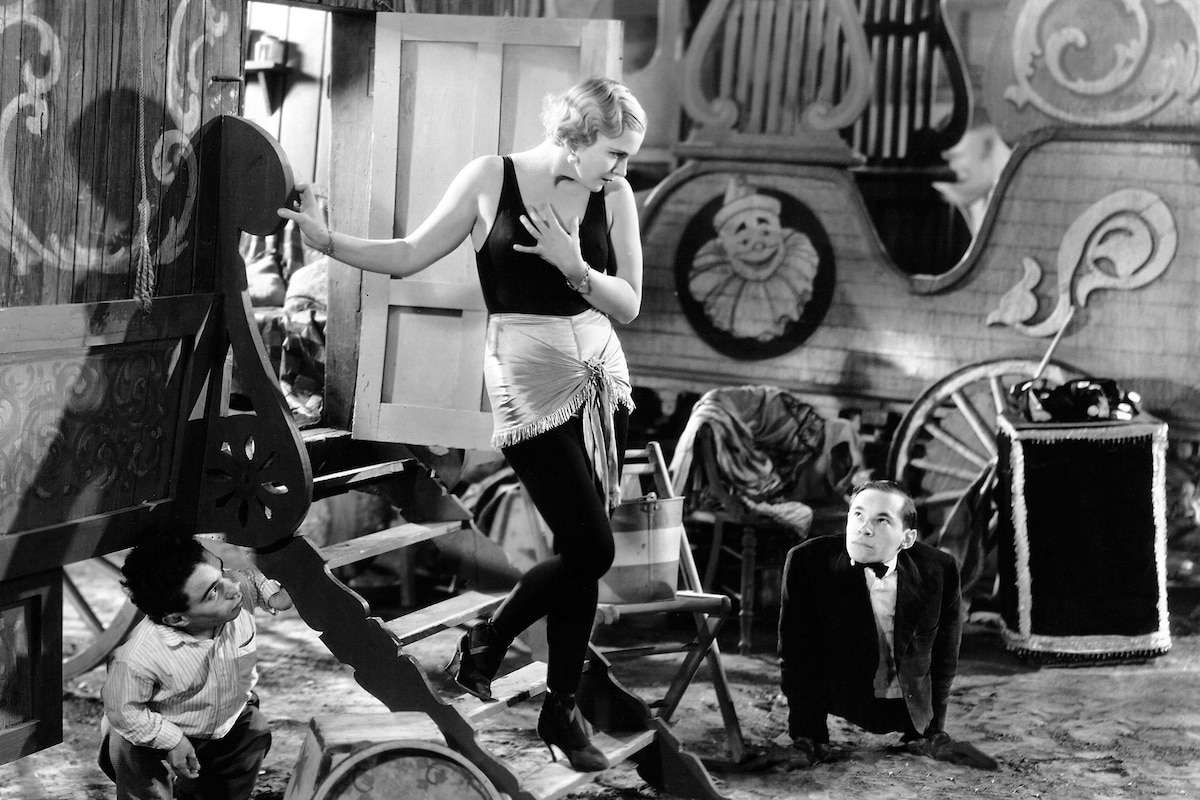
Freaks was one of many pre-Code films (meaning films released before strict enforcement of the Production Code) used to bolster arguments for increased censorship. It had the bad fortune to open in Washington, D.C., just before Senator Smith W. Brookhart (R-Iowa) launched a campaign for federal film censorship. Moralists complained not just about the depiction of the deformed, but about the double-entendre dialogue between the two human couples, Cleopatra and Hercules, and Phroso and Venus.
The wedding banquet scene in Freaks is referenced in "There's No Disgrace Like Home," a 1990 episode of The Simpsons.
Freaks's influence on other films has been considerable - everything from Edmund Goulding's Nightmare Alley (1947) to Federico Fellini's La Strada (1954) to Jack Cardiff's The Mutations (1974). Even the punk rock group, The Ramones, lifted their rallying cry of "gabba-gabba-hey" from the bizarre wedding sequence in Freaks where the sideshow oddities chant a strange toast to the newlyweds Hans and Cleopatra. Robert Altman plays homage to it in a scene from The Player (1992) when cop Lyle Lovett chants the phrase "One of us, one of us" over and over to his superior officer Whoopi Goldberg.
by Frank Miller
Pop Culture 101 - Freaks
by Frank Miller | February 20, 2013
SIGN UP FOR OUR NEWSLETTERS

CONNECT WITH TCM