Harry Earles, who had played the crook dressed as a baby in Browning's 1925 The Unholy Three, suggested the director make an adaptation of "Spurs," a 1923 short story by Clarence Aaron "Tod" Robbins, who had written the 1925 film's screenplay. The sideshow-set story was a natural for Browning, who had run off with the circus at an early age and befriended many of the carnival performers. He had drawn on that background throughout his filmmaking career, directing silent pictures with circus backgrounds and often casting Lon Chaney in roles that created the same mixture of compassion and disgust Browning had witnessed in sideshow audiences. On Earles's recommendation, Browning got MGM to purchase the rights for $8,000.
After the success of Dracula (1931) at Universal Pictures, Browning started a new contract at MGM. The studio offered him a chance to direct the mystery Arsene Lupin (1932), the first film to team John and Lionel Barrymore, but instead he proposed bringing Robbins's story to the screen. Only production head Irving Thalberg, who had championed the director's career earlier at Universal, was even willing to consider the project. He insisted Browning find the humanity within the story before he would commit the studio to it.
At Browning's request, Thalberg assigned Willis Goldbeck and Elliott Clawson to the screenplay, though from Goldbeck's recollections, neither was aware of the other's work. In fact, Goldbeck would later say he had never even been told about Robbins's story. Eventually, Leon Gordon, Edgar Allan Woolf, Al Boasberg and Charles MacArthur contributed to the screenplay, though no writers were actually credited.
The main change made to Robbins's story was in the ending. Originally, Jacques (who would become Hans in the film to better fit the German-born Earles) retires to a farm with his wife and, to punish her for her insults at the wedding banquet, forces her to carry him around the country roads for the rest of her life. In the five months it took to assemble the screenplay, Browning and the writers also added a normal, happy couple (Phroso the clown and Venus the seal trainer) to balance Hans's unhappy marriage to Cleopatra and various incidents designed to humanize the sideshow performers.
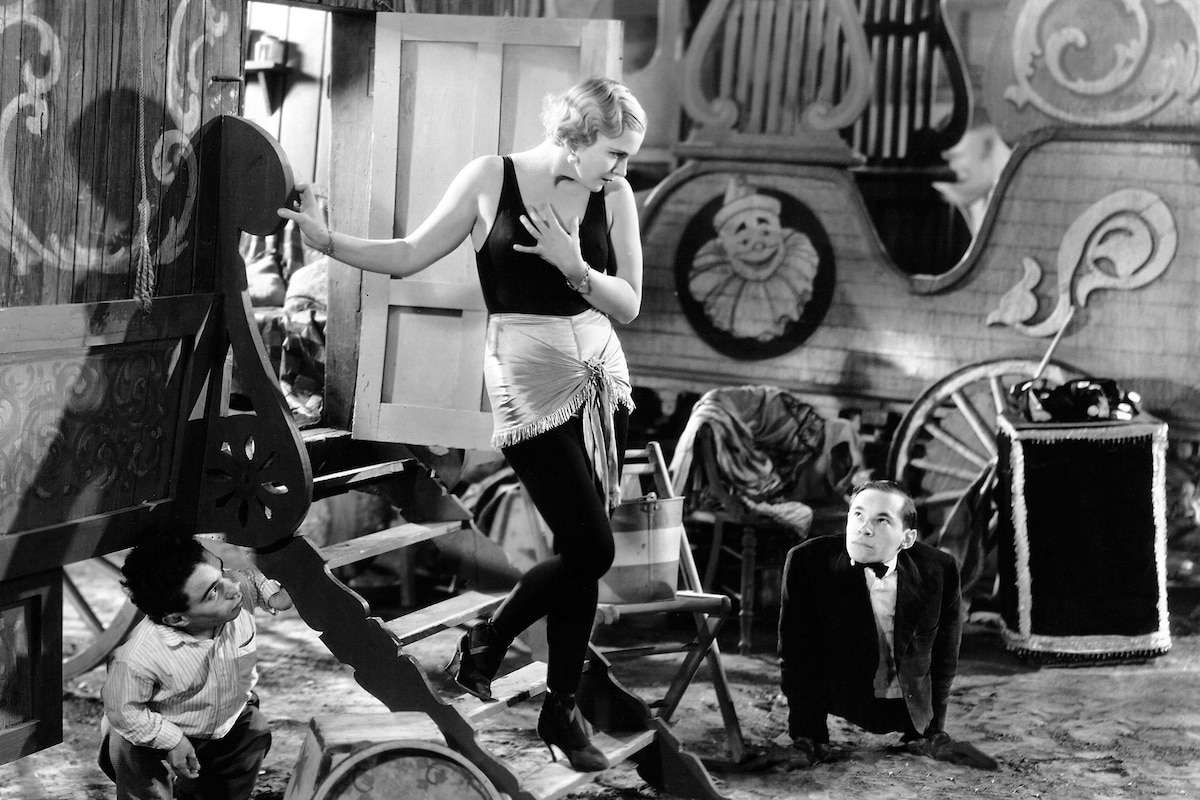
Browning cast Earles in the lead and his sister, Daisy, as his jilted love interest in Freaks. Their sister Tiny Doll also has a small role.
Browning insisted that the sideshow attractions featured in the film have other talents. As a result, he cast seasoned vaudeville performers Daisy and Violet Hilton, who were real-life Siamese Twins.
Casting director Ben Piazza spent almost a month on the East Coast scouting sideshow performers for Freaks. Among those cast were Johnny Eck, whose body seemed to end just below the rib cage; British Guiana native Prince Randian, who had neither arms nor legs; Koo Koo the bird girl from Mars, whose rapid aging was the result of progeria; Austrian hermaphrodite Josephine/Joseph and a troupe of microcephalics performing as "pinheads."
Browning wanted to cast Myrna Loy as Cleopatra and Jean Harlow as Venus, but Thalberg nixed the idea. Instead, Cleopatra was played by Olga Baclanova, a former member of the Moscow Art Theatre who had declined to return to the Soviet Union at the end of their 1925 U.S. tour. She had been building a name for herself in late silent films at Paramount, particularly Paul Leni's The Man Who Laughs and Josef von Sternberg's The Docks of New York (both 1928). Leila Hyams, a contract player typed as beautiful but good women, won the role of Venus.
In addition to Earles, cast members who had worked with Browning previously included Michael Visaroff, the innkeeper from Dracula, as the groundskeeper who lets the circus stay on his land, and Rose Dione, the barkeeper in West of Zanzibar (1928), as the sideshow performers' den mother.
by Frank Miller
The Big Idea - Freaks
by Frank Miller | February 20, 2013
SIGN UP FOR OUR NEWSLETTERS

CONNECT WITH TCM