SYNOPSIS
'Colonel' Harry Harrington and his daughter Jean are two cardsharps who make their living preying on wealthy travelers abroad luxury liners. Once Jean learns that Charles Pike, the son of a millionaire brewer, is on board, she attempts to lure him into her 'trap.' What starts as a fleecing turns into a love affair only to take a turn for the worse when Pike finds out about Jean's larcenous past. When he dumps her, it sets the stage for comic revenge, as Jean reappears in his life as the regal and mysterious Lady Eve.
CAST AND CREW
Producer: Paul Jones
Director: Preston Sturges
Screenplay: Monckton Hoffe (story), Preston Sturges
Art Direction: Hans Dreier, Ernst Fegté
Cinematography: Victor Milner
Costume Design: Edith Head
Film Editing: Stuart Gilmore
Original Music: Sigmund Krumgold
Cast: Barbara Stanwyck (Jean Harrington/Lady Eve Sidwich), Henry Fonda (Charles Pike), Charles Coburn ("Colonel" Harrington), Eugene Pallette (Mr. Pike), William Demarest (Muggsy Ambrose Murgatroyd), Eric Blore (Sir Alfred McGlennan Keith).
BW-97m.
THE LONG VIEW
The crown jewel in Preston Sturges' career as writer-director, The Lady Eve (1941) is one of those rare comedies that manages to be genuinely sexy, funny, and romantic, all at the same time. It was loosely based on a nineteen page story Paramount owned entitled "Two Bad Hats." Sturges completely reworked it into a script of his own and insisted on casting Barbara Stanwyck, Henry Fonda, and Charles Coburn in the lead roles. The studio wanted Brian Aherne for the Charles Pike role and Madeleine Carroll or Paulette Goddard for the part of Jean but Sturges, a hot property after the unexpected success of The Great McGinty (1940), held firm and got his way. In many ways, The Lady Eve was a complete departure from Sturges' first two films (The Great McGinty & Christmas in July, both 1940) which dealt with middle class characters and concerns. For one thing, it took place in an upper-class world of luxury liner staterooms, sprawling estates, and nouveau riche millionaires. Paramount also gave Sturges his biggest budget yet, allowing him to hire Edith Head to design twenty-five gowns for Stanwyck and fourteen changes of costume for Fonda.
According to the biography, Madcap: The Life of Preston Sturges by Donald Spoto, "Sturges, who had directed Christmas in July wearing a straw boater and carrying a bamboo cane, invariably paraded on this set with a colorful beret or a felt cap with a feather protruding, a white cashmere scarf blowing gaily round his neck and a print shirt in loud hues...the reason for the peculiar outfits, he told visitors, was that they facilitated crew members' finding him amid the crowds of actors, technicians, and the public." Despite Sturges' extroverted behavior and outward confidence, the director had some insecurities about his direction of The Lady Eve. In his autobiography, he wrote, "I happen to love pratfalls, but as almost everything I like, other people dislike, and vice versa, my dearest friends and severest critics urged me to cut the pratfalls down from five to three. But it was actually the enormous risks I took with my pictures, skating right up to the edge of nonacceptance, that paid off so handsomely. There are certain things that will convulse an audience, when it has been softened up by what has occurred previously, that seem very unfunny in cold print. Directing and acting have a lot to do with it, too. I had my fingers crossed when Henry Fonda went over the sofa. I held my left ear when he tore down the curtains and I held everything when the roast beef hit him. But it paid off. Audiences, including the critics, surrendered to the fun, and the picture made a lot of money for the studio. Barbara Stanwyck had an instinct so sure that she needed almost no direction; she was a devastating Lady Eve."
For Stanwyck, The Lady Eve marked a real turning point in her career. Audiences that had grown used to seeing her play tough, take-charge working girls, self-sacrificing mothers or hard-bitten prostitutes were dazzled by her stylish, sophisticated appearance in Sturges' film. Here she radiated sex appeal in her scenes with Fonda, whether she was throwing out a sleek leg to trip him or nibbling provocatively on his ear. Stanwyck, in an interview about Sturges for the New York Times said, "He'd ask us how we liked the lines. If we didn't, we'd say so, and he'd say the scriptwriter was fifty kinds of an imbecile - and change them. But, you see, he wrote the thing himself." In the biography, Stanwyck, author Axel Madsen wrote that the actress compared Sturges' set to "a 'carnival.' In Fonda, she met her match. He, too, always knew his lines and was affectionately called 'One-Take Fonda.' After The Lady Eve, he called Barbara his favorite leading lady...The set was so ebullient that instead of going to their trailers between setups, the players relaxed in canvas chairs with their sparkling director, listening to his fascinating stories or going over their lines with him. To get into mood for Barbara's bedroom scene, Sturges wore a bathrobe."
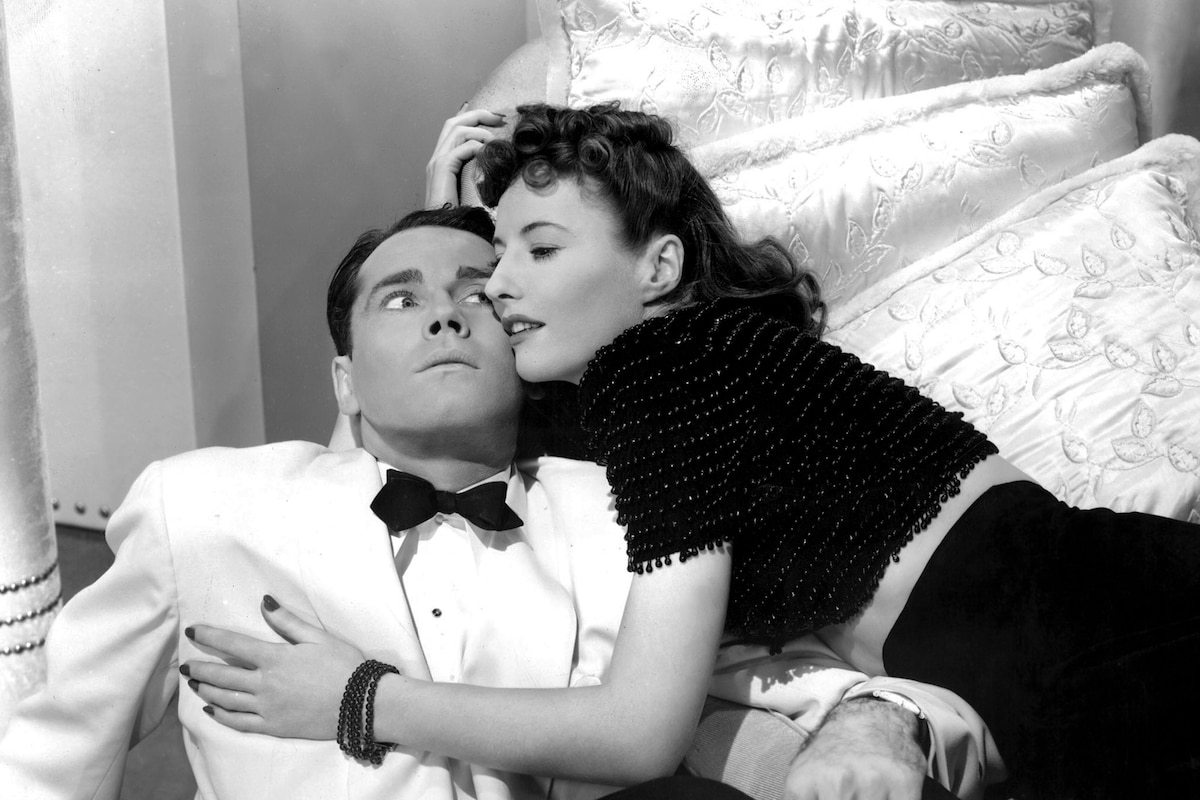
Considering the risqué nature of some of the scenes in The Lady Eve, it's surprising that the censors didn't give Sturges any trouble over the film, particularly in regards to the love scenes. There were at least eight of them and one intimate sequence, shot in tight close-up, lasted almost five minutes with Stanwyck caressing Fonda's ear lobes, cheeks, neck, and shoulder while he tried to contain his obvious excitement. But audiences and critics alike delighted in it and the film went on to win an Oscar nomination for Best Writing. (Unfortunately, it lost to Here Comes Mr. Jordan). Stanwyck and Fonda proved to be such a dynamic screen couple that they were cast together again in You Belong to Me (1941), a minor romantic comedy by Wesley Ruggles that could have used Sturges' magic touch. As for Paramount Studios, they tried to repeat the success of The Lady Eve with a remake of it in 1956 entitled The Birds and the Bees starring George Gobel, Mitzi Gaynor, and David Niven. It was a box office disappointment but considering the brilliance of the original, what did they expect?
by Frank Miller & Jeff Stafford
The Essentials - The Lady Eve
by Frank Miller & Jeff Stafford | February 20, 2013
SIGN UP FOR OUR NEWSLETTERS

CONNECT WITH TCM