Director Joseph Lewis began his career as a camera assistant in the 1920s, moved to the editorial department at MGM in the next decade, apprenticed as a second unit director, and was given a full directing contract at Universal in 1937, where he earned the nickname "Wagon Wheel Joe" for his penchant for framing shots through the spokes of a wagon wheel to add some visual variety to the many B westerns he made. He worked steadily in feature films through the late 1950s, although a 1953 heart attack slowed down his output a little, creating thrillers, war movies, westerns, and at least one other film noir that has become a classic of the form, The Big Combo (1955). In 1959, he moved to television, directing episodes of The Rifleman, Gunsmoke, and The Big Valley, among other series. He retired in 1966, spending the years until his death in August 2000 at age 93 lecturing and deep-sea fishing off his trawler.
Arguably the most talented and successful of the group of blacklisted film artists known as the Hollywood 10, Dalton Trumbo began as a writer of short stories and novels while still a young man in the 1920s and 1930s. In 1934, he was hired as a reader at Warner Bros., where he eventually began writing B-movie scripts. By the early 40s, he had moved up to prestigious productions, earning an Academy Award nomination for his screenplay for the Ginger Rogers film Kitty Foyle (1940). He worked steadily through the decade as one of the most respected and highly paid writers in the business until he was blacklisted from the industry and jailed for ten months over his refusal before Congress to answer questions about his political activities and to name names of other film professionals who may have been members of the Communist Party. Despite this, he continued to turn out screenplays through the 1950s, either uncredited or fronted by a non-blacklisted writer. including the Oscar®-winning scripts for Roman Holiday (1953) and The Brave One (1956), which were given to, respectively, front Ian McLellan Hunter and the non-existent Robert Rich, Trumbo's pseudonym. Those awards eventually carried Trumbo's name, but not for many years after Kirk Douglas and Otto Preminger broke the blacklist by openly hiring him to write their respective films Spartacus (1960) and Exodus (1960). In 1971, he adapted and directed his anti-war novel of the 1930s, Johnny Got His Gun for the big screen. Dalton Trumbo died in 1976 at the age of 70.
Although he was actually only a front for Dalton Trumbo on this project, Millard Kaufman was a respected writer with several notable screenplays to his credit, including Bad Day at Black Rock (1955) and Raintree County (1957). His first novel, A Bowl of Cherries was published in 2007, two years before his death at the age of 92.
Russell Harlan had a long career (1937-1970) as a respected cinematographer, earning six Academy Award nominations for his work, including two in the same year: in the color category for the John Wayne film Hatari! (1962) and in black-and-white for To Kill a Mockingbird (1962). He worked his way up from stunt man in quickie westerns to shooting them. His most fruitful professional association was with director Howard Hawks, for whom he shot seven films, including the classic westerns Red River (1948) and Rio Bravo (1959).
Composer Victor Young's music has graced more than 200 pictures and earned 22 Academy Award nominations. He finally won for the last of these, Around the World in Eighty Days (1956).
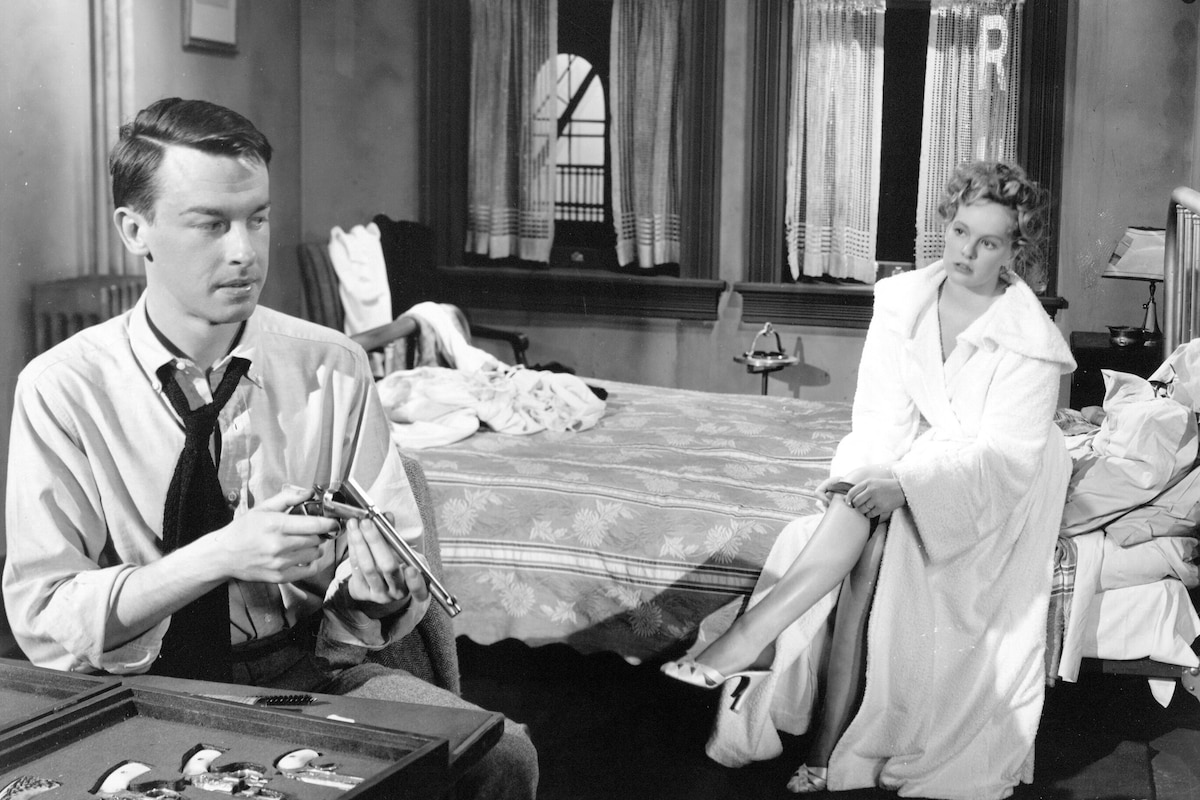
Born in Wales in 1925, Peggy Cummins is still alive (as of this 2012 article) and has occasionally appeared to speak at screenings of her work. Her career started with some promise in the early 1940s, but after she was let go as the lead in the period drama Forever Amber (1947), she never made it to major stardom. She retired from acting in 1964.
John Dall's film career also never quite took off from its early promise, even though he was nominated for a Best Supporting Actor Oscar® for his screen debut opposite Bette Davis in The Corn Is Green (1945). One of his most famous roles was as half of the murderous duo based on Leopold and Loeb in Alfred Hitchcock's Rope. After Gun Crazy he worked mostly on stage and occasionally on television, making only sporadic screen appearances, such as his role as Glabrus in Spartacus (1960). He died in 1971 at the age of 52, officially of a heart attack, although some reports claim his demise was the result of a punctured lung.
While casting for the part of the teenage Bart, Lewis noticed one boy sitting outside his office and asked his secretary to send in the one "with the big black eyes." It was Rusty Tamblyn, and Lewis never auditioned any of the other kids. Tamblyn had appeared in a handful of movies before this and would work steadily throughout the next two decades, eventually becoming known as Russ Tamblyn and appearing in such major productions as Seven Brides for Seven Brothers (1954), Peyton Place (1957), which earned him a Best Supporting Actor nomination, and West Side Story (1961). Roles became scarcer in the late 70s and into the 80s, but he had a resurgence with a recurring role on David Lynch's surreal TV series Twin Peaks in 1990-91, and he has continued to work since then, including several appearances on the TV show Joan of Arcadia (2003-2005), which starred his daughter, Amber Tamblyn.
Dalton Trumbo wasn't the only blacklisted member of this production. Around the time of the release of this film and three others he made the same year, including Cyrano de Bergerac (1950), Morris Carnovsky, who plays Judge Willoughby, was named by both Elia Kazan and Sterling Hayden as a communist and banned from motion pictures. A successful stage actor and founding member of the Group Theater in the 1930s, he did not appear in another Hollywood film until The Gambler (1974). He died in 1992 at the age of 94.
Nedrick Young, who plays Bart's journalist friend Dave Allister, appeared in 29 films but had a second, more prominent career as a writer. Also the victim of the infamous blacklist, Young wrote 11 screenplays, winning an Academy Award for his work on The Defiant Ones (1958) and nominated for his adaptation of Inherit the Wind (1960), both under the pseudonym Nathan E. Douglas.
by Rob Nixon
Trivia - Gun Crazy - Trivia & Fun Facts About GUN CRAZY
by Rob Nixon | February 20, 2013
SIGN UP FOR OUR NEWSLETTERS

CONNECT WITH TCM