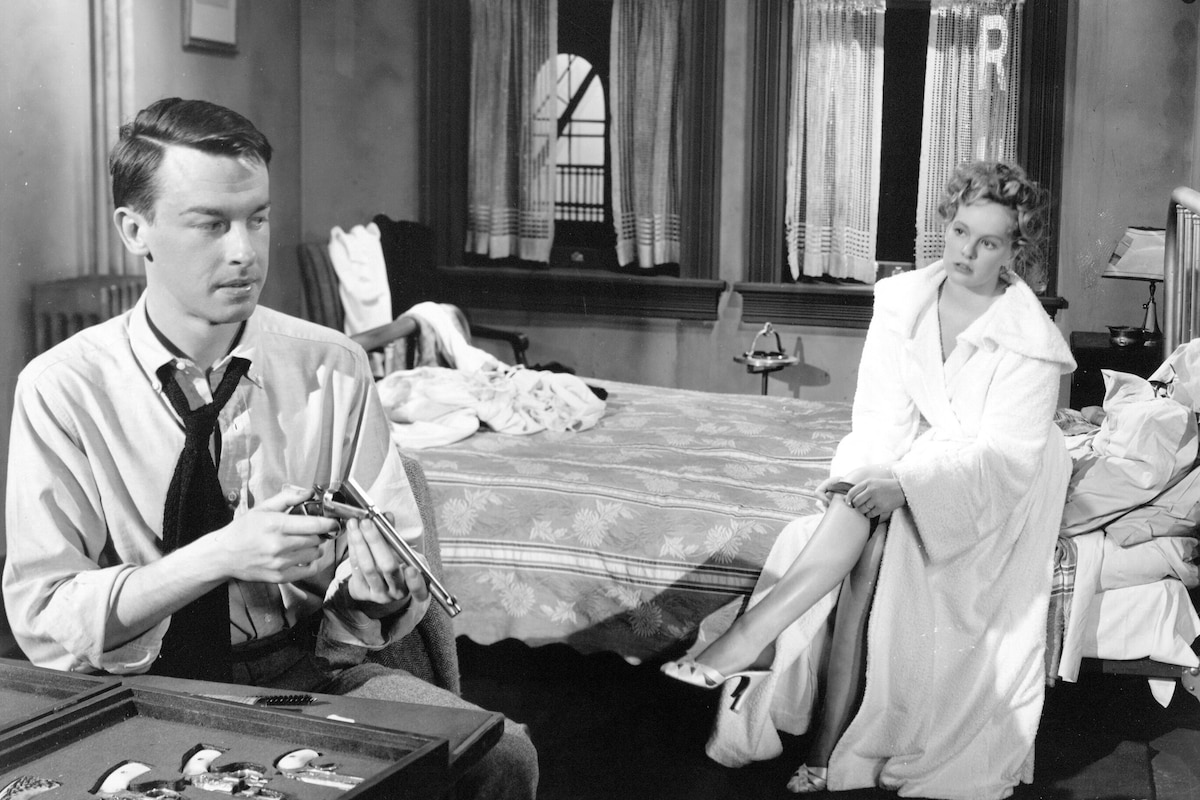
According to an item in the Hollywood Reporter around the time of production, Lewis had sought Veronica Lake for the female lead. He went instead with a young British actress, Peggy Cummins, then under contract to Twentieth Century-Fox, which was trying to dump her after bad notices for her performance in Moss Rose (1947). Lewis told author-critic Danny Peary that he asked a cutter at the studio to let him see pre-release dailies from Moss Rose. "I thought she was devastatingly beautiful and talented and that the fault for the picture's failure belonged to the director and producer." He said he and Cummins had lunch five days in a row and talked about Gun Crazy and much else. He became convinced she was a "terrific actress" and right for the role. According to Lewis' interview with Peter Bogdanovich, the dailies he watched were from the film Forever Amber (1947), in which Cummins was replaced as the lead by Linda Darnell, and their meetings and chats lasted three weeks, not five days.
For the main male role, Lewis made what must have seemed an odd choice at the time. John Dall was tall, lanky, "a bit too introspective for leads" (Peary). His last role had been one of the two apparently gay killers modeled on Leopold and Loeb in Alfred Hitchcock's Rope (1948). "A director thinks in many ways," Lewis told Peary. "For the character of Bart I wanted an actor who by osmosis or scent or whatever projected an inner weakness. I decided to cast a gay in the part. [Dall was, in fact, a gay man, which must have been known to at least some people in Hollywood for Lewis to make this assessment.] I didn't have to tell John Dall how to play Bart or that I wanted him to express Bart's weakness. I knew he'd betray himself. Subtly and gently."
Peary excuses Lewis' equating Dall's gayness to Bart's weakness by suggesting the director may have meant to imply an ongoing struggle within the character "in regard to self-identity and self-definition." At any rate, Lewis apparently didn't think the character of Bart was gay. In the shooting contest sequence at the carnival, for example, Lewis wanted the sexual attraction between Bart and Laurie to come across very strongly, so he told Dall, "Your cock's never been so hard." He said he told Cummins, "You're a female dog in heat, and you want him. But don't let him have it in a hurry. Keep him waiting." Lewis said that was the only direction he had to give his stars to get exactly what he wanted.
Dall and Cummins did all their own driving in the film, and according to Lewis, only one process shot (i.e., rear projection behind the actors pretending to drive) was used in the entire film.
Lewis made several changes to the script as he shot it. The script calls for the police, the dogs, and the cop cars to be seen as they surround Bart and Laurie in the climactic swamp scene, but Lewis decided to keep the camera on the couple with only the sounds of their pursuers coming out of the mist. On the page, Bart and Laurie were meant to separate after the meat-packing plant robbery, but Lewis decided to have them stop short in the cars they were driving in the opposite direction and, in broad daylight with the police closing in, run into each other's arms and drive off together, leaving one of their getaway vehicles in the road.
Because of his small budget and relatively short production schedule, Lewis employed a number of B-movie techniques to tell his story, e.g., inserting objects, such as FBI teletypes, to shorthand the series of minor hold-ups the couple embarks on. He also found ways to add greater tension and drama and keep the picture quickly moving forward in spite of the limitations, such as alternating deep focus compositions with many tight close-ups and cross-cutting Dall and Cummins both in right profile as they bicker. He often has the two facing away from each other or from the camera at moments of high conflict.
Lewis also employed unbalanced, off-kilter compositions to emphasize the instability and isolation of the characters. A good example of this is the close-up of the young Bart's face half off screen at the end of the gun theft scene and his placement at the window in deep-focus in the background of the courtroom scene.
The most talked-about and written-about sequence in the movie is considered exemplary of Lewis' ability to infuse a B picture with a distinctive sensibility and a visual and narrative flair-the single-take bank robbery scene. Lewis, of course, did not invent the use of a single long take to portray an entire sequence of actions. Orson Welles had made bold use of the technique in his groundbreaking Citizen Kane (1941), a film Lewis said inspired him. Lewis himself had executed a striking single-take crane shot of a trial sequence in Secrets of a Co-Ed (1942). His innovation here, however, was keeping the camera inside the car as Dall runs into the bank to execute the robbery and Cummins tries to distract a police officer on the street outside.
The 17-page bank robbery sequence was scheduled for a three-to-five-day shoot with numerous camera set-ups, but Lewis decided he didn't want to do it the conventional way. He told the producers he could pull it off in a single day with one shot that never entered the bank. Since that would cut down on production time and eliminate the need for a bank set, the idea appealed to their budget consciousness, but he still had to prove to them it was possible. So he did a test run with extras using his own 16mm camera.
To get the shot entirely from inside the car, the back of it was stripped out and replaced by boards and a jockey's saddle. The boards were greased so the camera could easily slide and change angles. Lewis and several crew members were crammed into the back. The only lights they had for the actors were two small key lights operating off batteries. The sound was recorded with microphones hidden in the sun visors. To get the dialogue on the sidewalk when Laurie gets out to distract the cop, Lewis placed two sound men with boom mics on the roof; they were strapped up there the entire time the car drove up to the bank and sped off.
Rather than blocking off the street for the robbery sequence, Lewis had Dall and Cummins drive around looking for a place to park, improvising their dialogue the entire time.
The production cost roughly $400,000 and took 30 days to shoot.
by Rob Nixon
Behind the Camera - Gun Crazy
by Rob Nixon | February 20, 2013
SIGN UP FOR OUR NEWSLETTERS

CONNECT WITH TCM