Writer/Director Lawrence Kasdan had been working throughout the 1970s and early 1980s trying to establish himself in Hollywood. He had found success penning screenplays for such diverse films as the John Belushi vehicle Continental Divide (1981) as well as the iconic blockbusters The Empire Strikes Back (1980), Raiders of the Lost Ark (1981) and Return of the Jedi (1983). Kasdan had also made a formidable splash with his first directorial effort, the sultry modern noir Body Heat (1981), another film that he had written himself.
It was while Kasdan was working on Body Heat at 20th Century Fox that the original first seed for The Big Chill was planted. There was a person with whom Kasdan worked during that time who inspired the theme of the film. "We were pretty good friends," said Kasdan in a 1998 interview. "We seemed to agree about a lot of things...and as we'd talk, every once in awhile he would say something that I found so counter to my own beliefs, so repugnant to me in some way, so awful and cynical, and I would feel a chill actually running down my body. Because here was a guy I got along with perfectly well in every other way, but clearly we had a vast value split that was enormous, and that feeling, that big chill that I would get is really the original impulse for the movie, because it was about the fact that even though we had certain kinds of values and held them dear when we were in school, they were put to a very severe test when we go out into the world...The world was a colder place than the university setting we had lived in in the 60s, and in order to survive and go on in the real world--a colder world--you had to make some compromises."
Kasdan asked a friend, writer Barbara Benedek, to work with him on hashing out ideas together for a new screenplay that would touch on those ideas. Kasdan liked Benedek's particular brand of humor that he knew she would bring to the story, and he especially liked the idea of her bringing the added value of a woman's perspective.
Together Kasdan and Benedek spent several months meeting and talking through potential ideas for the film. Eventually they were able to put together an original screenplay based on everything they had discussed with characters and storylines that were already well thought out and specifically structured.
Armed with this fresh new screenplay titled The Big Chill that he described as a "comedy of values," Kasdan began meeting with the heads of various studios to discuss making what would be his second film as both writer and director. Being fresh off the success of Body Heat, all of Hollywood was eager to work with Kasdan at the time. Nevertheless, he still found a great deal of resistance towards making The Big Chill. "They could not relate to this material," said Kasdan. "They didn't understand a movie that would have seven protagonists." The studio executives wanted to work with him, but not on The Big Chill. They encouraged him to find another project.
When Kasdan and co-writer Benedek serendipitously ran into Marcia Nasatir, the head of Johnny Carson's company Carson Productions, things took a turn for the better. Carson Productions was headquartered at Columbia Pictures, which had already turned the project down. However, Nasatir loved The Big Chill and understood immediately what it was trying to say. She even got the story's quirky humor and quickly became The Big Chill's champion. With a little persistence, Nasatir was eventually able to convince Columbia Pictures to make the film, and she would serve as Executive Producer.
With the welcome green light for the film, Kasdan now focused on choosing the right actors for the important ensemble cast. Kasdan always loved actors and loved working with them. In fact, he had started out in life wanting to be an actor himself, but ended up feeling that he just didn't have the talent and should focus his efforts on writing and directing. "I love actors, I'm amazed by them," said Kasdan in 1998. "To me, they are like athletes...they simply do something that I cannot do, and it mystifies me, and part of what I wanted to do with The Big Chill was to create an ensemble where I could hire many more actors, work with many more actors and have in the air the excitement that comes with having a bunch of great people. It's the same as having an all-star team in basketball."
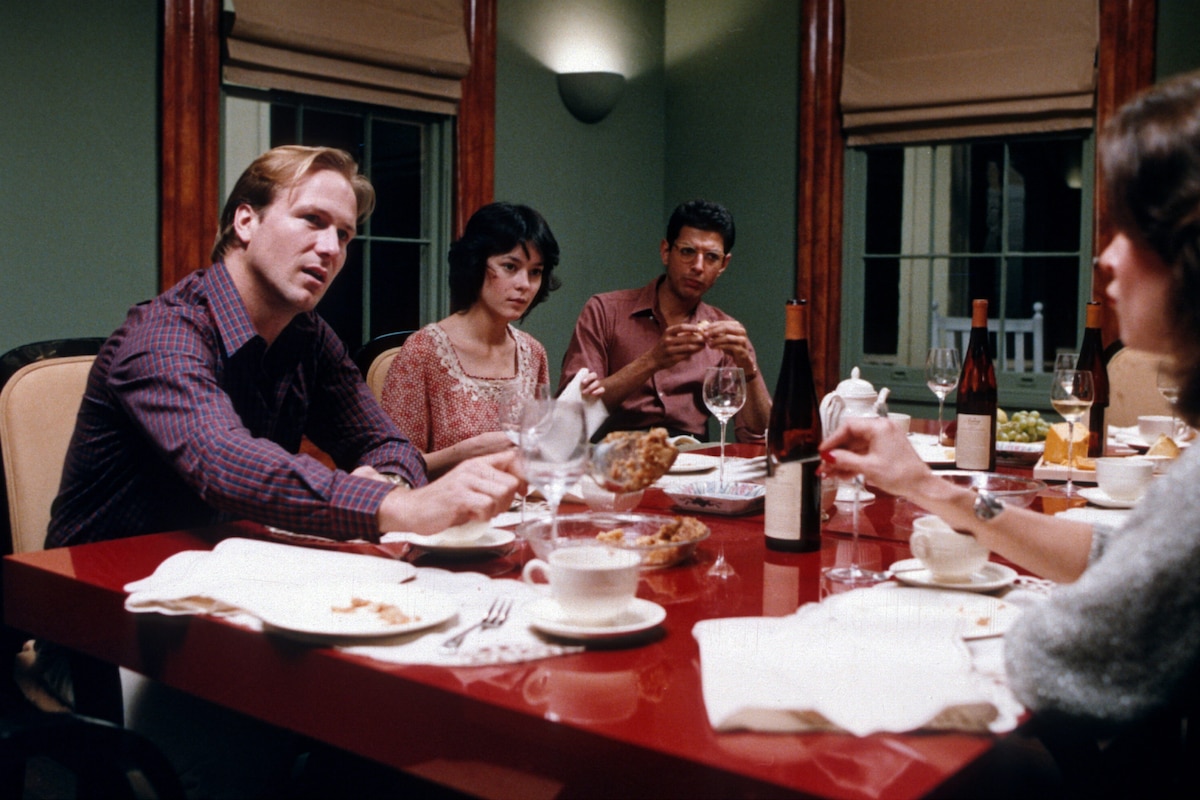
Working from instinct, Kasdan began putting together his dream cast. For the role of Nick, the drug-addled Vietnam veteran, Kasdan chose William Hurt, with whom he had previously worked on Body Heat. It had been a good experience for them both. "I think Bill Hurt is one of the great actors of my generation," said Kasdan in 1983. "He's powerful, intelligent, sensitive, and has a strong sexual presence, which is used in an oblique way in this film. He's a strong center to a group. He commands attention."
Kasdan had met Kevin Kline for Body Heat. Even though Kline didn't end up in that film, Kasdan was impressed with him. Having established himself with a distinguished theater career and a plum role in Sophie's Choice (1982) opposite Meryl Streep, Kasdan wanted Kline to play Harold, the solid businessman, husband and father. "Kevin Kline is a graceful, wonderful, serious actor," said Kasdan. "At the same time he has this great, unexpected comedic gift. As Harold, he's the steady center, the keel of this group. It's a terribly difficult role to play because Harold has desires and irritations just like anybody else. Kevin expresses all these things with enormous humor and grace."
In choosing Glenn Close to portray the warm level-headed Sarah, Kasdan saw a remarkable depth in the actress who had just been nominated for an Academy Award for her film debut in The World According to Garp (1982). "Sarah is a strong, accomplished woman," said Close in 1983 while promoting the film. "But there is another side to her character that isn't really happy despite all the material and external success she's had. She's confused by her own intense feelings and sometimes what she doesn't say is more important than what she does say."
For the role of sexy TV star Sam Weber, Kasdan chose actor Tom Berenger. Berenger had previously garnered attention for his supporting role in Looking for Mr. Goodbar (1977) and had impressed Kasdan playing the young Paul Newman role in Butch and Sundance: The Early Days (1979). "Tom has an enormous physical presence, a very fine sense of irony about his physical being," said Kasdan upon the film's release. "We needed some of that confidence for Sam, who as a TV star is essentially a modern-day matinee idol. Tom carries that image and has the same earnestness as Sam, who takes himself seriously until his balloon is punctured."
The multi-talented Mary Kay Place was tapped to play the complex role of Meg, the jaded yet warm single attorney who wants to have a baby on her own. The Emmy winning actress, writer and singer was best known at the time for her memorable supporting work on the popular TV comedy Mary Hartman, Mary Hartman. Her dramatic role in The Big Chill would be a departure of sorts for the actress, and Kasdan had plenty of faith that she could handle it.
Kasdan had been impressed with actress JoBeth Williams from her work in the hit films Kramer vs. Kramer (1979) and Poltergeist (1982) and he chose her to play the part of unhappy wife and mother Karen. "JoBeth is an amazing actress, serious and comic," said Kasdan. "The part of Karen is as difficult as anything in the movie because it is so dependent on irony. Karen, the character, is not always aware of what she's doing. It takes an actress with enormous intelligence to pull off something like that and JoBeth has it."
Jeff Goldblum, who had appeared in several memorable small roles in films and television up to that point, including Woody Allen's Annie Hall (1977) and Robert Altman's Nashville (1975), was tapped to play entertainment journalist Michael, whose loftier novel writing dreams have fallen by the wayside. Kasdan had almost used Goldblum in a supporting role in Body Heat that had ultimately gone to Ted Danson. "I've always been a Jeff Goldblum fan for years," said Kasdan. "He has an eccentric, unique sense of timing and wonderful crisp delivery. Jeff is an elegant, mime-like actor."
The role of Chloe, the deceased Alex's much younger girlfriend, was a crucial one, as it called for someone to play outside observer to this group of disillusioned friends. Actress Meg Tilly had burst on to the Hollywood scene with memorable roles in films such as Tex (1982) and Psycho II (1983), and Kasdan thought she would be perfect to play the complex character who possesses a quiet and often misunderstood intelligence. "Meg Tilly is obviously an incredible natural beauty with an amazing physical presence and a crystalline voice," said Kasdan. "She's a very subtle actress. The part of Chloe is terribly difficult. She seems to be there at all times, yet she says very little in a group of very talkative people.
Last but not least, for the key role of Alex, the fallen friend whose suicide brings the friends back together, Kasdan cast a then unknown actor named Kevin Costner who had not yet made his mark in Hollywood.
When Kasdan was deciding where The Big Chill should be filmed, it didn't take him long to settle on the beautiful seaside town of Beaufort, South Carolina. The critically acclaimed Robert Duvall film The Great Santini (1979) had been shot there a few years earlier and had used a local residence in the historic district as the family's home in the film. The house, known locally as The Edgar Fripp House or Tidalholm, was a gorgeous sprawling white antebellum treasure that had once been used as a Union hospital during the Civil War. When Kasdan saw it, he fell in love with it right away and thought it would be perfect as Harold and Sarah's southern summer home where the friends spend the weekend together.
To further prepare for The Big Chill, Kasdan started thinking about what music he wanted to ultimately use on the film's soundtrack. "It was always clear in my mind," said Kasdan in a 1998 interview, "that the score of the movie would be the songs that I liked then when I was in college." Kasdan, himself a graduate of University of Michigan like the characters in the film, asked his wife Meg, who had also been present during his college days, to start compiling tapes of favorite songs from that era. Meg Kasdan, who would go on to be credited as the film's Music Consultant, carefully considered all the songs that had been popular at the time and tried to decide which ones she thought might be a good match for particular scenes in the film. It was a significant job that would have far more impact on the finished film than anyone ever dreamed.
by Andrea Passafiume
The Big Idea - The Big Chill
by Andrea Passafiume | February 19, 2013
SIGN UP FOR OUR NEWSLETTERS

CONNECT WITH TCM