Duel in the Sun (1946) ranks as one of the screen's greatest testaments to
obsession. Not only does it chronicle the doomed love between amoral cowboy
Lewt McCanles (Gregory Peck) and half-breed temptress Pearl Chavez
(Jennifer Jones), it was made to satisfy the two obsessions that drove
independent producer David O. Selznick's career from the '40s through the
end of his life: his need to outdo his spectacular success with Gone
With the Wind and his quest to make protegee (and later wife) Jones
into the screen's greatest star.
The story was born in another man's attempt to influence the career of the
actress he loved. Niven Busch wrote the novel, then pitched it to RKO with
himself as producer in hopes that it would provide a career-changing role
for his wife, Teresa Wright, who was typed in "good girl" roles. When
Wright got pregnant, however, the studio had to find another leading lady,
particularly since they'd already signed John Wayne to play Lewt. When
their second choice, Hedy Lamarr, turned down the role because she, too,
was pregnant, studio head Charles Koerner tried to borrow Jones, who was
under contract to Selznick's production company. The choice was
unconventional -- Jones was primarily identified with her Oscar®-winning role as St. Bernadette of Lourdes -- but it appealed to Selznick, who was having an affair with her at the time. But the deal was never closed. Complaining that Wayne didn't have the sex appeal for the male lead and a first-time producer like Busch couldn't make the film important
enough for Jones, he refused the loan out. When RKO lost interest in the
project, he bought the rights himself. Not only did he ink Jones to play
Pearl, but he cast two other actors whose contracts he held -- Gregory Peck and
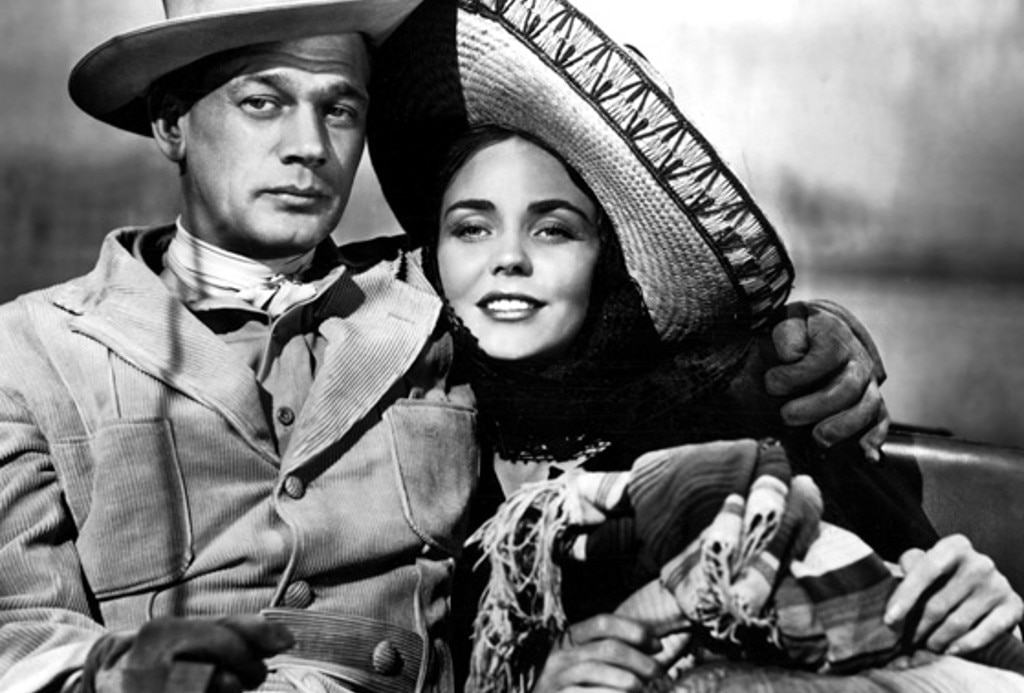
Joseph Cotten -- as Lewt and his honorable half-brother, Jesse,
respectively.
Selznick first considered William Dieterle as director because Jones had
just had a good experience working with him on Love Letters (1945), but
then decided he'd put too much emphasis on the romance. Instead he chose
King Vidor, who'd excelled with westerns and other outdoor films like
Billy the Kid (1930) and Northwest Passage (1940), but had also directed
strong women's pictures like Stella Dallas (1937). Initially, he offered
Vidor the chance to serve as his own producer, saying he was too busy to
spend a lot of time on the picture.
As he worked on the script, however, Selznick's attitude changed. He
started seeing the opportunity for spectacle and became increasingly
intrigued at the thought of presenting Jones to the filmgoing public in a
new, sexier image. By the time the film went on location in Arizona,
Selznick insisted on approving every setup and was re-writing the script
daily. Some of his revisions were incredibly picky; he would change only a single line of dialogue
or, in one case, the position of Cotten's arm as he sat on a sofa. One day
he arrived on the set after Cotten had been released for the day with a
new version of the scene they'd just shot. To get one minor line change
in, he had Cotten called back and kept him shooting until midnight.
He also had various additional directors -- including Dieterle, Joseph von
Sternberg and William Cameron Menzies -- on hand to shoot additional scenes
or serve as consultants. He even tried to shoot a few scenes himself when
Vidor fell ill. At least that meant there was somebody handy when
Selznick's interference and on-set tantrums finally led Vidor to walk off
the film. Ostensibly there were only two days left, and Selznick got
Dieterle to fill in. Then as the film was being cut, Selznick kept adding
scenes that dragged the production out for almost a year and tripled the
budget.
Among the new scenes were a prologue, in which Pearl's father kills her
mother for cheating on him, and a sexy dance Pearl performs for Lewt. The
latter posed special problems for Jones, who had little confidence in her
dancing abilities and was already uncomfortable with the character's sexual
nature. It didn't help that the sequence had to be shot three times to get
past the Production Code. After the film was released, Selznick had to cut
it entirely to appease the Catholic Church's Legion of Decency and avoid a
boycott of the film.
The entire process was grueling for Jones. On location in February and
March, she had to endure snowstorms and sub-zero temperatures. In the
final scene, Pearl and Lewt shoot each other, then she crawls
through a jagged canyon so they can die together. For this sequence, Vidor wanted to use
padding to protect Jones from the rough terrain. But Selznick insisted that
it wouldn't look natural. By the time they were done shooting, the actress was
covered with welts and bruises. The film was emotionally trying, too. Her
relationship with Selznick had already contributed to the breakup of her
marriage to actor Robert Walker. Shortly before production began, Selznick
told his wife about Jones. Throughout filming and postproduction, he
vacillated between leaving his wife for her and then trying to break things
off to save his marriage. Shortly after the film was finally finished,
Jones even attempted suicide, in despair over the state of her relationship
with Selznick. Some of that emotional turmoil made it onto the screen.
Pearl Chavez is now considered one of her best performances, and she still
amazes audiences with the passion and commitment of her work in the
film.
Further production delays were caused by a series of strikes, including one
at Technicolor that almost kept the film from opening in time for the 1946
Academy Awards®. On the day of its premiere, a freshly struck print
was rushed to Loew's Egyptian. Selznick also ran into trouble with his
usual distributor, United Artists, partly over the film's sexual nature.
Faced with their refusal to distribute Duel in the Sun, he created
his own distribution company, Selznick Releasing Organization. Because all
of his money was tied up in the film, he took a chance on a new releasing
pattern, opening the film in hundreds of theaters around the country rather
than starting slowly in a few first-run houses in the major cities, as was
then the custom. Opening the film wide was decades ahead of its time, but
proved a box-office bonanza as audiences, prodded by a $2 million publicity
campaign, raced to see the film wherever it played. Despite pretty awful
reviews, the picture grossed $10 million, making it the second-highest-grossing
film of the year (behind The Best Years of Our
Lives).
At the time, Selznick was stung by the poor reviews, jokes about "Lust in
the Dust," as the film was dubbed, and even complaints in Congress about
the picture's unbridled sexuality. He even instructed his publicity
department to find a way to salvage his image. He didn't have to worry.
MGM's re-issue of Gone With the Wind later in 1947 reminded critics
and audiences of just how great a producer he was. In recent years,
Duel in the Sun has been re-evaluated by critics, most notably
director Martin Scorsese, who consider the work ahead of its time. In an
era in which filmmakers are expected to put their personal visions and
obsessions on screen, Duel in the Sun stands as a testament to
Selznick and Vidor's ability to use the western as a vehicle for artistic
expression.
Producer: David O. Selznick
Director: King Vidor
Screenplay: Oliver H.P. Garrett
Based on the novel by Niven Busch
Cinematography: Lee Garmes, Harold Rosson, Ray Rennahan
Art Direction: J. McMillan Johnson
Music: Dimitri Tiomkin
Cast: Jennifer Jones (Pearl Chavez), Joseph Cotten (Jesse
McCanles), Gergory Peck (Lewt McCanles), Lionel Barrymore (Sen. McCanles),
Lillian Gish (Laura Belle McCanles), Herbert Marshall (Scott Chavez),
Charles Bickford (Sam Pierce), Harry Carey (Len Smoot), Tilly Losch (Mrs.
Chavez), Butterfly McQueen (Vashti).
C-145m. Closed captioning.
by Frank Miller
Duel in the Sun
by Frank Miller | November 24, 2008
SIGN UP FOR OUR NEWSLETTERS

CONNECT WITH TCM