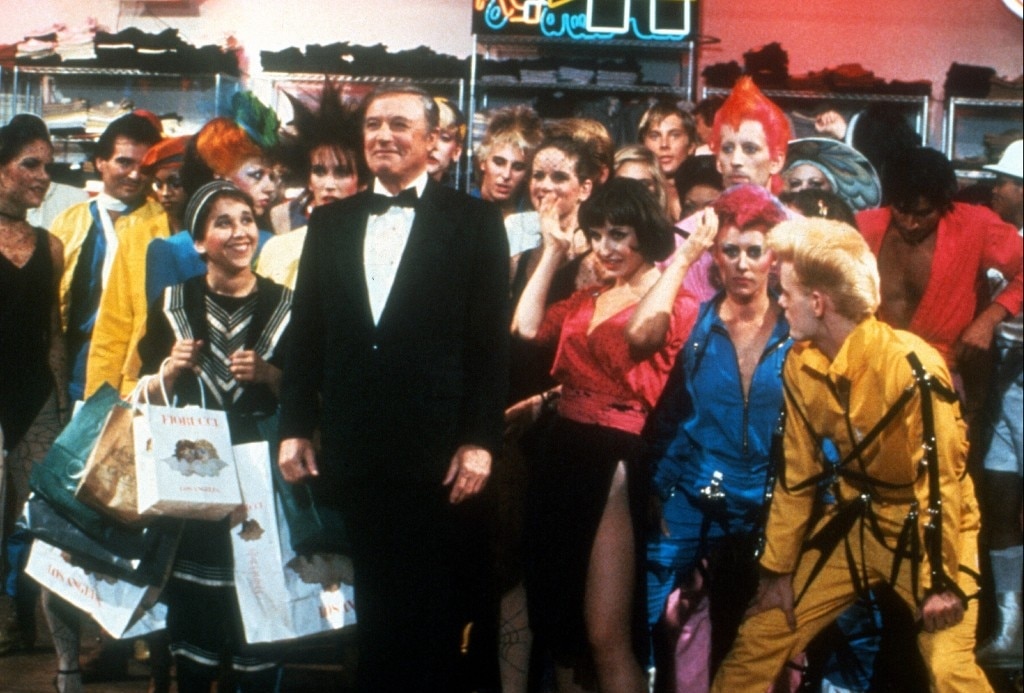
Xanadu (1980) was a remake of the Rita Hayworth film Down to Earth (1947) about Terpsichore, the Muse of Dance who falls in love with a mortal. Xanadu has Terpsichore (Olivia Newton-John), one of the Nine Muses of Olympia, fall in love with mortal Sonny (Michael Beck), a frustrated painter who creates large copies of record albums for store advertising but dreams of being an important artist. While working on an album by a group named The Nine Sisters, Sonny meets the mysterious, roller-skating Kira, who is really Terpsichore in disguise. Sonny learns that his friend Danny (Gene Kelly), a former 1940s big-band clarinetist and nightclub owner, lost his own muse forty years before when his girlfriend left him. That girlfriend looked a lot like Kira, who befriends the two men and encourages them to open a new nightclub called Xanadu. Also in the cast were Matt Lattanzi (who would later marry Olivia Newton-John), and veteran actors Wilfrid Hyde-White and Coral Browne.
The idea behind Xanadu came from co-producer Joel Silver. Silver was developing projects for the Lawrence Gordon Productions company through Warner Bros, but that studio later dropped Xanadu and it was picked up by Universal Pictures. Xanadu was originally conceived as a low-budget disco roller-skating film to capitalize on the then current crazes, but the budget was boosted to $10 million when singer Newton-John, then hot off the success of Grease (1978) was added to the cast, and later rose to $20 million. Gene Kelly agreed to appear in the film only if he was not required to dance, yet would later dance and roller skate. It would be Kelly's last dramatic role.
Directed by Robert Greenwald from a screenplay by Richard Christian Danus and Marc Reid Rubel, Xanadu began filming on September 18, 1979 at various locations in Los Angeles, including the Pan-Pacific Auditorium, which was used for exterior shots of the Xanadu nightclub. The City of Los Angeles would not grant permission for the filmmakers to shoot inside the building, so Greenwald was forced to create interiors on Hollywood Center Studios' Stage 4. The Pan-Pacific Auditorium, an iconic LA Art Deco landmark, had fallen on hard times by the 1970s and would burn down in the 1990s.
The film's soundtrack album went Double Platinum in the United States on the strength of Newton-John's title track Xanadu (which would go to number one on the Billboard charts in the United States),Magic, Suddenly a duet Newton-John sang with Cliff Richard, and other songs by The Tubes and ELO.
Xanadu made back its cost for Universal when it went into general release in September 1980, earning $22.8 million at the box office, but was generally panned by the critics. Roger Ebert wrote in The Chicago Sun-Times that the film was "a mushy and limp musical fantasy, so insubstantial it keeps evaporating before our eyes. It's one of those rare movies in which every scene seems to be the final scene; it's all ends and no beginnings, right up to its actual end, which is a cheat. [...] [I]t's not as bad as Can't Stop the Music (1980) [but] [i]t's pretty bad, though." While it was a critical flop, Xanadu and Can't Stop the Music inspired John (J.B.) Wilson to create the satirical Golden Raspberry Awards, given annually to the worst films of the year on the night before the Academy Awards. At the first Razzie Awards, Xanadu earned six nominations, with Greenwald winning for "Worst Director." In 2005, it would be nominated again as "The Worst Musical of Our First 25 Years." Despite the Raspberries, this wasn't the end of Xanadu; a 2007 Broadway adaptation of the film was a surprise hit starring Tony Roberts, Cheyenne Jackson, and Jane Krakowski, and was nominated for several Tony Awards.
SOURCES:
The AFI Catalog of Feature Films
Ebert, Roger "Xanadu (1980)" The Chicago Sun-Times 1 Sep 80
The Internet Movie Database
By Lorraine LoBianco
Xanadu
by Lorraine LoBianco | October 08, 2012
SIGN UP FOR OUR NEWSLETTERS

CONNECT WITH TCM