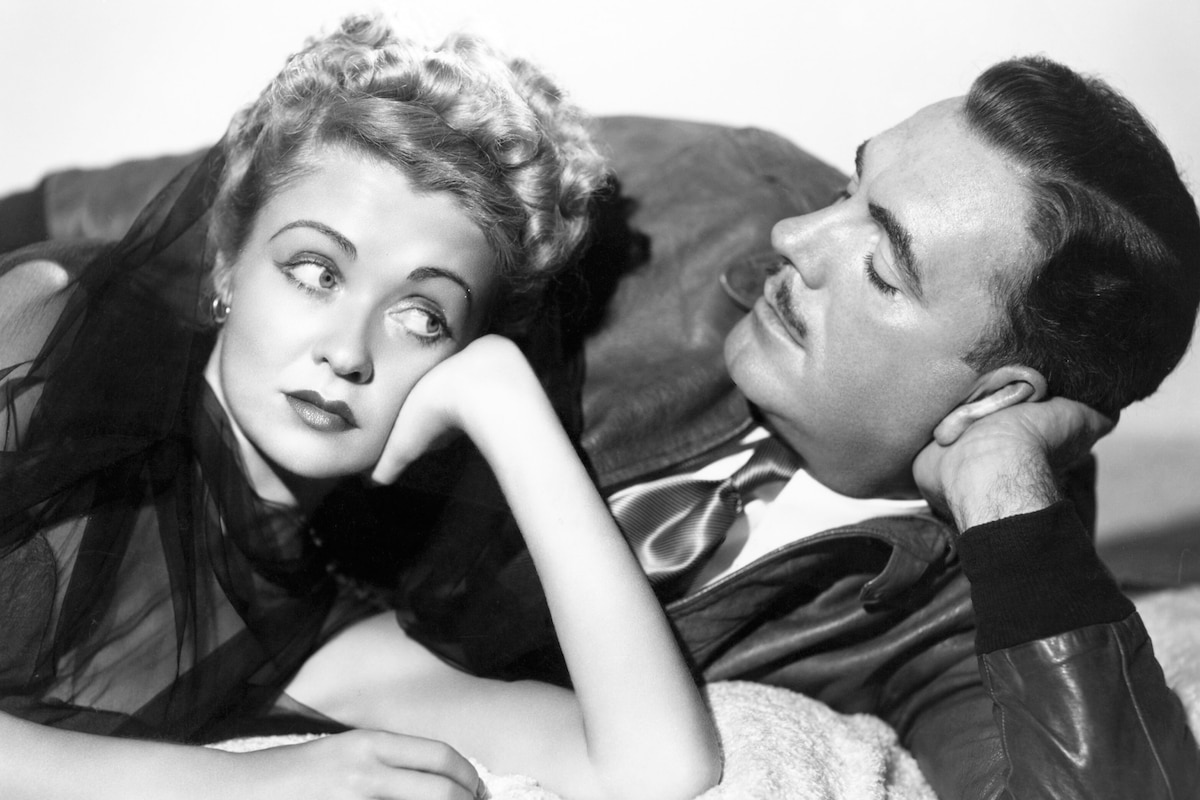
Contemporary appreciation of the 1940 Columbia thriller Escape to Glory tends to place it within a style of narrative presumed to originate with Grand Hotel (1932), one in which a sprawling cast of characters from diverse backgrounds and backstories find themselves enclosed within a single location where their respective storylines converge. In the case of Escape to Glory, the characters are a motley bunch indeed: an American army pilot (Pat O'Brien), a corrupt district attorney (John Halliday) and his secretary (Constance Bennett), a killer on the D.A.'s trail (Alan Baxter) and a German doctor of uncertain loyalty (Erwin Kalser). It is 1939, and they are traveling aboard a British freighter when war is declared on Germany. It is not long before they cross paths with a German U-boat, presenting a crisis that puts each character to the test.
The film is an action picture above all else - the arrival of the German submarine portends an explosive confrontation between the two vessels, with a deluge of special effects to assist. The story was written, at least in part, by Fredric M. Frank, who authored the screenplays to many of Cecil B. DeMille's most spectacularly outlandish productions. The just-over-an-hour runtime all but ensures that action takes precedence over the human drama; it is a far cry from Alfred Hitchcock's handling of at-sea tensions in Lifeboat (1944), a more authentic chamber drama that prioritized character over action and aimed for a certain level of sophistication and prestige.
This is not to say, however, that the drama in Escape to Glory is altogether disposable. The characters embody many appealing archetypes of 1930s Hollywood, with O'Brien doing his boozehound act and Halliday and Baxter cycling through a number of gangster movie tropes. In fact, it is when the interpersonal friction is thickest (and when the rote action-movie conventions are in abeyance) that director John Brahm really shines.
Brahm is a relatively obscure figure in Hollywood history, best known for infusing optimum menace into two horror-thrillers starring Laird Cregar - The Lodger (1944) and Hangover Square (1945) - and for later directing 12 episodes of The Twilight Zone. While Escape to Glory is an early work, and far less accomplished than his later outings, it contains intimations of what was to come. For instance, it is commonly pointed out that "Judgment Night," one of his Twilight Zone entries, revives the shipboard claustrophobia approach with wartime drama that marks Escape to Glory. It is easy to speculate that the film's more inspired moments are Brahm's doing, while its sundry imperfections can be attributed to Columbia's unit-production formula for wartime programmers.
If Escape to Glory was early in Brahm's career, after which he would cut ties with Columbia and moved to a posher studio (Twentieth-Century Fox), it marked the beginning of Constance Bennett's decline as a star. Once one of Hollywood's highest-paid actresses, with high-end contracts with both MGM and RKO, Bennett was now relegated to less glamorous roles in lower-budget features. Still, as Pat O'Brien's love interest, she handles herself admirably, and as her stardom waned, she found ample work in radio and theater, and even found some success as a businesswoman with a cosmetic company to her name.
By Stuart Collier
Escape To Glory
by Stuart Collier | September 17, 2012
SIGN UP FOR OUR NEWSLETTERS

CONNECT WITH TCM