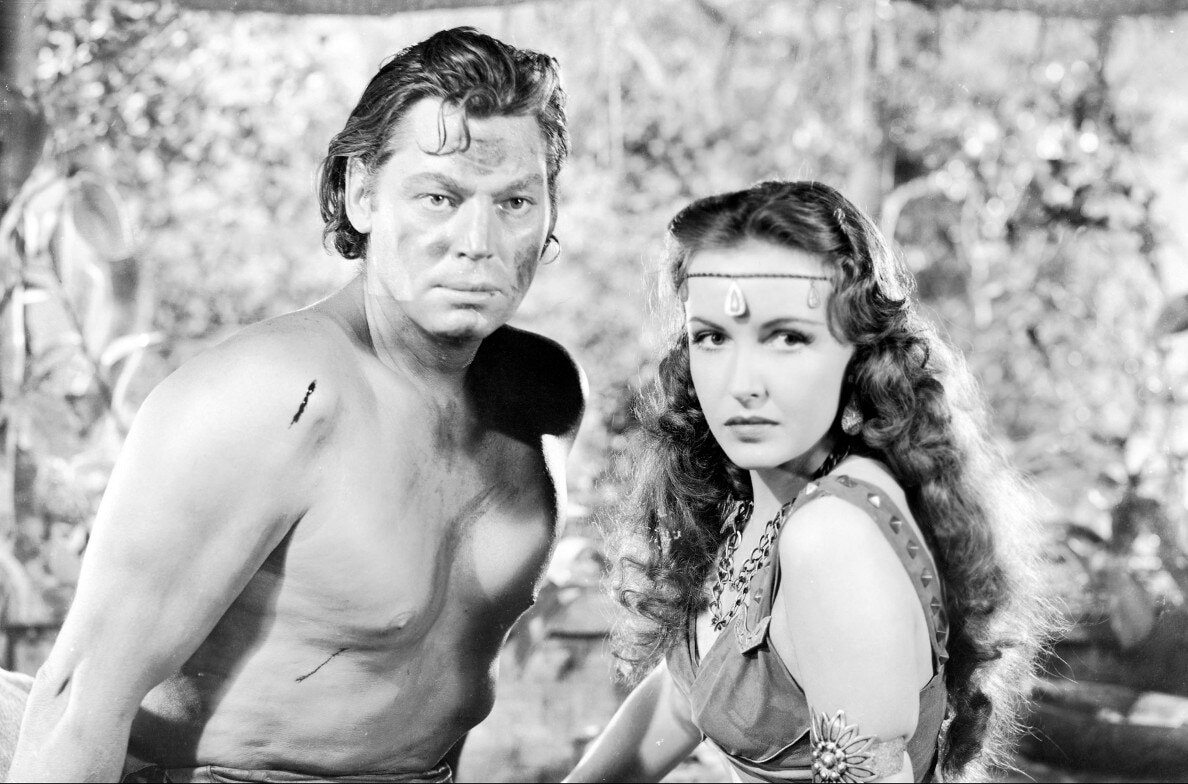
Tarzan Triumphs (1943) was the seventh film to star Johnny Weissmuller as Edgar Rice Burroughs' legendary ape man, and the first of that series to be produced by Sol Lesser at RKO Radio Pictures. The first six Weissmuller Tarzan pictures were produced at Metro-Goldwyn-Mayer at a careful pace (only one film every two or three years) and usually with a generous budget. Moving to RKO, the series picked up the pace, both in terms of frequency and in terms of action; Lesser may have worked with smaller budgets than those available at MGM, but he made up for it with a bigger display of onscreen excitement, more reminiscent of the action found in Saturday morning serials. Tarzan Triumphs was also the first film in the series to benefit from the presence of a type of villainy that Tarzan could combat without pulling any punches: Nazis.
MGM contract player Maureen O'Sullivan had played Tarzan' mate Jane throughout the previous entries in the series. Anxious to escape the role, she took the opportunity with the change of studio and turned down producer Lesser's offer to continue the part. Early in Tarzan Triumphs, Boy (Johnny Sheffield) reads a letter to Tarzan (Johnny Weissmuller) from the unseen Jane, explaining that she was in London visiting her sick mother; Jane also mentions the threat of the Nazi bombing raids. The Nazi menace arrives in Tarzan's jungle when paratroopers invade the hidden city of Palandrya. One soldier, Lt. Schmidt (Rex Williams), drifts off course and is rescued by Tarzan from the jaws of a crocodile. The injured Schmidt tries to set up radio communications with his superiors, but Cheetah the chimp steals one of the vital radio components. The Nazis that have landed in Palandrya, led by Colonel Von Reichart (Stanley Ridges), bully princess Zandra (Frances Gifford) and kill her brother; they take control and plan to gather raw material for the Nazi war machine from the local natural resources. Zandra flees from Von Reichart when he makes oily advances on her, and is saved by Tarzan during her escape. Zandra pleads with Tarzan to help her people rid themselves of the Nazi menace, but the Lord of the Jungle is reluctant to get involved; reluctant, that is, until the dastardly invaders kidnap Boy.
Sol Lesser was a theater owner in the earliest years of motion pictures, and became a producer in 1915 when he shot some documentary footage of the dismantling of the notorious Barbary Coast district in San Francisco. Eventually, Lesser owned a large chain of theaters but gave up the exhibition side of the business to become a full-time independent producer, mostly turning out low budget westerns. In the early 1930s, as the first Weissmuller film was about to go before the cameras, Lesser announced plans to shoot his own Tarzan film. He had recently acquired a 1928 option on the property that Burroughs had signed. It was all perfectly legal, although MGM persuaded Lesser to hold off on his production until after their first film had been released. Lesser had a 5-picture option and MGM eventually bought out his interest in three of them. The two Tarzan pictures that Lesser did produce in the period were Tarzan the Fearless (1933) with Weissmuller's friend and fellow Olympic swimming champion Buster Crabbe, and The New Adventures of Tarzan (1935) with Herman Brix (later known as Bruce Bennett). Both of these independently-shot films were made on much lower budgets than those of the MGM series, and Metro additionally used their clout to keep the movies from playing in anything but the lowest-rung theater circuits.
In his book Tarzan At the Movies (Citadel Press, 1968) author Gabe Essoe reported that MGM let the Tarzan franchise go following Tarzan's New York Adventure (1942) because "World War II had cost the studios a good chunk of their lucrative foreign markets, which meant at least fifty percent of the Apeman's grosses." Having dropped the Burroughs character, MGM also opted out of renewing their contract with Johnny Weissmuller. Sol Lesser, who had joined RKO in 1941 as a feature production executive, was keeping an eye on the Tarzan franchise and gladly snapped up both the property and the actor. Essoe also writes, "During the early stages of production on Tarzan Triumphs, producer Lesser was contacted by the State Department, which considered Tarzan an important propaganda weapon. They were most eager to have films show that democracy will be victor only if it is alive and active, not complacently inert in its corner of the world." The writing and playing of Tarzan-as-allegory could not have been much more obvious in the final film. Initially Tarzan is a staunch isolationist: when the Nazi threat is presented to him by Zandra, Tarzan merely opines, "Nazi go away." Zandra replies, "You don't know them. Once they conquer us, they will spoil everything you stand for." When the Nazi menace hits home as Boy is abducted, Tarzan loses all complacency and becomes an active Nazi-smasher. His memorable line, "Now Tarzan make war!" was, by all accounts, met with cheers in crowded wartime movie theaters. The final on-screen Nazi death count in Tarzan Triumphs is 14 - probably a record for the franchise. Nazis die in a number of ways: being pushed off a cliff by an elephant, eaten by piranha, thrown off a cliff by Tarzan, a knife to the chest, eaten alive by a lion, and more. Even Boy and Cheetah get into the act and knock off a few!
Critical reaction to Tarzan Triumphs was generally positive. The reviewer for Variety wrote that the "picture does not stack up against the first two or three Metro produced, but tops later films in the series. Tarzan Triumphs will please grown-ups as well as juve[nile]s, provides bangup entertainment for action fans and is [a] graphic illustration of what careful budget production helming can do with a budgeted picture. More action than usual distinguishes latter portion of [the] film, Tarzan's declaring war on Nazis who have kidnapped his son resulting in movement of serial proportions." The Hollywood Reporter also had praise for the film: "The script and its excellent direction by William Thiele mixes enough plausible incident to balance the more extravagant flights of pure fancy... Weissmuller's work is marked with practiced vigor."
Immediately following Tarzan Triumphs, Sol Lesser produced the morale-boosting wartime revue Stage Door Canteen (1943) at United Artists. Many celebrities pitched in and played themselves in the film, including George Raft, Katharine Hepburn, Helen Hayes, Ray Bolger, Paul Muni and many others. Lesser made sure to include Weissmuller too, in a scene in which Johnny washes dishes in the canteen with Franklin Pangborn (when Weissmuller takes off his shirt due to the heat, Pangborn is inspired to try out the Tarzan yell!) The following Tarzan film in the Lesser-RKO-Weissmuller series was another bout with Nazis, Tarzan's Desert Mystery (1943), and aside from a few documentaries, Lesser would go on to produce Tarzan films almost exclusively for the next fifteen years.
Producer: Sol Lesser
Director: William Thiele
Screenplay: Carroll Young (story and screenplay); Roy Chanslor (screenplay); Edgar Rice Burroughs (characters)
Cinematography: Harry Wild
Art Direction: Hans Peters
Music: Paul Sawtell
Cast: Johnny Weissmuller (Tarzan), Johnny Sheffield (Boy), Frances Gifford (Zandra), Stanley Ridges (Colonel Von Reichart), Sig Ruman (Sergeant), Philip Van Zandt (Captain Bausch), Rex Williams (Lt. Reinhardt Schmidt), Pedro de Cordoba (Oman)
BW-77m.
by John M. Miller
Tarzan Triumphs
by John M. Miller | May 09, 2012
SIGN UP FOR OUR NEWSLETTERS

CONNECT WITH TCM