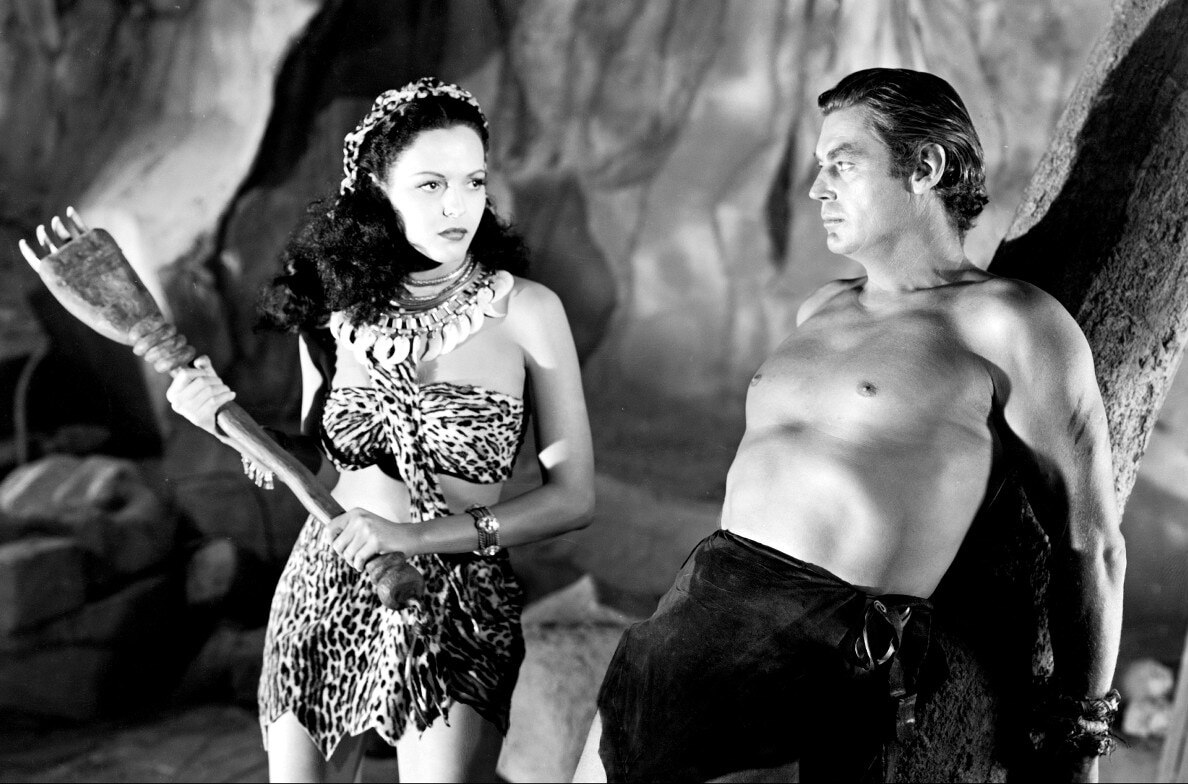
Johnny Weissmuller was 41 when he filmed his tenth Tarzan picture, Tarzan and the Leopard Woman (1946). Thanks to a concerted effort he had recently made to get his body back into good physical condition -- following some saggy appearances in recent Tarzan entries -- he was in his best shape in years. In one scene, he even wrestles and heaves high into the air a 200-pound character named "Tongolo the Terrible" (played, incidentally, by an actual wrestler known as "King Kong Kashey").
The story has Tarzan battling a cult of jungle men who worship a leopard god and are led by the High Priestess Lea (Acquanetta). The men dress in leopard skins and claw their victims to death before cutting out their hearts. Eventually, Tarzan, Jane (Brenda Joyce) and Boy (Johnny Sheffield) are all captured, and it's up to Cheeta to start saving the day.
This was Brenda Joyce's second turn as Jane following two entries in which Jane was not even present, as Maureen O'Sullivan had left the role following Tarzan's New York Adventure (1942). Johnny Sheffield, in his seventh film as Boy, had his first significant fight scenes here, saving Jane from having her heart cut out by the deadly Kimba, High Priestess Lea's younger brother.
Tarzan and the Leopard Woman made money, and the series continued. But while it stands today as a satisfying, action-packed entry in the series, critics of the time were dismissive, with The New York Times declaring the "one thing which apparently has the ape man stumped [is] how to find an author who will write him into a really lively adventure." Variety thought Tarzan and Weissmuller were both getting too old and too stale, and complained that "the film is bogged down by stock situations and unimaginative production and direction... Leopard men's dances, staged by Lester Horton, resemble a high school gym class warming up... Acting honors, if there are any, go to little Cheeta."
The Los Angeles Times made special mention of the Leopard Woman herself: "The head push of this movie is a vicious star named Acquanetta. If Tarzan is the lord of the jungle, Acquanetta is most definitely the lady. This is a star in the making." In fact, Acquanetta had been a "star in the making" for a few years, but she was already growing disillusioned with Hollywood and after this film would take a five-year hiatus from the screen.
Acquanetta was one of several "exotic," foreign-looking actresses whom Hollywood tried to make into stars in the 1940s, but she never reached the level of Carmen Miranda or Maria Montez. Born on an Indian reservation in Cheyenne, Wyo., as Burnu Acquanetta, which means "Burning Fire, Deep Water," her mother was an Arapaho Indian and her father was of French and English descent. Given up for adoption, she was raised in Norristown, Penn., by a new family who renamed her Mildred Davenport. At 16, she became a fashion model in New York, and a few years later she took a trip to Hollywood just for fun; she was quickly discovered by a talent scout and the next thing she knew she had signed with Universal and was being promoted as "the Venezuelan Volcano" in such films as Arabian Nights (1942), Rhythm of the Islands (1943) and Captive Wild Woman (1943). The Universal publicity machine played up her exotic looks by dropping her first name and telling the press she slept in a teepee and other such nonsense. Tarzan and the Leopard Woman was her most notable picture, but her film career would soon sputter out as she lost interest in the roles being offered to her. Eventually she married a car salesman in Phoenix and settled there to raise a family.
Following Tarzan and the Leopard Woman, Weissmuller would make Swamp Fire (1946), opposite Buster Crabbe. "I took one look at that picture and went back to the jungle!" Weissmuller later said. Indeed, after Swamp Fire he starred in two more Tarzan pictures and then began a new franchise, playing "Jungle Jim" for virtually the rest of his career.
The studio pressbook for this film notes that Tarzan is required to deliver 30 lines of dialogue, "setting an all-time record" for a Tarzan movie. Look for Dennis Hoey in the role of the commissioner -- a comic part quite similar to that of his Inspector Lestrade in the Sherlock Holmes films of the same period.
Producer: Sol Lesser
Director: Kurt Neumann
Screenplay: Carroll Young (story and screenplay); Edgar Rice Burroughs (characters)
Cinematography: Karl Struss
Art Direction: Lewis Creber
Music: Paul Sawtell
Film Editing: Robert O. Crandall
Cast: Johnny Weissmuller (Tarzan), Brenda Joyce (Jane), Johnny Sheffield (Boy), Acquanetta (Lea, the High Priestess), Edgar Barrier (Dr. Ameer Lazar), Dennis Hoey (Commissioner), Tommy Cook (Kimba), Anthony Caruso (Mongo).
BW-73m. Closed Captioning.
by Jeremy Arnold
Sources:
David Fury, Johnny Weissmuller: Twice the Hero
David Fury, Kings of the Jungle: An Illustrated Reference to "Tarzan" on Screen and Television
Howard Mutti-Mewse, obituary of Acquanetta in the U.K. Independent, 8/19/04
Tarzan and the Leopard Woman
by Jeremy Arnold | June 25, 2012
SIGN UP FOR OUR NEWSLETTERS

CONNECT WITH TCM