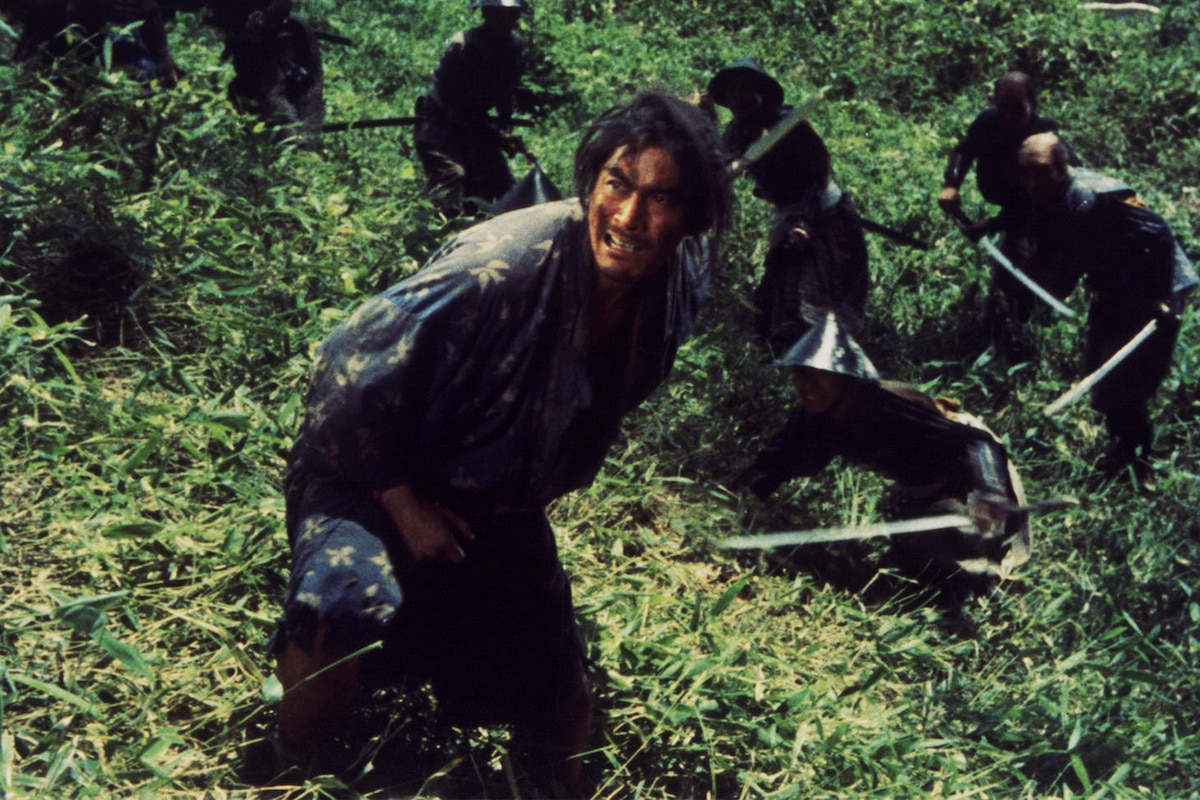
In Samurai II: Duel at Ichijoji Temple (1955), Musashi Miyamoto fights against the fearsome Baiken, a master of the weapon known as the kusarigama, or chain-sickle, but the wise priest Nikkan spurs him to further introspection and development. He also spends time under the mentorship of the sword smith Koetsu Honami. Otsu and Akemi continue to pursue him fruitlessly and a third woman, the courtesan Lady Yoshino, falls in love with him, but he resolves to pursue his goal of taking on the Yoshioka school of swordsmanship. A brilliant young swordsman named Kojiro Sasaki is awed by Musashi's skills and vows to duel him in the future.
Whereas much of Samurai I was shot out doors, Samurai II relied mainly on studio sets. The critic and film historian Stuart Galbraith IV notes that it also has relatively subdued color compared to Parts I and III. Galbraith especially admires the opening duel with Baiken but also singles out the lyrical treatment of Musashi's duel with Denshichiro.
The feline actor Koji Tsuruta, who becomes the chief foil against Toshiro Mifune in this and the next film, Samurai III: Duel at Ganryu Island (1956), was a popular star with Toho Studios and later Toei, specializing in crime thrillers during the 1960s. Michiyo Kogure, who plays Lady Yoshino, appeared in a number of major Japanese films during the 1940s and 1950s, including Yasujiro Ozu's The Flavor of Green Tea Over Rice (1952) and Kenji Mizoguchi's Street of Shame (1956). Eijiro Tono, who plays Baiken, was a versatile actor who played in over two hundred roles in his lifetime, working with directors such as Yasujiro Ozu, Akira Kurosawa, Shohei Imamura and Masahiro Shinoda and playing in swordplay (chambara) films, comedies and dramas. While Samurai II continued the success of Samurai I in Japan, becoming one of the year's most popular films, it was not released in the US until 1967.
Producer: Kazuo Takimura
Direction: Hiroshi Inagaki
Script: Tokuhei Wakao and Hiroshi Inagaki, based on Hideji Hojo's adaptation of the novel Musashi Miyamoto by Eiji Yoshikawa
Director of Photography: Jun Yasumoto
Lighting: Shigeru Mori
Art Direction: Makoto Sono, Kisaku Ito
Music: Ikuma Dan
Cast: Toshiro Mifune (Musashi Miyamoto), Akihiko Hirata (Seijuro Yoshioka), Ko Mihashi (Koetsu Honami), Koji Tsuruta (Kojiro Sasaki), Daisuke Kato (Toji Gion), Kokuten Kodo (Priest Nikkan), Kaoru Yachigusa (Otsu); Kuroemon Onoe (Takuan), Eiko Miyoshi (Osugi), Mariko Okada (Akemi), Sachio Sakai (Honiden Matahachi), Eijiro Tono (Baiken Shishido), Michiyo Kogure (Lady Yoshino), Yu Fujiki (Denshichiro Yoshioka), Kenjin Iida (Jotaro), Mitsuko Mito (Oko), Machiko Kitagawa (Kogure).
C-104m.
by James Steffen
Sources:
Galbraith, Stuart IV. The Emperor and the Wolf: The Lives and Films of Akira Kurosawa and Toshiro Mifune. London: Faber and Faber, 2001.
Samurai II: Duel at Ichiioji Temple
by James Steffen | May 08, 2012
SIGN UP FOR OUR NEWSLETTERS

CONNECT WITH TCM