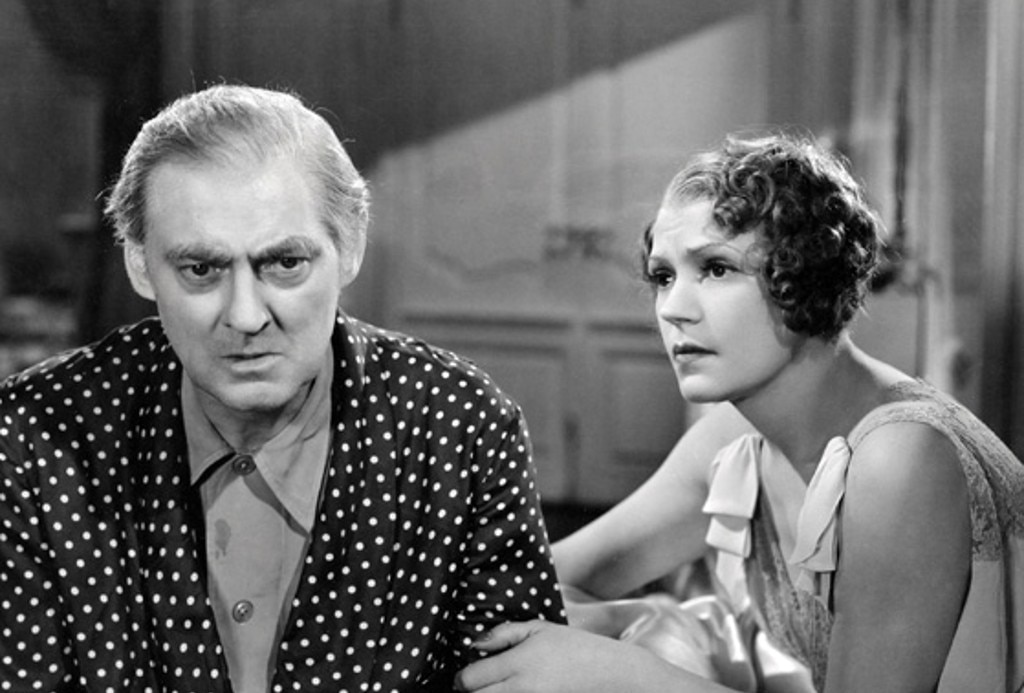
A roundelay about love in which everyone is attracted to the wrong person, the witty, delightful screwball comedy Should Ladies Behave (1933) centers on a May-December marriage between a grumpy older man Augustus Merrick (Lionel Barrymore) and his flighty younger wife Laura (Alice Brady). Bored with her marriage, Laura longs to rekindle a long-ago romance with the painter Max Lawrence (Conway Tearle) whom her divorcee sister Winifred Lamont (Katharine Alexander) has invited to the Merrick's country home. When Laura discovers that Max only has eyes for her coed daughter Leone (played by 20-year-old Mary Carlisle), all hell breaks loose.
Setting the stage for her seduction by an older man, the Merricks' beloved, sheltered daughter Leone has grown tired of her judgmental, immature college boyfriend Geoffrey Cole (William Janney) who says Leone needs to become more "experienced" and shed her innocent demeanor in order to become a good mate. When the suave, worldly Max comes along, Leone is utterly smitten, despite the fact that her father Augustus knows a rat when he sees one.
Unbeknownst to all of the Merricks is the fact that Max is a professional roué, with a habit of romancing married women. His latest conquest is Laura's own sister "Aunt Winne," who hasn't yet let on that she is involved with Max. When, after a very brief romance, Max and Leone decide to run off together to be married, the entire family, including Geoffrey -- who has shown up at the country estate to see Leone -- conspire to keep the couple from uniting.
In the less showy role amidst a cast of women, consummate actor Lionel Barrymore performs the marvelous feat of drawing the audience's attention for the simple fact of his rich, detailed characterization of a grumpy father and husband who adores his daughter but has grown tired of his meddlesome wife. Surrounded by the pretenses and machinations of his family, Augustus bristles at every word from his wife and sister-in-law's lips. He sees Leone as a woman as yet unsullied by such pretense, a still-innocent girl. Some of his churlishness seems the result of having long ago married a beautiful young girl like his own daughter -- Laura -- whose frustration with her boring life in remote Connecticut has turned her into a silly, frivolous woman. Augustus clearly hopes to prevent his daughter from making the same mistake. And yet, despite his general unpleasantness, Barrymore manages to make Augustus exceedingly likable.
Most famous for another unrepentant killjoy - Mr. Potter in Frank Capra's It's a Wonderful Life (1946) - Barrymore excelled at playing snarling curmudgeons including Scrooge from Charles Dickens' A Christmas Carol each year on the radio. Barrymore started his film career in 1911 with D.W. Griffith and would go on to star in many notable films of the classic Hollywood era including Grand Hotel (1932), Dinner at Eight (1933), Treasure Island (1934) and David Copperfield (1935). The great uncle of actress Drew Barrymore, Lionel was Hollywood royalty, a highly talented actor, music composer, writer, painter and director who excelled onscreen but also on the stage. He won an Academy Award for his performance in the Pre-Code film A Free Soul (1931) as an alcoholic lawyer who defends a gangster (Clark Gable) accused of murder. In the previous year he had been nominated for a Best Director Academy Award for Madame X (1929).
Part of the famous Barrymore acting clan, which included his sister Ethel and brother John, the Barrymore siblings only appeared in one film together, Rasputin and the Empress (1932).
Despite a 61 year movie career Barrymore didn't initially seem destined for the limelight. When Barrymore was six his parents were touring and put him into a last minute role to replace a sick child. Instead of delivering his lines, Barrymore cried. His parents decided to keep him out of showbiz until Lionel reached his teens.
Barrymore was so admired as an actor, that even after arthritis and a hip injury confined him to a wheelchair in 1938, he continued to act, with writers and directors happy to write a disability into his roles.
Beloved by his peers, Barrymore proved his popularity with audiences too. The New York Times reported that 2,000 fans attended Barrymore's 1954 burial at Los Angeles' Calvary Cemetery.
Producer: Lawrence Weingarten
Director: Harry Beaumont
Screenplay: Bella Spewack, Sam Spewack (writers); Paul Osborn (play)
Cinematography: Ted Tetzlaff
Art Direction: Fredric Hope, Harry McAfee
Music: William Axt (uncredited)
Film Editing: Hugh Wynn
Cast: Lionel Barrymore (Augustus Merrick), Alice Brady (Laura Merrick), Conway Tearle (Max Lawrence), Katharine Alexander (Mrs. Winifred Lamont), Mary Carlisle (Leone Merrick), William Janney (Geoffrey Cole), Halliwell Hobbes (Louis).
BW-88m.
by Felicia Feaster
Should Ladies Behave?
by Felicia Feaster | May 08, 2012
SIGN UP FOR OUR NEWSLETTERS

CONNECT WITH TCM