In 1933, Kay Francis was well on her way toward the peak of her stardom and popularity. She had just starred in two of the most profitable films of 1932, Trouble in Paradise and One Way Passage, had a $4000-per-week salary from Warner Brothers, and was a constant presence in fan magazines. While Francis is not as well remembered today as other stars of that era, her impact on 1930s American culture and on the huge popularity of the woman's film genre was important and significant.
As Jeanine Basinger wrote in her book on the genre, A Woman's View, "When one thinks of fashion and glamour, Kay Francis should be the standard by which everything else is measured. Sitting on-screen, as she does at the end of The House on 56th Street (1933), wearing a stark evening gown and dealing blackjack with a grace and style that have long since disappeared from American movies, she is the absolute personification of what fashion and glamour meant to the woman's film of the 1930s." (And as Variety tersely put it in its review: "Women will like it.")
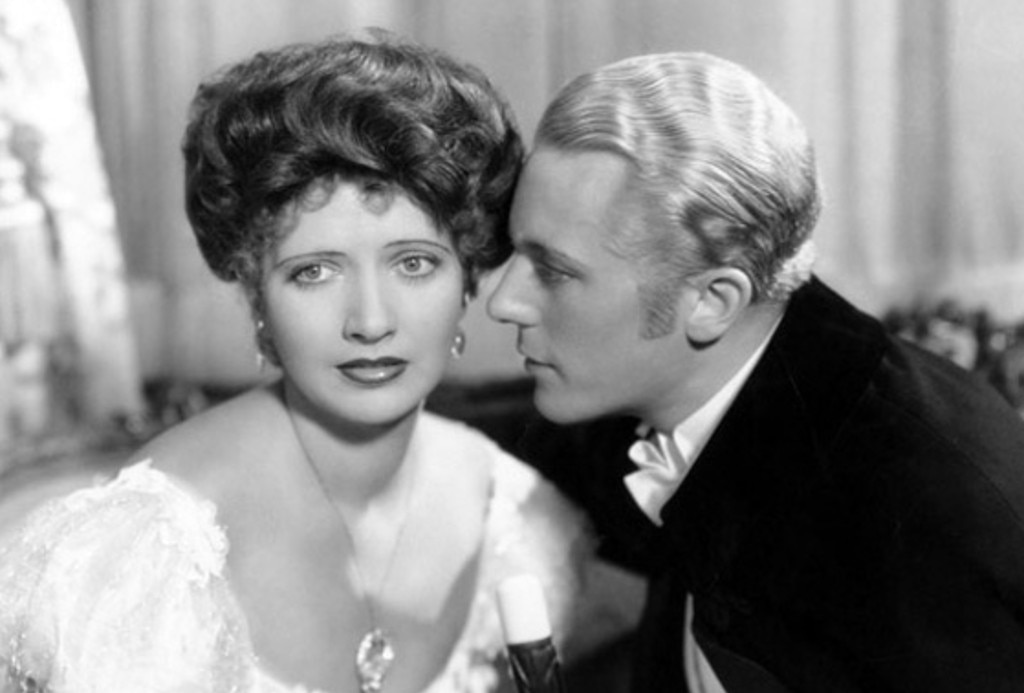
It's no accident that the film's title puts the house front and center. Like Rebecca (1940), The Enchanted Cottage (1945), Enchantment (1948) and other movies, The House on 56th Street features a house not only as a character in the story but as a metaphor for, and reflection of, its principal character. Kay Francis (who took the role after Ruth Chatterton turned it down) plays a 1905 chorus girl who marries a rich gentleman (Gene Raymond) much to the consternation of his family, who deem her unsuitable. But she wins them all over, transforming herself into a society woman, and she and Raymond move into the beautiful house of the title, which he promises will be hers forever. Since this is a melodrama, a crazy turn of events soon lands Francis in prison for 20 years, and when she is released in the middle of the jazz age -- with no husband, no house, and no connection to a daughter (Margaret Lindsay) who has grown up without her -- she must start from scratch. She falls in with a gambler (Ricardo Cortez), transforms herself yet again into a modern fashion queen, and amazingly finds herself back at the house on 56th Street... but in a new, far different way than before. And all along, the look and condition of that house have also changed over and over again.
Basinger argues that the house in a woman's film is often used to define the woman's world, and this picture is no different -- in fact it is more powerful than most in that the "definition" keeps changing during the story: "The house...is at first Kay Francis's dream, then her nightmare and trap, and then her solace. It represents every step of her career in terms of society's approval."
For director Robert Florey, The House on 56th Street was his favorite among the films he directed at Warner Bros. in the 1930s. (He moved to Paramount in 1935.) Florey was especially keen about recreating the New York of 1905 in the first part of the film, which he said was based on the lives of the Florodora Sextette, the chorus girls in the famous Broadway musical Florodora. While Warners gave this picture a big budget and approved the creation of intricate costumes and decor, Florey's zest for detail did lead to a clash with production chief Hal Wallis, who told the director in a memo, "Let's not overdo the wardrobe just because we are in a period." According to author Brian Taves, this penchant for accuracy, which the studio saw as wasteful spending, would keep Florey from being assigned to many more period films.
Florey remains an underrated director from the era, and throughout The House on 56th Street he employs intelligent and imaginative use of sound and montage to create heightened emotional impact, especially in sequences like Francis's release from prison -- in which she sees the new, modern New York City and is flabbergasted at the difference from 1905 -- and a honeymoon montage that's brief yet highly evocative of each place that's visited. The entire film packs more narrative into its brief running time than anyone should have a right to expect.
The House on 56th Street was shot in 28 days in the summer of 1933. Audience ovations at previews persuaded the studio to hold release until the lucrative Christmas season, and it opened that December, indeed becoming a sizable hit.
Many believe this touching, poignant film contains Kay Francis's finest performance. She certainly is called upon to portray a huge range of emotions -- and of course ages, since the story spans 25 years. Francis herself quipped at the time, "If it does better than my other films, it's because I parade thirty-six costumes instead of sixteen."
Director: Robert Florey
Screenplay: Austin Parker, Sheridan Gibney (screenplay); Joseph Santley (story)
Cinematography: Ernest Haller
Art Direction: Esdras Hartley
Music: Bernhard Kaun (uncredited)
Film Editing: Howard Bretherton
Cast: Kay Francis (Peggy Martin Van Tyle/Peggy Stone), Ricardo Cortez (Bill Blaine), Gene Raymond (Monty Van Tyle), John Halliday (Lyndon Fiske), Margaret Lindsay (Eleanor Van Tyle Burgess), Frank McHugh (Chester Hunt), William Boyd (Mr. Bonelli), Hardie Albright (Henry Burgess), Sheila Terry (Dolly, a Sextet Girl), Phillip Reed (Freddy).
BW-69m. Closed Captioning.
by Jeremy Arnold
Sources:
Jeanine Basinger, A Woman's View: How Hollywood Spoke to Women 1930-1960
Scott O'Brien, Kay Francis: I Can't Wait to be Forgotten -- Her Life on Film and Stage
Lawrence J. Quirk, The Great Romantic Films
Brian Taves, Robert Florey, The French Expressionist
The House on 56th Street
by Jeremy Arnold | May 07, 2012
SIGN UP FOR OUR NEWSLETTERS

CONNECT WITH TCM