Although the United States in the late 1930s was officially outside the conflicts then heating up in Europe and Asia, drums had already begun beating in Hollywood against Nazi Germany. Of all the studios, the socially conscious Warner Bros. led the pack, coming out with what is considered the first anti-Nazi feature, Confessions of a Nazi Spy, in April 1939, more than four months before Hitler's invasion of Poland officially started World War II. The Edward G. Robinson film was a significant hit, so the studio decided to follow it up with more propaganda pictures. Three weeks before Warners released Espionage Agent (1939), France and Great Britain declared war on Germany, making the picture particularly timely.
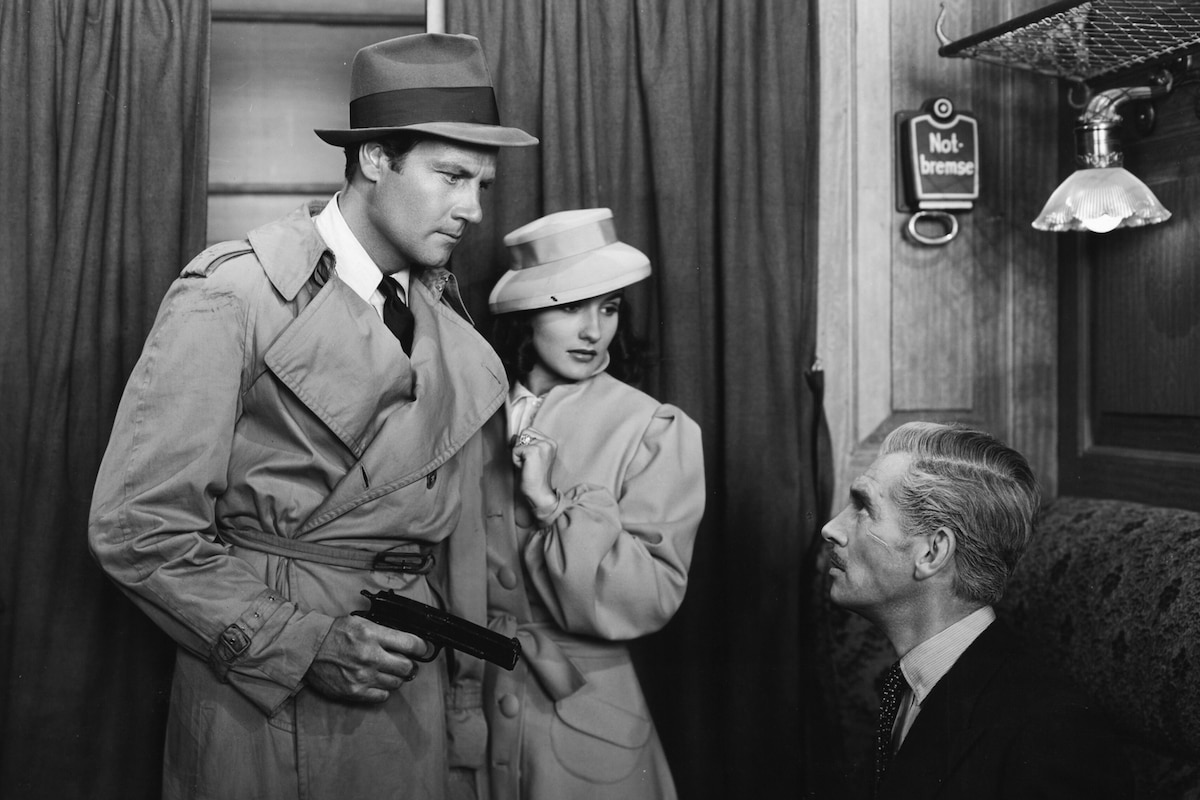
Joel McCrea plays the scion of a family of career diplomats, an attaché at the U.S. consulate in Tangiers. There he meets Brenda Marshall, an American desperate to flee war-torn North Africa with a forged passport obtained in exchange for spy services on behalf of Germany. The two fall in love, but her past forces him to resign from foreign service. The two then work together to expose a vast espionage ring working within the States.
Warners took a bold step in making Espionage Agent as well as the earlier Robinson piece. Most studios at the time, still dependent on lucrative foreign markets, didn't want to alienate other governments and risk having their pictures banned. The film was released one day after President Franklin Roosevelt signed the Neutrality Act of 1939, a bill he pushed through Congress, against isolationist wishes, that maintained official neutrality while allowing for the "cash and carry" sale of munitions to countries fighting against the Axis powers. Anticipating this move and recognizing the importance of American manufacturing to the war effort, the screenwriters (among them novelist James Hilton, who contributed additional dialogue uncredited) had the Nazi spy ring working to disable the industrial capabilities of the U.S. (a theme that would be taken up again in Alfred Hitchcock's Saboteur (1942), after America's entry into the war).
The working title of Espionage Agent was the far less provocative and exciting "Career Man." This was Brenda Marshall's first credited screen role. She had a promising start at Warners with roles opposite Errol Flynn in The Sea Hawk (1940), John Garfield in East of the River (1940), and James Cagney in Captains of the Clouds (1942). She married William Holden in 1941 and made only a handful of pictures before retiring in 1950.
Future TV Superman George Reeves has a small uncredited part as secretary to Lowell Warrington, played by Jeffrey Lynn.
Less than a year after the release of Espionage Agent, Joel McCrea would be fighting enemy agents on screen once again as the star of Alfred Hitchcock's wartime thriller Foreign Correspondent (1940).
Espionage Agent was shot by the innovative and much respected Charles Rosher, winner (shared with Karl Struss) of the first Academy Award for cinematography for F.W. Murnau's beautiful silent classic Sunrise (1927). Rosher would win another Oscar® several years later for The Yearling (1946). His first film was Life of Villa (1912), a documentary about the Mexican revolutionary Pancho Villa. One story that circulated around Hollywood at the time was that Villa insisted Rosher film the funeral of a friend. The service lasted three days, and although Rosher had run out of film a half day into it, according to the story, he pretended to keep filming for fear of being shot.
Director: Lloyd Bacon
Producer: Hal B. Wallis
Screenplay: Warren Duff, Michael Fessier, Frank Donoghue; story by Robert Buckner
Cinematography: Charles Rosher
Editing: Ralph Dawson
Art Direction: Carl Jules Weyl
Original Music: Adolph Deutsch
Cast: Joel McCrea (Barry Corvall), Brenda Marshall (Brenda Ballard), Jeffrey Lynn (Lowell Warrington), George Bancroft (Dudley Garrett), Stanley Ridges (Hamilton Peyton).
BW-84m. Closed Captioning.
by Rob Nixon
Espionage Agent
by Rob Nixon | March 14, 2012
SIGN UP FOR OUR NEWSLETTERS

CONNECT WITH TCM