In the dark semi-explored jungles - urban,
industrial, suburban and otherwise - of film noir,
a great many films still remain forgotten and
overlooked, and the more of these you see, as they
trip out onto video one by one or in packs, you
become increasingly aware that if someone thinks
they know noir because they've seen The Asphalt
Jungle, Out of the Past, Mildred
Pierce and maybe Pickup on South Street,
they don't actually know much at all. Noir is
famous for being a heavily codified, self-invented
genre, and equally famous for the coolness of those
codes - the femmes fatale, the Venetian blinds, the
fedoras, the handguns encountered in dark alleyways
or corridors - which have all been over-analyzed
and iconicized in both popular and academic
culture. Noir only existed properly for perhaps 16
years or so, from Double Indemnity (1944) to
Sam Fuller's Underworld U.S.A. (1961), but
in that span hundreds of films hooked into the
Zeitgeist, and many of them crossed into other
genres, pulsed with their idiosyncratic directors'
ideas, and generally explored the dark fields of
the genre in ways that didn't fit neatly into
"codes."
Mitchell Leisen's No Man of Her Own (1950) is
a prime example, a fiercely ambivalent and morally
fraught noir that cross vectors with the "woman's
film" melodrama with far more nerve and queasiness
than any Joan Crawford film of the day. Leisen
himself remains an underappreciated
journeyman-auteur whose lengthy career is filled
with genre films that mutate into stranger and more
affecting things: Death Takes a Holiday
(1934) is a romantic fantasy harboring a bitter
pagan pessimism, Easy Living (1937) is a
screwball with a salient capitalism critique at its
center, Remember the Night (1940) is a
Preston Sturges rom-com that turns the corner into
disarmingly grown-up pathos, and so on. Leisen's
Oscar-nominated hits, Hold Back the Dawn
(1941) and To Each His Own (1946) are Olivia
de Havilland melodramas remarkable for their
oddness and sincerity. Leisen had his fair share of
mediocrities, too, but No Man of Her Own is
a restless freak, beginning with Barbara Stanwyck's
portentous narration telling us that the perfect
suburb she lives in is indeed perfect "but not for
us," meaning her Thomas Wolfe-reading husband (John
Lund) and dozing child, suggesting a Brief
Encounter-style disrupted domesticity but then
coming clean with, as she says on the soundtrack,
"murder."
How exactly Stanwyck's weary Mom came to be haunted
by more than one cold corpse is something of a
crazy uber-noir story (adapted from a Cornell
Woolrich novel), beginning, shockingly, with a
40-something Stanwyck pregnant, penniless, and
sobbingly begging at the skid row apartment door of
the despicable louse (Lyle Bettger) who knocked her
up. Her name is different, too, but how exactly she
has a new identity thrust upon her is merely the
outrageous set-up; eventually, once Stanwyck
embraces her new life amid the nouveau riche with
her new bastard baby, Bettger comes crawling back
into the picture, and blackmail spawns far nastier
business.
Shades of Antonioni's The Passenger,
adopting a dead person's identity is fraught with
potential disaster, not to mention an existential
dilemma that metaphorically reaches out to the very
idea of marriage (particularly for a woman in the
mid-century) as well as a good deal of postwar
lostness and aimlessness. But Leisen's film has
more classically James M. Cain-ish things on its
mind. The twisted angst of the story is completely
founded on a dread of losing newfound affluence and
sanctuary - Stanwyck's very self-aware character
walks on eggshells for the whole film, this close
at all times to being disqualified from the
American Dream. Leisen, as always, hones in on the
emotionally ambivalent details. Lund, as the
brother of the dead man the family thinks Stanwyck
became pregnant by, is full of both suspicion and
ardor from the beginning, but as he himself admits
deep in, he doesn't care what Stanwyck's real name
is, or who fathered her child. Stanwyck resonates
in this tense situation, but never so much as when
she, strong-armed by Bettger into a shotgun wedding
service, decides silently to kill the bastard, and
subtly smiles and tears up in the same instant.
Look at Lund, too, returning to the car after
dumping the body, a complete future of haunted
guilt soaking his features. Everyone is alive to
the gravity of what's at stake - Bettger's the
villain, but nothing he does compares to what's
done to him. It's a heck of a narrative millstone
to tie around the pearl-adorned throat of the
film's romantic aspects, and that's the film's ace
in the hole. Like so many films before it, but more
acutely than, say, Otto Preminger's Fallen
Angel or Michael Curtiz's Mildred Pierce
(both from 1945), Leisen's semi-noir paints a deft
portrait of suburban paradise, only to lift the
carpets and examine the social stratum's bloody
costs and repressed anxiety. Even during the
finale, which typically pulls a few rabbits out of
a hat and absolves Stanwyck from any technical
culpability, the film is eloquently conflicted and
tellingly guilt-ridden.
For more information about No Man of Her
Own, visit Olive Films. To
order No Man of Her Own, go to
TCM
Shopping.
by Michael Atkinson
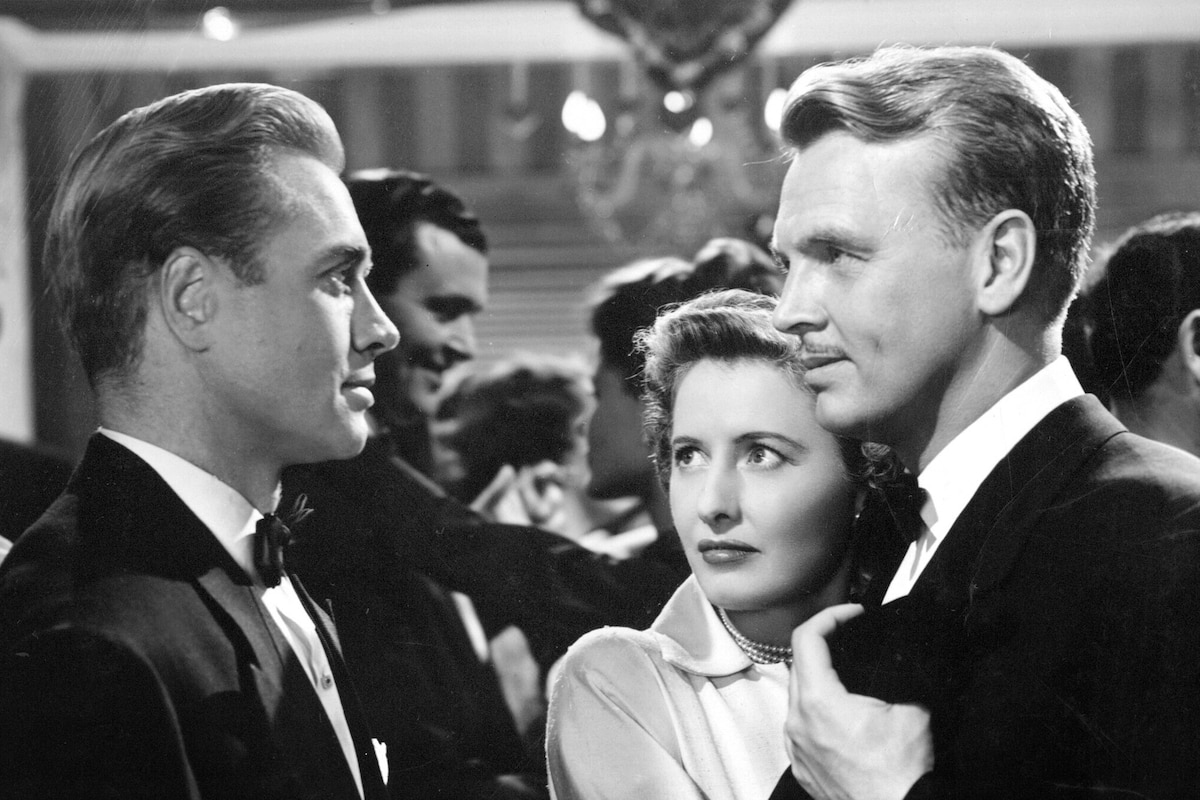
No Man of Her Own (1950) - Barbara Stanwyck in NO MAN OF HER OWN, Directed by Mitchell Leisen
by Michael Atkinson | March 13, 2012
SIGN UP FOR OUR NEWSLETTERS

CONNECT WITH TCM