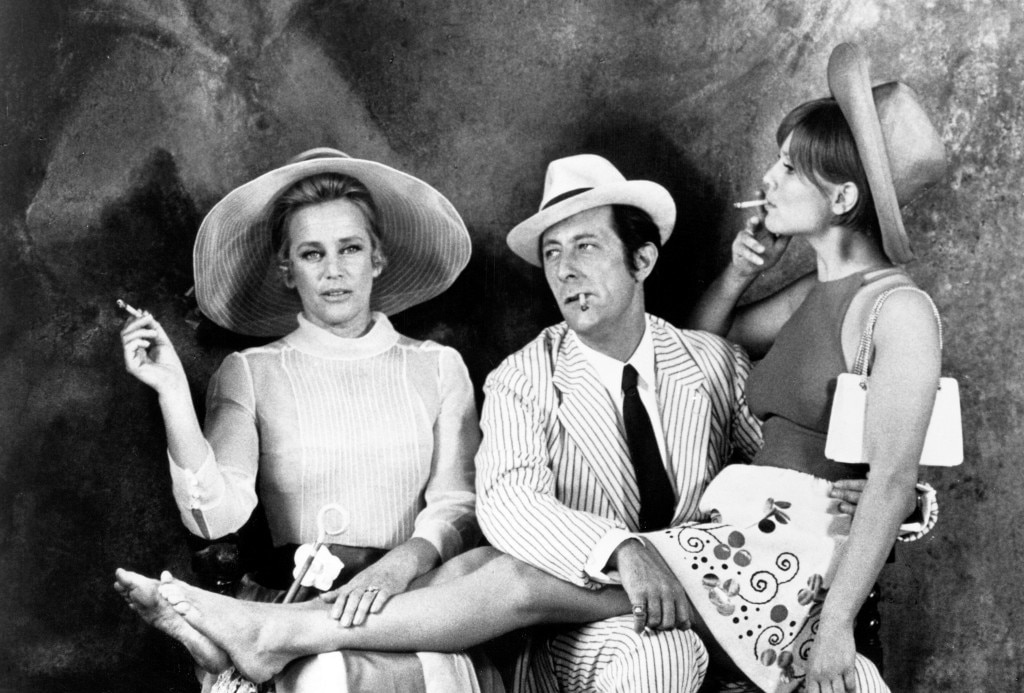
Philippe de Broca's 1969 confection The Devil by the Tail opens like a haunted house film. We walk through endless, cobweb-filled hallways and a labyrinth of staircases, until we emerge on... a leaky attic and floor covered in chamber pots collecting the drips. No, it's not that kind of old, dark house. In fact, it's not all that dark, just old and crumbling, in some scenes quite literally -- pieces of the ceiling frescoes of the grand dining room drop on the inn's sole guest. Count Georges (Jean Rochefort), the nominal manager of the family business, just shrugs it off and his daughter Amélie (Marthe Keller), her nose buried in a book as she runs a late night snack through the labyrinth, doesn't even notice. It's just another day of trying to run the crumbling 16th century chateau as a hotel, a pipe dream of the matriarch Marquise (Madeleine Renaud), who is trying to hold on to what is left of the family legacy.
Salvation arrives when the Marquise decides it's time to turn the place into a brothel, figuratively if not literally. She sends her granddaughter Amélie to sway the local gas jockey and mechanic (Xavier Gélin) to send them business any way he can (in other words, a little mechanical sabotage) while her daughter, the Countess Diane (Maria Schell), plays the seductive hostess for the new arrivals. Little do they realize that their newest guest, the dignified and well-mannered Baron César Maricorne (Yves Montand), is actually a crook on the lam with a small fortune in hand; he arrives with a valise, two assistants, and stories of his adventures as an esteemed government diplomat on missions of state. When the police set up roadblocks and search the grounds for their suspect, the Marquise proclaims it an opportunity to finance some renovations and plots their charming guest's untimely demise.
The Devil by the Tail, as you might by now guess, is a crime movie played out as a farce, with threadbare but fun-loving aristocrats shifting gears from jolly hoteliers selling the charms of their historical inn with "original furnishings" (in other words, second-hand junk) to energetic would-be assassins, planning elaborate schemes that could have been hatched in a Looney Tunes cartoon. Director Philippe de Broca built his career on such whimsical contrivances. Though he apprenticed directing short documentaries and assisting on some of the films that launched the Nouvelle Vague in France, notably Claude Chabrol's Le beau Serge (1958) and Les Cousins (1959) and François Truffaut's The 400 Blows (1959), he found his success directing colorful parodies of action and adventure films starring Jean-Paul Belmondo, such as Cartouche (1962) and That Man from Rio (1964), and made his international reputation for his affectionate anti-war farce King of Hearts (1966).
Such a string of popular hits brought him superb casts. Jean Rochefort, who plays the Count with an easygoing resignation to the disastrous state of the estate and the crazy schemes of his mother-in-law, was a veteran de Broca player whose talent for light comedy landed him roles in both knockabout comedies (The Tall Blond Man with One Black Shoe, 1972) and sly satires (The Phantom of Liberty, 1974) in a career going strong through the 21st century. Madeleine Renaud, who gives the Marquise a nonchalantly aristocratic and slightly daffy poise, was a veteran of the Comédie-Française and a French theater luminary who made her screen debut in the silent era and starred opposite Jean Gabin in numerous films throughout the 1930s. Maria Schell, who commits herself completely to her duties as the estate-inn's hostess, Countess Diane ("Every man is a husband to me," she smiles), was one of Germany's biggest post-war movie stars and an international star of stage and screen, with roles in such major American movies as The Brothers Karamazov (1958) and Cimarron (1960). And the Swiss-born Marthe Keller, in a supporting role as the flirtatious and sexually precocious young Baroness Amélie, was a rising star in 1969, and the young beauty went on to star in Marathon Man (1976) and Black Sunday (1977).
Yves Montand, however, is by far the biggest star of the cast: Singer, actor, heartthrob, and epitome of French charm and worldliness (even though he was Italian by birth). Montand was equally adept at drama (The Wages of Fear [1953], Z [1969]) and comedy (1960's Let's Make Love, starring opposite Marilyn Monroe) and, though he makes his appearance twenty minutes into The Devil by the Tail, he immediately dominates the production with his confidence, charm, and con-man command of every situation. Part of what makes him so attractive is that he never actively attempts to seduce the women of the house, yet they all fall for him as a matter of course. It doesn't stop their plans to murder him, but it does give them pause... right before they volunteer to be the next "distraction" in the plot. If there is one thing that is consistent throughout The Devil by the Tail, it is that they all find a way to enjoy their work.
Producers: Philippe de Broca, Alberto Grimaldi
Director: Philippe de Broca
Screenplay: Daniel Boulanger (scenario and dialogue); Claude Sautet (decoupage); Philippe de Broca (scenario, uncredited)
Cinematography: Jean Penzer
Music: Georges Delerue
Film Editing: Françoise Javet
Cast: Yves Montand (Le baron César Maricorne), Madeleine Renaud (La marquise), Maria Schell (La comtesse Diane), Jean Rochefort (Le comte Georges), Jean-Pierre Marielle (Jean-Jacques Leroy-Martin, le "play-boy"), Clotilde Joano (La comtesse Jeanne (La cousine pianiste)), Claude Piéplu (Monsieur Patin (Le client assidu)), Tanya Lopert (Cookie (La minette)), Marthe Keller (Amélie (La jeune baronne)), Xavier Gélin (Charlie (Le petit garagiste)).
C-95m.
by Sean Axmaker
The Devil By the Tail
by Sean Axmaker | February 02, 2012
SIGN UP FOR OUR NEWSLETTERS

CONNECT WITH TCM