Albert Brooks initially considered casting Bill Murray in the lead role in Lost in America
and experiencing what it would be like just to write and direct. According to Herb Nanas,
Brooks's manager and executive producer of the film, Murray was so booked at the time that the
picture would have had to wait at least a year for him, so Brooks decided to go ahead and play
the part, realizing that losing the momentum would be a bad decision.
For the part of his wife, Brooks cast Julie Hagerty, who had recently made her mark as a comic
actress in Airplane! (1980) and its 1982 sequel and in Woody Allen's A Midsummer
Night's Sex Comedy (1982). In my interview with Brooks for The Essentials, he said she was
always his first choice. "She had a quality I knew from the beginning I needed, someone who could
lose all this money and the audience wouldn't want to kill her," he said. "She has an odd comic
quality, instinctive in that off-kilter way of behaving."
Lost in America was shot over the course of 45 days. Only three days were spent on a sound
stage; the rest was done on locations across the U.S., including spots in Georgia, Texas, New
Mexico, Arizona, and Washington, D.C., among others, as well as the movie's main locations, Los
Angeles, Las Vegas, and New York. The small town where the couple settles for a short time after
losing all their money is Safford, Arizona.
Brooks and his cast and crew worked in actual functioning facilities, and instead of props and
extras, preferred to include real people and objects that were on the scene. Producer Marty Katz
said that using studio sets for most of the picture "would have cheated the audience of a rich
movie experience and wouldn't have fully expressed the theme of the film."
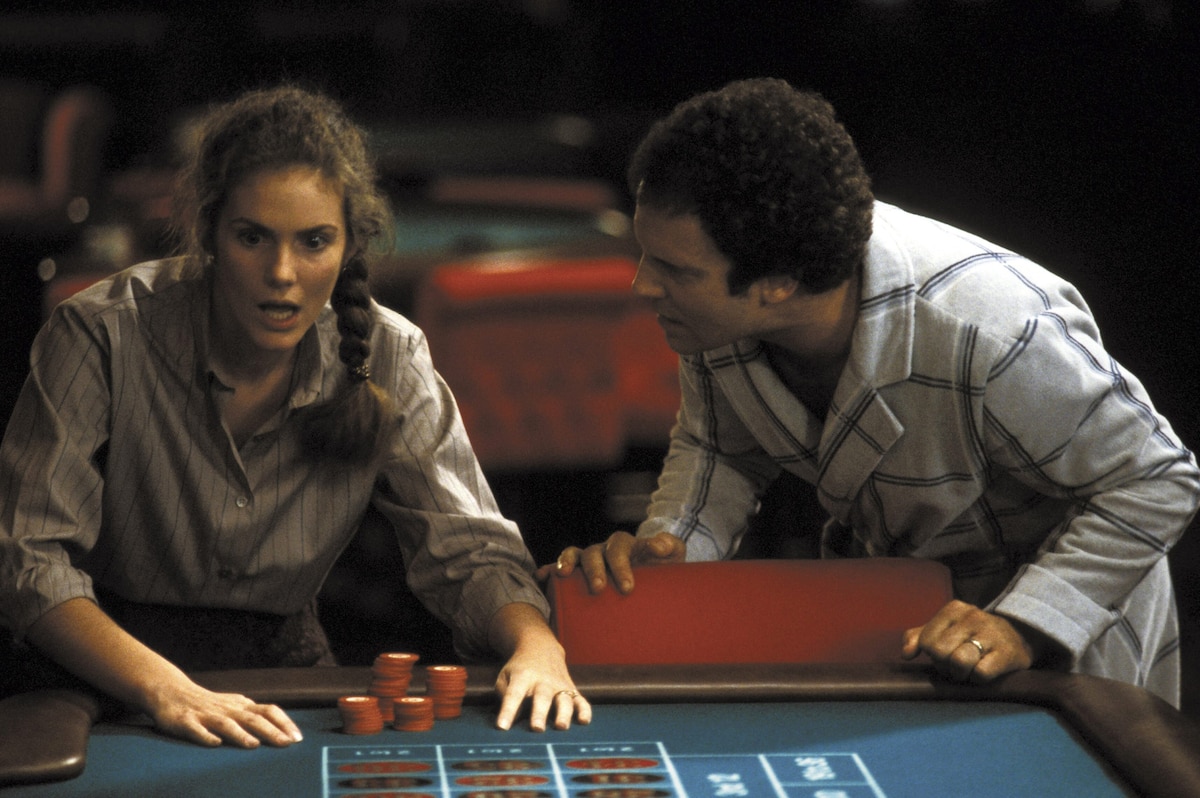
In Las Vegas, the company worked and stayed at the Desert Inn Hotel, filming in the casino,
lobby, and coffee shop. Using the most up-to-date lighting instruments available at the time and
shooting on high-speed film, director of photography Eric Saarinen and his crew were able to
avoid the usual, powerful movie lights that would have detracted from the authentic atmosphere of
an operational casino.
In his autobiography, Garry Marshall, the producer-director who plays the head of the Desert Inn
casino, said that he was highly frustrated and annoyed by the numerous takes Brooks did of the
scene in which David tries to talk the manager into returning the couple's money. When he saw
the film and realized how much that contributed to the character's own sense of frustration and
irritation on screen, Marshall declared he was very satisfied with the final result.
The scenes at Hoover Dam were shot on both the Arizona and Nevada sides of the structure. The
montage at the film's end, showing the couple speeding across the country to New York in their
Winnebago, took ten days to film. Various perspectives on the trip were captured by placing
cameras in the motor home's passenger seat, mounted in a camera car traveling with them, and set
up at roadside.
The journey made by the main characters across the country from Los Angeles to New York was
actually shot in reverse order, starting on the East Coast and heading west. Brooks said the last
scheduled shoot of the three main locations was New York, so it only made sense in terms of time
and money to drive West from there.
"The drive West was great fun--for about the first 200 or 300 miles," Brooks wryly noted. "Not
that driving across country is bad, just not with that many people in those conditions." With 30
people--cast and crew--piled into two Winnebagos, searching for locations to shoot and staying in
"crummy motels," the trip became increasingly more miserable. "We got about as far as Phoenix
before everyone stopped talking to each other."
One tricky part of the cross-country shoot was finding shots that matched with the lyrics of the
song Brooks had decided on for the soundtrack to the montage, Frank Sinatra's recording of "New
York, New York." Brooks had written the song into the script from the beginning, when the ad rep
from New York tells David the company landed the rights to "New York, New York" for the Ford
campaign. Brooks said he was pretty sure that up to that point Sinatra had not allowed anyone to
use any song recorded by him in a movie in which he did not also appear, but Brooks made a good
plea to Sinatra's lawyer, Mickey Rudin, followed by an obviously effective letter to Sinatra
himself. Securing the number for the soundtrack was a real coup for the production.
Brooks drove the Winnebago for many of the shots but he was not comfortable doing it anywhere but
on a straight road with no turn-arounds or back-ups. He did, however, actually swing the vehicle
up to the curb on the busy Manhattan street for a shot at the end of the movie.
Brooks's manager and the film's producer, Herb Nanas, went along on the cross-country trip. At
one point, in New Orleans or somewhere in Louisiana, Brooks recalled, Nanas asked to be given a
chance to pilot the RV and was allowed to back one of them out of where it was parked, tearing
the awning off the side. He was not allowed to drive again for the rest of the trip.
A the end of the cross-country trip, Brooks had about four hours of material that had to be
sifted for what looked best and most matched the song lyrics, then edited down into a montage
lasting only several minutes.
by Rob Nixon
Behind the Camera - Lost In America
by Rob Nixon | December 30, 2011
SIGN UP FOR OUR NEWSLETTERS

CONNECT WITH TCM