SYNOPSIS
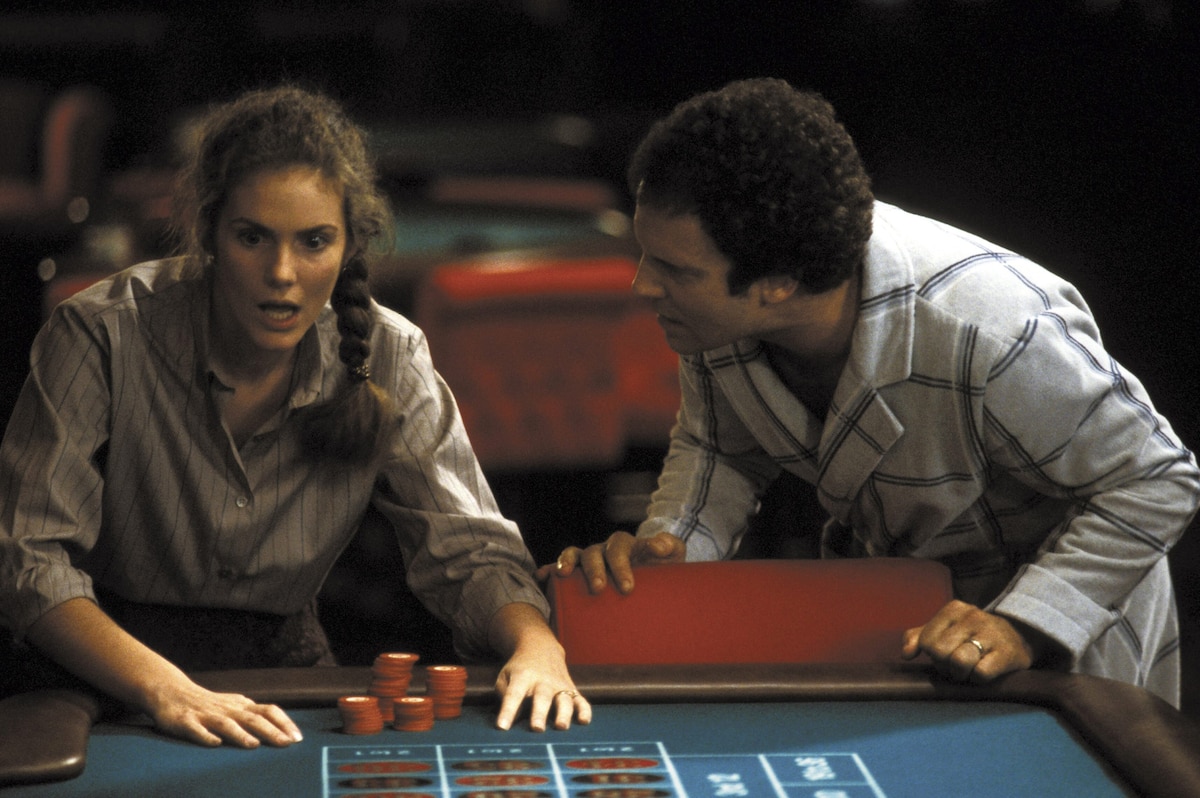
After being passed over for a major promotion, Los Angeles advertising executive David Howard quits his job in a fury and talks his wife Linda into liquidating their assets, buying a Winnebago, and heading out across the country to find themselves and start a new life. When Linda loses all of their nest egg in a crazed night of gambling in Las Vegas, the couple are forced to lower their expectations and soon find that "dropping out" and living in small-town America without money is not the life-changing adventure they hoped it would be.
Director: Albert Brooks
Producers: Herb Nanas, Marty Katz
Screenplay: Albert Brooks, Monica Mcgowan Johnson
Cinematography: Eric Saarinen
Editing: David Finfer
Production Design: Richard Sawyer
Cast: Albert Brooks (David), Julie Hagerty (Linda), Garry Marshall (Casino Manager), Michael Greene (Paul Donne), Tom Tarpey (Brad Tooley), Joey Coleman (Skippy).
C-91m.
Why LOST IN AMERICA Is Essential
You know you've got an enduring classic movie when it manages to be very much about the period in which it was made, a clear reflection of its era, and at the same time universal enough to still remain relevant and enjoyable decades later. Lost in America (1985) is one such gem, produced in the midst of the Reagan Era, when the word "yuppie" had recently entered the vernacular to mean young urban (or upwardly mobile) professionals, men and women (and in the case of married couples, generally childless two-income families) often derided for their conspicuous consumption and their striving for social status.
At the beginning of Lost in America, David and Linda Howard (writer-director-star Albert Brooks and Julie Hagerty) are apparently just that sort of couple. Surrounded by packed boxes on the cusp of moving into a newer, bigger, better home (where he will park his newer, more luxurious, more prestigious Mercedes), David begins to fret about whether or not they're making the right decision, and that's where another key observation of the times creeps into the story like a nagging itch. By 1985, the kids who had been weaned on the counter-culture, the Easy Rider (1969) generation, were grown up and solidly in the mainstream, but the idea of dropping out and starting life all over again was still a romantic-enough notion to entertain in the middle of a sleepless night. The irony that the Howards would chase that dream in an expensive motor home with a nest egg of more than $200,000 to fall back on would not occur to them until they had lost it all and were forced to beat a hasty retreat back into the rat race.
This is what makes the movie something anyone can still identify with. It is not so much, as it has often been termed, a "yuppie" movie or a critique of materialism (however skewed the Howard's thinking may be at the start of their journey) but a movie that, in Brooks's words, looks at the predicament of people who make a horrible mistake in life; they lose everything, panic, and find that, quite apart from having freed themselves, they now have to "eat sh*t" and realize they were not, in fact, "born to be wild."
Lost in America also remains remarkably fresh for us now because, unlike comedies that depend on high concepts or zany situations, or those that are too specific to the times in which they're made, it's about the eternal human condition and how the best and worst parts of us are there to be tapped, even at the most inappropriate times. You could even say it's a comedy about the things in life that aren't funny. In fact, the story comes close to losing our good humor altogether at the moment that Linda, the winsome, gentle wife, blows the couple's entire nest egg (a term we'll never hear the same after this picture) on an out-of-control night of gambling. How could she do it, we wonder, and how could her husband ever look at her the same again? One reviewer has suggested the major flaw in the movie is our inability to forgive Linda her transgression even after her husband does. It's not an unreasonable analysis, but it takes a bit more consideration to see where Brooks was going with this.
From the very beginning, Linda is obviously rather closed in and repressed, and she expresses her concern about the stagnation that comes from too many years of sticking to the "right" economic, social and professional track. Luckily, we also have the luxury of consulting the creator of the film for his take on Linda's Vegas meltdown, in an interview this writer conducted in March 2012 with Brooks specifically for The Essentials. "You're supposed to let stuff out, a little at a time, release the pressure safely, like a well-managed nuclear plant," he says. "Otherwise, it all just explodes disastrously." As Brooks sees it, Linda was just someone too blocked for too long and really in need of this one night of craziness. And as far as whether we can forgive her and recover enough to laugh through the rest of Lost in America, he had two secret weapons going for him. One was his decision to cast Hagerty, one of the most appealing and underrated comic actresses of the 1980s, because she was "someone who could lose all this money and the audience wouldn't want to kill her." The other was his own off-kilter, nervy humor, following Linda's disastrous faux pas with two classic scenes still quoted by fans: the attempt to talk the casino manager into returning their money ("the Desert Inn has heart, the Desert Inn has heart") and his outburst about the "sacred" nest egg and the principles that govern it.
It's fun to watch the movie today and realize that, apart from certain details of fashion and technology, it could almost have been made yesterday. "The idea of dropping out, of letting go, will always be alive," Brooks says, and the cyclical nature of people's relationship to money, status, and the need for life alternatives is what keeps the story interesting to him almost 30 years after its release. The 60s, he notes, were very much about opposing the capitalist, corporate, mainstream world, and he created characters in Lost in America who held on to a vestige of that rebellious spirit, even if they got its execution all wrong. "Then in the 90s, we see movies about the big engine of business and affluence revving up again. Now, here we are today in a place of people saying where do we go, what do we do now?" In these dark economic times many of us are looking again at leaving it all behind, changing our lives, thinking about growing our own food and other ways to reduce our needs and expectations, less out of rebellion than out of necessity. That ongoing cycle, and the desperation and panic that accompanies it--the "nagging terror inside the complacency" of the middle class that Pauline Kael admired in the film's satire--are what fuels the humor in Lost in America. And isn't that, after all, what really makes this an essential classic? Socio-economic analyses far aside, it's just so damn funny.
by Rob Nixon
The Essentials - Lost In America
by Rob Nixon | December 30, 2011
SIGN UP FOR OUR NEWSLETTERS

CONNECT WITH TCM