The house in What Ever Happened to Baby Jane? where the fictional Hudson sisters lived is located in the Hancock Park neighborhood of Los Angeles at 172 South McCadden Place.
For Jane's old movie clips in Baby Jane, Robert Aldrich used scenes from two of Bette Davis' actual films: Parachute Jumper and Ex-Lady (both 1933). For Blanche's old movie clips in the film, Aldrich used scenes from Joan Crawford's 1934 film Sadie McKee.
Actor Peter Lawford reportedly turned down the role of Edwin Flagg saying, "It's a spot I wouldn't have given to my dry cleaner."
Just before Baby Jane was released, on September 21, 1962 Bette Davis famously took out the following ad in the Hollywood Reporter: "Mother of three--10, 11, and 15. Divorcee. American. Thirty years experience as an actress in motion pictures. Mobile still and more affable than rumor would have it. Wants steady employment in Hollywood (has had Broadway). BETTE DAVIS, c/o Martin Baum, GAC. References upon request." The ad shocked the Hollywood community, though Davis claimed it was done tongue-in-cheek. "There was great objection by one and all to my ad," said Davis later. "Those who were part of my professional life felt this a very foolish thing to do. It was also misunderstood. If I had not been employed at the time, I never would have done this. I did it to poke fun at the bankers and their list of who was not bankable. If we were not allowed to make films, how would they know whether or not we were bankable?"
In 1963 Robert Aldrich and Bette Davis traveled to the Cannes Film Festival to screen What Ever Happened to Baby Jane? in competition. It was there that Davis saw the finished film for the very first time.
Bette Davis took her teenage daughter B.D., who had a small role in Baby Jane as the next door neighbor's daughter, to the Cannes Film Festival. Davis later called the decision to take B.D. with her "one of the greatest mistakes in my life." Her regret was because it was there that B.D. met Jeremy Hyman, the nephew of Seven Arts head Eliot Hyman, who later became her husband. "I believe it was this union that, years later," said Davis, "produced B.D.'s book about me." The book was called My Mother's Keeper, published in 1985, and it painted a sometimes very unflattering portrait of Davis. The book was compared to the notorious book Joan Crawford's daughter Christina has written about her, Mommie Dearest just a few years earlier. Davis, who unlike Crawford, was very much alive when the book was published, was heartbroken and never forgave B.D., who was promptly disinherited.
According to Bette Davis, Joan Crawford came to her during the pre-production phase of Baby Jane and said that she hoped her "color scheme" wouldn't clash with Davis'. To that Davis replied, "Color scheme??? Joan, I haven't a speck of color in any dress I wear. Wear any color you want. Besides, it's a black-and-white film."
In her 1987 memoir This 'N That Bette Davis credits Baby Jane as the film that made her permanently give up driving a car. One day while Bette Davis was driving herself and daughter B.D. on the Pacific Coast Highway to get to the beach for a location scene, she was violently rear-ended by a woman driving another car. "She was not hurt, nor were B.D. and I," said Davis, "but we were badly frightened. I loved driving a car. After that experience, I should have started driving again immediately, but I didn't. Now with the madness of the freeways you could not pay me to drive again."
While promoting What Ever Happened to Baby Jane? on Jack Paar's Tonight Show on television, Bette Davis said, "I must say we are gloating. When Aldrich tried to interest the studios in Joan Crawford and myself, the moguls said, 'We wouldn't give you a dime for those two old broads.'" The audience loved it, but Davis soon received a letter from Crawford asking her to please never refer to her as an "old broad" again.
When Academy Award time arrived, Davis' nomination was very special to her. It was her eleventh time being up for the Best Actress award, and it was her first nomination in a decade. She desperately wanted to win. If she was victorious, she would be the first actress to ever have won the Oscar® three times.
As the Academy Awards ceremony drew closer, Davis became convinced that Joan Crawford, who had been overlooked by the Academy, was conspiring against her. "Joan did everything she could possibly think of to keep me from winning," said Davis. "She campaigned openly in New York, contacting all the Oscar® nominees who were in plays in New York that year. She offered to accept their Oscars® if they won and were unable to attend the ceremony. She also contacted all the members of the Academy who lived in New York, requesting that they vote for one of the nominees then on Broadway. Leaving aside the fact that I felt I deserved to win, the rule of thumb was that an Oscar® winner usually added at least a million dollars to the box office receipts of a film. Since Joan and I each had a percentage of the movie, how Medean, how foolish she was to work against my winning."
On Academy Awards night, Bette Davis seemed a lock for the Best Actress category. Everyone--including herself--expected her to win. When her category was announced, however, the winner was...Anne Bancroft in The Miracle Worker. Later Davis admitted to the Los Angeles Times, "I almost dropped dead when I didn't win." In her memoir Davis said, "That year, each nominee sat in a separate dressing room backstage, equipped with a TV monitor...When Anne Bancroft's name was announced, I am sure I turned white. Moments later, Crawford floated down the hall, past my door. I will never forget the look she gave me. It was triumphant. The look clearly said, you didn't win and I am elated!. Joan traveled around the world, carrying the Bancroft Oscar® with her. When she came back to New York, she threw a lavish party on the stage of Mother Courage, the play Anne Bancroft was in, and presented her with the Oscar®." If Crawford actually had intentions of working against Davis, she didn't betray her feelings publicly. "Months before the awards," said Crawford, "I predicted that Bette would be nominated and would win. She was nominated, but she didn't win, and that I'm truly sorry for."
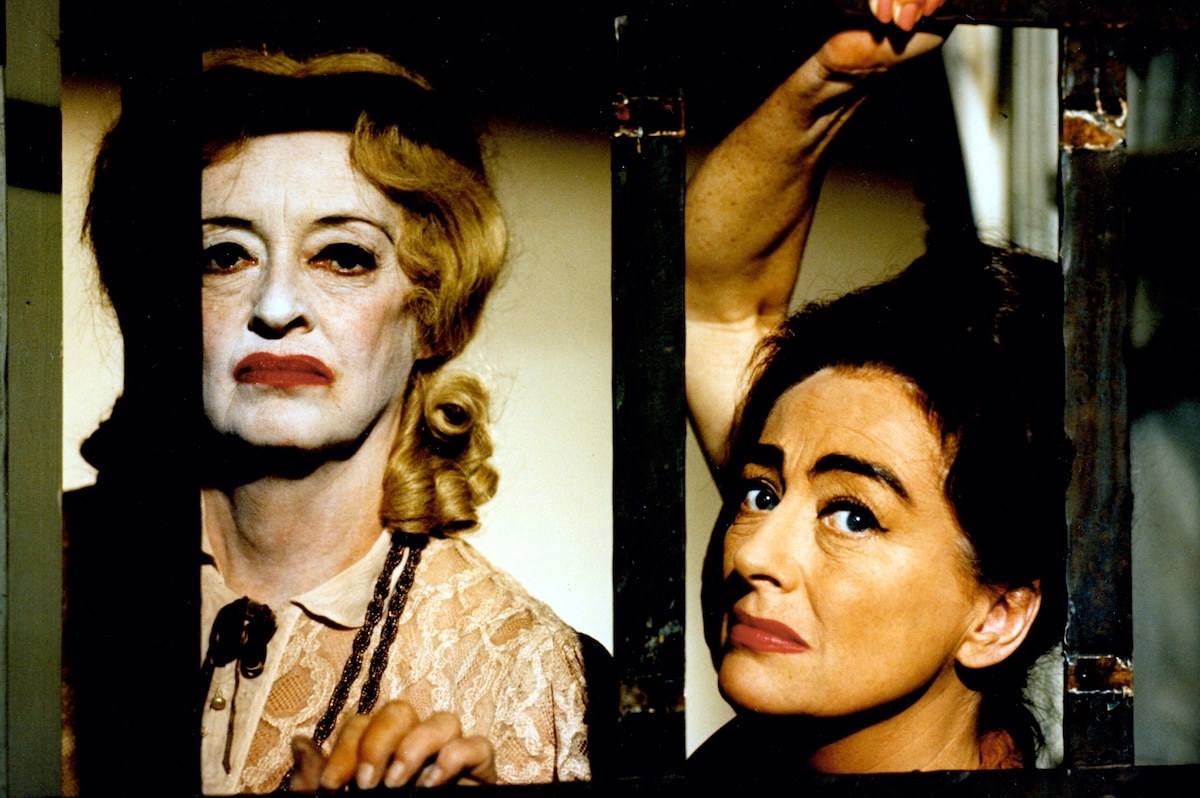
The incredible success of Baby Jane boosted the flagging careers of both women for years to come. They each embarked on a fresh second phase of already illustrious careers, finding steady work in B movies. Bette Davis believed Baby Jane was a "breakthrough" in women's films. "Not in ten years had there been a successful woman's film," she explained. "Actresses had owned the industry for the previous twenty years and the men were entitled to their turn in the fifties and sixties. By then the world's problems were wars, drugs, crime, political corruption--all the ills that involve men much more than women. And writers write about what is going on in the world. Given that trend, Baby Jane was truly a break for both Joan and me."
Robert Aldrich soon tried to reunite Davis and Crawford in another women-focused film thriller. It was based on another story by Baby Jane author Henry Farrell called What Ever Happened to Cousin Charlotte? Davis was interested, but told Aldrich that she refused to work with Crawford again. Not only was she still angry about Crawford's behavior regarding the Academy Awards, but she also believed Crawford was wrong for the part of Miriam. Davis also strongly objected to the title, feeling it was far too close to Baby Jane.
Aldrich believed that keeping the title What Ever Happened to Cousin Charlotte? would ensure the success of the film since fans would flock to it hoping for another Baby Jane. He tried to convince Davis to accept the title as well as Crawford as her co-star. Finally, Davis made a deal with Aldrich. "Robert," she told him, "I will accept Crawford, if you change the title to Hush...Hush, Sweet Charlotte." Aldrich agreed to her terms.
Production began on Baby Jane's unofficial sequel, Hush...Hush, Sweet Charlotte (1964) with Davis, Crawford and Aldrich all together again on location in Baton Rouge, Louisiana. However, just a few days into shooting, Crawford became ill and checked into a hospital. Weeks later, she asked to be released from the film and was replaced by Bette Davis' good friend Olivia de Havilland. Davis and Crawford never worked together again. Even so, as Davis later acknowledged, "Twenty years after we had worked together, and half a dozen years after her death [in 1977], we are still a team in the public's mind."
Memorable Quotes from WHAT EVER HAPPENED TO BABY JANE?
"Blanche, you're not going to sell this house. Daddy bought this house, and he bought it for me. You don't think I remember that, do you?"
"You're wrong, Jane. You've just forgotten. I bought this house for the two of us when I signed my first contract."
"You don't think I remember anything, do you? There are a whole lot of things I remember. And you never paid for this house. Baby Jane Hudson made the money that paid for this house, that's who."
"You don't know what you're saying."
"Blanche, you aren't ever going to sell this house. And you aren't ever going to leave it, either."
-- Jane (Bette Davis) and Blanche (Joan Crawford)
"You wouldn't be able to do these awful things to me if I weren't still in this chair."
"But you are, Blanche! You are in that chair!"
--Blanche and Jane
"We're right back where we started. When I was on the stage, you had to depend on me for everything. Even the food you ate came from me. Now you have to depend on me for your food again. So you see, we're right back where we started."
"Why are you doing this to me? Why?"
"Doing what?"
"Making me afraid to eat. Trying to make me starve myself."
"Don't be silly. If you starve, you die. I don't know what you're talking about. You really must be sick."
-- Jane and Blanche
"Blanche, you know we've got rats in the cellar?"
-- Jane
"I didn't bring your breakfast because you didn't eat your din-din!"
--Jane, to Blanche
"I'll bring you some tea. You like tea?"
"Oh, Yes. I'm quite fond of tea. You must have guessed that I'm English."
"Oh, really? How nice for you."
--Jane and Edwin Flagg (Victor Buono)
"I got a friend down there. Someone who's come to see me. He doesn't even know you exist, and you don't like that, do you?"
"You're wrong, Jane. I've always wanted you to have friends. That's what I've always wanted. Really."
"Then how come I never had any?"
"Well, maybe you weren't...I mean, maybe you were just too independent."
"No, that's not why. You always stopped me from having friends, that's why."
"Not anymore, Jane. Not anymore. I'm pleased that you have a friend. That's what you need."
"Sure."
"I was just hoping maybe I could meet him and we could have a nice talk, just the three of us."
"Yeah, you'd like that, wouldn't you? Then you could tell him a whole lot of lies about me. Scare him off...Or maybe have him for yourself."
-- Jane and Blanche
"You mean, all this time we could have been friends?"
--Jane, to Blanche
Compiled by Andrea Passafiume
Trivia - What Ever Happened to Baby Jane? - Trivia & Fun Facts About WHAT EVER HAPPENED TO BABY JANE?
by Andrea Passafiume | May 02, 2012
SIGN UP FOR OUR NEWSLETTERS

CONNECT WITH TCM