Awards and Honors:
Summertime received Oscar® nominations for Best Actress for Katharine Hepburn and Best Director for David Lean.
It also received BAFTA (British Academy of Film and Television Arts) nominations for Best Film from any Source and Best Foreign Actress for Katharine Hepburn.
It won the New York Film Critics Circle Award of 1955 for Best Director for David Lean.
The Critics' Corner on SUMMERTIME
"As the secretary, Katharine Hepburn has an air of stylized hysteria that is somewhat unsettling when we first meet her. After she quiets down, though, she is wonderfully effective, making the most of her opportunities for registering pathos and passion, and turning in a couple of first-rate slapstick sequences as well." - The New Yorker, 1955
"With Katharine Hepburn in the role originated by Shirley Booth and with the scenic beauties of the canal city, the film stacks up as promising entertainment - with some reservations. There is a lack of cohesion and some abruptness in plot transition without a too-clear buildup. Lesser characterizations, too, are on the sketchy side. Covering these flaws is a rich topsoil of drama as the proud American secretary who hits Venice as a tourist falls for and is disillusioned by the middle-aged Italian charmer. Rossano Brazzi, as the attractive vis-a-vis, scores a triumph of charm and reserve. Hepburn turns in a feverish acting chore of proud loneliness." - Variety, 1955
"Miss Hepburn has labored long in the service of her art and, like many grand actress personalities; she has now created herself in her own image. Everything superfluous is gone, the elements are refined and complete - the sad mouth, the head-back laugh, the snap of chic in shirtmaker dresses, the dream of enchantment behind wistful eyes, the awakened puritan passion of the girl in love, the 'regular' way with children, the leggy stride, and always the bones - the magnificent, prominent, impossible bones which a visiting journalist, made somewhat exuberant by the deceptively mild local wine, described as the 'greatest calcium deposit since the white cliffs of Dover.'" - Lee Rogosin, The Saturday Review, 1955
"Both Miss Hepburn and Brazzi are excellent in their roles, with the former making the most of her characterization as the shy and lonely dreamer and Brazzi scoring as the realistic charmer." - Rose Pelswick, The New York Journal-American, 1955
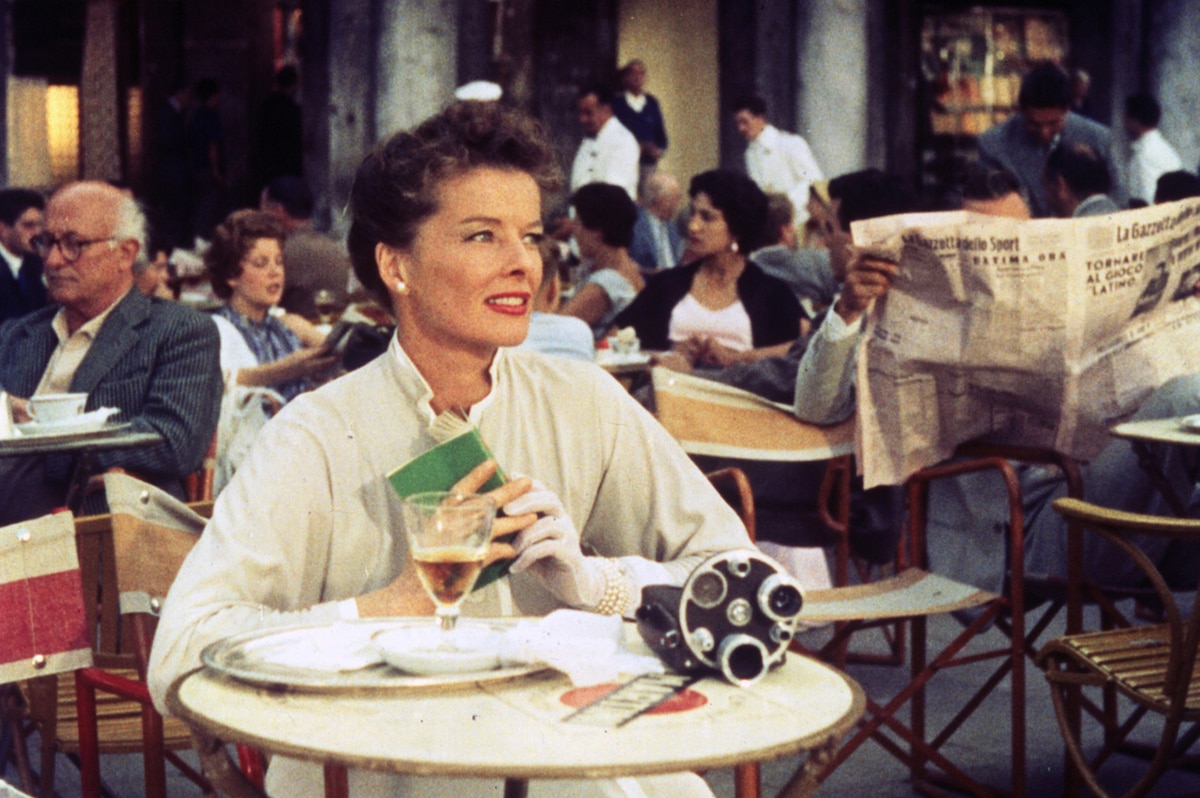
"In adapting for the screen Arthur Laurents' stage play "The Time of the Cuckoo," Mr. Lean and H. E. Bates discarded most of the individual shadings and psychological subtleties of that romance. They reduced the complicated pondering of an American woman's first go at love with a middle-aged merchant of Venice to pleasingly elemental terms. And they let the evident inspiration for their heroine's emotional release be little more than the spell cast by the city upon her fitful and lonely state of mind. The challenge thus set of making Venice the moving force in propelling the play has been met by Mr. Lean as the director with magnificent feeling and skill. Through the lens of his color camera, the wondrous city of spectacles and moods becomes a rich and exciting organism that fairly takes command of the screen. And the curious hypnotic fascination of that labyrinthine place beside the sea is brilliantly conveyed to the viewer as the impulse for the character's passing moods. Miss Hepburn is clever and amusing as a spirited American old maid who turns up in Venice with her guide books and a romantic gleam in her eye. She makes a convincing summer tourist. And her breathlessly eager attitude is just right for the naïve encounters and farcical mishaps that have been arranged..." - Bosley Crowther The New York Times, June, 1955
"Few actresses in films could equal Hepburn's evocation of aching loneliness on her first night in Venice as she wanders, forlorn and proud, like a primly starched ghost in a city of lovers .... The script has dropped overboard many of the plot gimmicks that playwright Arthur Laurents used as cogs for stage action. With them go some of the harsher truths about the career girl's character and therefore any possibility of comparing Hepburn's performance with that of Shirley Booth in the stage play. The Eastman Color and the camerawork by Jack Hildyard are superb." - Time, 1955
"It may be relevant that Hepburn rarely played a woman with a child; she was almost invariably the modern woman, the career girl, the bachelor girl. By 1955, in Summertime, she was at the end point of that tradition--as the aging virgin, an innocent abroad in corrupt, sensual Venice. Prim and gaunt, withering in her loneliness, she is the female Yankee, the archetype of a Henry James heroine grown old. There is an element of embarrassment in this kind of role, but she is so good at that she almost--though not quite--kills the embarrassment...." - Pauline Kael, Kiss Kiss Bang Bang, 1968
"Lilting film....Hepburn's sensitive portrayal is one of her best...Beautifully filmed." - Leonard Maltin's Movie Guide
Compiled by Greg Ferrara
Critics' Corner - Summertime
by Greg Ferrara | May 02, 2012
SIGN UP FOR OUR NEWSLETTERS

CONNECT WITH TCM