Once the script of Summertime was in hand, the cast and crew made its way to Venice to begin prepping the locations. Lean had accepted the job of directing it in part because of a desire to no longer do soundstage work but work on locations outside. He remarked that working on a soundstage made it feel as though one was working in a "pitch-black mine... I prefer the sun." He set out about Venice, picking out locations and taking pictures. Lean would fall in love with Venice and later live there part of every year. Once location scouting was completed, Lean and his cast and crew were ready to begin work.
The filming of Summertime was one without any behind-the-scenes acrimony. Katharine Hepburn expressed how, early on, everything seemed right, "Constance Collier, my friend, and Phyllis Wilbourn, her secretary, were going to go with me. Spencer was going to do The Mountain [1956] in the French Alps, so everything was perfect. He was busy - I was busy." After a brief mix-up, in which Hepburn put her two friends up in a house far from Venice, she got them an apartment on the Grand Canal and never had to suffer for loneliness while filming. That didn't mean she didn't have to suffer other things.
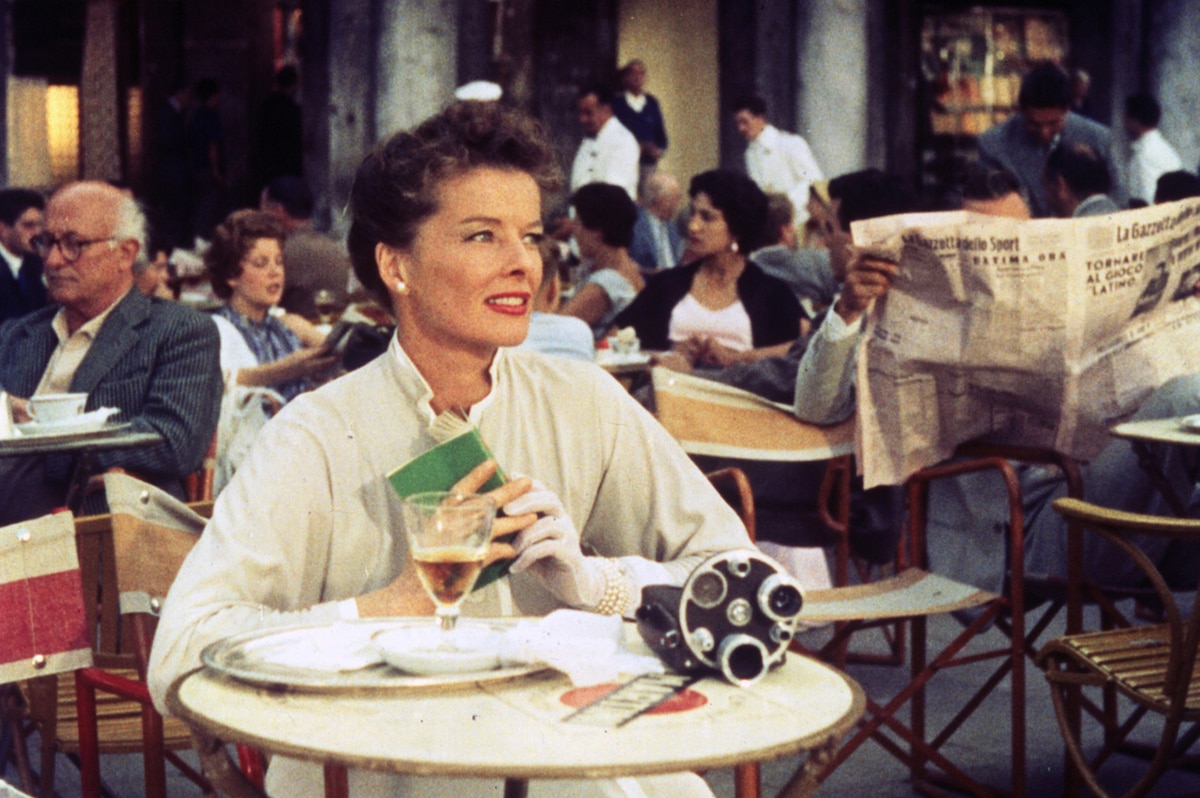
Shooting schedules for Hepburn often ran from morning to night, giving her, on average, twelve hours of shooting per day. The hot sun of Venice caused Hepburn to remark on more than one occasion that it was hotter than her shoots in Africa for John Huston's The African Queen (1951). And, of course, there was that little fall into the canal. In one of the movie's most famous shots, Hepburn's character sets up a camera shot for a home movie. In doing so, she backs up until she inadvertently falls off the edge and into one of Venice's notoriously polluted waterways. This was not something she wanted to do. In fact, she asked Lean to use a double but Lean believed a double would be far too obvious since the shot should include her face. Hepburn agreed and preparations were made for the shot.
David Lean had strong disinfectants poured into the water where the shot would take place. It created a foam that looked unnatural and had to be scooped away before filming. Of course, putting a disinfectant in a moving waterway probably had little to no effect. According to A. Scott Berg in his biography, Kate Remembered, "Hepburn took every precaution before shooting the scene, putting lotion all over her body and even antiseptic unguents on a small cut on one of her fingers, as soon as Lean got his shot, she immediately bathed and gargled with disinfectant. But it never occurred to her to wash out her eyes; and the next morning the whites had turned crimson. A staph infection plagued her for the rest of her life, causing her to tear. 'But it's a cute moment,' Kate said, 'fun,' as though that made it all worthwhile."
How many times Hepburn had to perform that "cute" moment is a matter of debate. Michael Korda reported that she had to do it several times. Peter Newbrook, one of the film's camera operators, said it happened only once but that she did have to get back into the water for certain reaction shots.
As for the production schedule, David Lean encountered problems with the locals and had to donate money for the restoration of a local church to break the deadlock. It was the height of tourist season and several merchants and gondoliers claimed that filming was disrupting their business. Lean paid for lost income as well as work on the church.
Another problem for Lean was Isa Miranda. Having been cast as the older widowed concierge of the hotel, Lean was upset to find she had recently had a facelift and looked too young for the part. Since recasting at that late stage was out of the question, Lean went with it. Aside from her appearance, Lean was also displeased with her performance. She was having trouble working up tears for her scene with Darren McGavin, which was frustrating Lean to no end. Hepburn said she would coach Miranda, took her aside and slapped her sharply across the face. Miranda was shocked and then began to tear up. Lean was impressed and told Hepburn she was a tougher director than he.
One person neither Lean nor Hepburn had problems with was Rosanno Brazzi. He was a favorite of Hepburn's and she, reportedly, was responsible for Brazzi receiving co-star billing. The two worked together splendidly on screen.
In the end, Katharine Hepburn was more than impressed with her experience working with Lean. She even asked to sit in on the editing sessions with him to watch him at work. In her autobiography, she wrote, "[Summertime] was told with great simplicity in the streets, in the Piazza San Marco. We would shoot in tiny streets only a few feet wide. The sun would come and go in a matter of minutes. It was a very emotional part, and I tell you I had to be on my toes to give David enough of what he wanted practically on call. But it was thrilling... He seemed to me to simply absorb Venice. It was his. He had a real photographic gift. He thought in a descriptive way. His shots tell the story. He was capable of a sort of super concentration. It made a very deep and definite impression on me, and he was one of the most interesting directors I ever worked with. Wasn't I lucky to work with him?"
by Greg Ferrara
Behind the Camera - Summertime
by Greg Ferrara | December 30, 2011
SIGN UP FOR OUR NEWSLETTERS

CONNECT WITH TCM