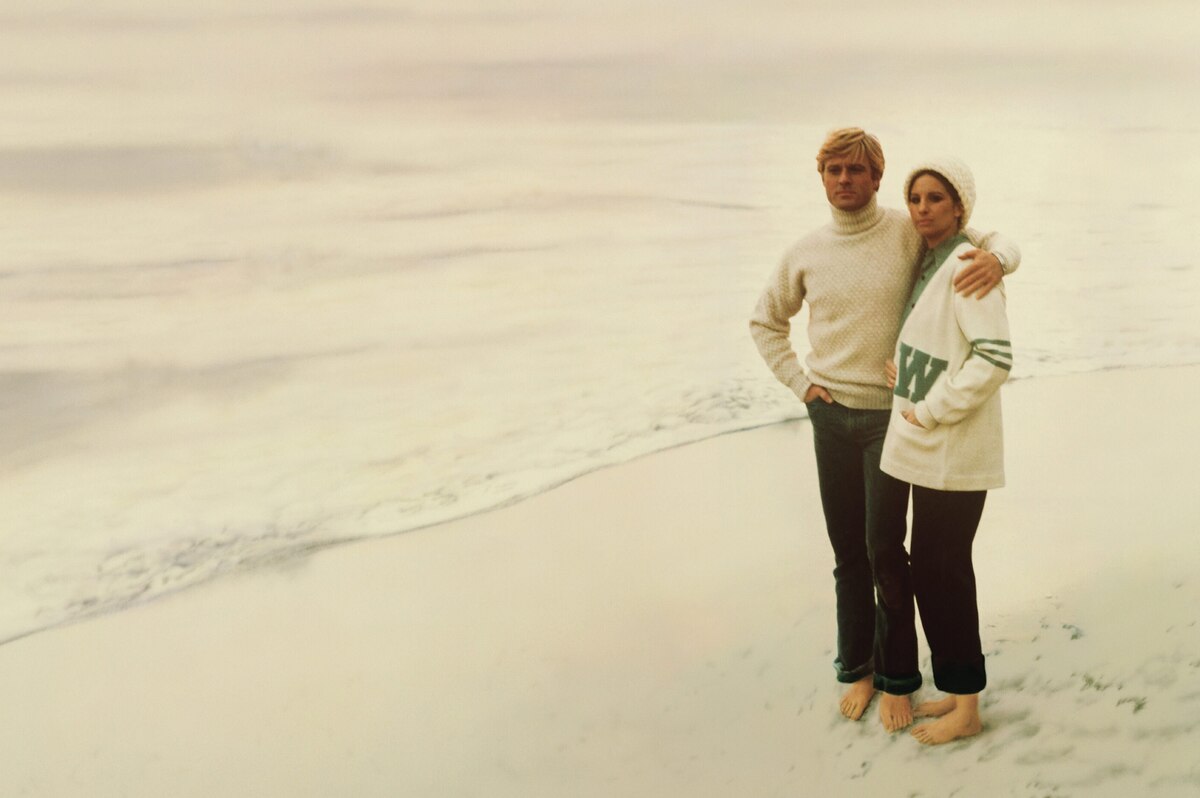
Filming began on The Way We Were in September 1972. The cast and crew first traveled to the Union College campus in Schenectady, New York for two weeks of location shooting. Following that, the production moved to Manhattan. When word got out to the public that Barbra Streisand and Robert Redford would be filming on the city streets, it was no small feat to keep crowds of adoring fans at bay.
Streisand and Redford had very different approaches to acting. Streisand liked to analyze the part at length and rehearse a great deal, while Redford was more of an intuitive actor, preferring to be more spontaneous. "Barbra would call me up every night at nine, ten o'clock and talk about the next day's work for an hour, two hours on the phone," recalled director Sydney Pollack. "Then she'd get in there and start to talk and Bob would want to do it. And Bob felt the more the talk went, the staler he got. She would feel like he was rushing her. The more rehearsing we did, she would begin to go uphill and he would peak and go downhill. So I was like a jockey trying to figure out when to roll the camera and get them to coincide."
Despite their differences, however, Streisand and Redford had a deep respect for each other and worked well together. They were both opposite in many ways, just like their characters, and they used those differences to the benefit of the film. "I just loved working with him," said Streisand years later. "Every day was an exciting adventure. We played well together--in the moment, slightly different, slightly unknowing, always interesting. He's a man of depth who has what it takes to be a great movie star: mystery behind the eyes. You wonder, What is he really thinking?" Redford was also intrigued by Streisand. "When we started on The Way We Were, she wanted me to be Hubbell," said Redford. "That was how she conceived me. And then, as the shoot went on, she saw I was not that man, not in any way. So she reoriented herself, and the professional took over. But afterward I wondered, Did she return to that banal concept of me? Was I--am I--a Hubbell figure in her mind? I never fully sorted that out, and some of that tension made our chemistry on-screen."
Meanwhile, re-hired screenwriter Arthur Laurents returned to work, but the atmosphere was still full of tension. "The set was an unacknowledged battlefield--," said Laurents, "Sydney and Redford on one side, me on the other, Barbra in between..." Laurents was often frustrated over Sydney Pollack's choices as a director. He fought to keep certain lines and scenes in the film that Pollack wanted to cut or change. Streisand was an ally to Laurents most of the time when conflicts arose, often supporting his suggestions. "[Streisand] had been a wonderful pest, dredging up a scene here, a line there from my earlier versions, lugging them to the set and utzing Sydney to put them back," said Laurents. "She knew Katie Morosky better than he did and fought like her for her."
Among the battles that Laurents fought (and won) to keep in The Way We Were was the "People are their principles" line that Katie says to Hubbell during their big confrontation at Union Station. That line, said Laurents, was "the point of the whole scene, the political point of the whole picture."
In another instance, Laurents fought to keep one of Hubbell's lines in the film. In the scene towards the end when it's clear the couple is headed for a split, Katie says to Hubbell, "I want us to love each other." The original script had Hubbell responding, "The trouble is we do." It was a line, said Laurents, that "summed up the relationship between Hubbell and Katie: they loved each other despite, not because." Pollack ended up cutting the line to Laurents' dismay. "The simple problem," said Laurents, "was that the man who was directing a political love story knew even less about love than he did about politics."
Eventually, Laurents came to realize that he would have to accept the changes to his original work. "To make a mantra of 'It's only a movie' was as useless and foolish as feeling pain," he said. "No matter what I felt or thought, no matter what I tried to accomplish or how, Sydney Pollack would ultimately have his way. That was what I had to face and accept. They didn't cry 'Author! Author!' in the movies, they never had. Now they cried 'Auteur! Auteur!' -- even if the auteur f*cked up the picture."
After the last leg of filming was completed at The Burbank Studios, The Way We Were was ready to go into post-production. There was already great anticipation growing for the film, as the public couldn't wait to see two of Hollywood's biggest stars working together on the big screen. From a business standpoint, there was also great pressure for the film to be a hit. "Columbia [Pictures] was terribly worried," explained Sydney Pollack. "They were going under at the time, they were changing management, they hadn't had a hit in years."
A rough cut of The Way We Were screened in a San Francisco theater as a sneak preview. The audience, however, didn't respond as positively as hoped. Sydney Pollack and film editor Margaret Booth immediately retreated back to the cutting room where they ended up trimming five scenes, eliminating approximately eleven minutes of footage. It was mostly political material that got the axe including a scene in which Katie, living in Hollywood, drives by the UCLA campus and sees a younger version of her activist self, and another in which Hubbell tells Katie that an old friend has betrayed her to HUAC (both scenes can be seen as extras on the DVD Special Edition).
Having those scenes excised from the film upset Barbra Streisand. "There weren't many movies made about this period of time in the blacklist," she explained in a 1999 interview, "and that's why it killed me to have those two scenes taken out. I was really heartbroken." Redford was also unhappy with the cuts, but it was clear to Sydney Pollack that preview audiences were responding more to the love story, and the political angle had to be toned down a bit. "I think we'd both have preferred a more political Dalton Trumbo-type script," said Redford later, "but finally Sydney came down on the side of the love story. He said, 'This is first and foremost a love affair,' and we conceded that. We trusted his instincts, and he was right." The very next time the film was previewed for audiences with the new changes, the response was much more enthusiastic.
Even though Barbra Streisand had resisted singing for The Way We Were, producer Ray Stark eventually convinced her to use her golden pipes to perform a theme song that would play over the film's opening credits. Stark approached the young composer Marvin Hamlisch, whose history with Streisand dated all the way back to Funny Girl on Broadway--a show on which Hamlisch had served as the rehearsal pianist. "'Marvin, I'm working on a new picture which needs a theme song,'" said Stark according to Hamlisch in his 1992 memoir The Way I Was. "'I think it's up your alley, and I'd like to give you a chance. But you haven't got the track record yet, Marvin, and the director wants you to do this on spec.' Which meant that if he didn't care for the song, it was no harm, no foul. I'd be here today, gone tomorrow. If, on the other hand, he liked it, I would get the job of scoring the whole movie. What Stark didn't tell me till the end of the conversation was that the director was Sydney Pollack, the stars were Barbra Streisand and Robert Redford, and the movie was The Way We Were. For this I would certainly work 'on spec,' and I must confess that I sensed from the beginning that this was going to be my watershed in the movies."
Hamlisch's goal was to capture the melancholic beauty of a love story between two people who couldn't make their relationship work in his music: "the sorrow and despondency and pain of the relationship and its outcome, the frustration and yearning of the woman in the relationship, and the star-crossed nature of it all."
After Hamlisch had composed the music for the theme song, it next needed lyrics. Ray Stark called in the distinguished songwriting team of Alan and Marilyn Bergman, who had recently won an Academy Award for the theme song to The Thomas Crown Affair (1968), "The Windmills of Your Mind." The words they came up with for "The Way We Were" met with everyone's approval. "The lyrics," said Hamlisch, "couldn't have been better."
When Streisand heard the song for the first time, she loved it. However, she made two important suggestions that ended up transforming the song into something even better. She suggested a slight shift in the melody to send it soaring at a crucial point in the song, and she also suggested changing the first line of the song from "Daydreams light the corners of my mind" to "Memories light the corners of my mind." The rest, as they say, is history.
While waiting for the final cut of The Way We Were to be completed, lyricist Alan Bergman began to have second thoughts about the song they had turned in. He suggested to Marvin Hamlisch that they come up with another version of "The Way We Were" to see if they could do even better. Reluctantly, Hamlisch agreed to try.
The new song they wrote (nicknamed "The Way We Were 2") was, Hamlisch described, "more complex in structure, with a more complicated melody." Streisand liked it and recorded it. When the time came to actually put the song with the film, no one could decide which version of it to use. Sydney Pollack had the idea to put both songs with the film and play each version separately so that everyone could compare the two. When he was done, it was clear by all accounts that the original version of "The Way We Were" was the right choice.
When Hamlisch had finished orchestrating the film's score, he couldn't wait to see how audiences would respond, especially at the heartbreaking final scene between Katie and Hubbell in front of the Plaza Hotel. "Now the Hamlisch acid test for movie emotion is simple: Do people cry?" said Hamlisch. "The audience at the preview had not, and I knew part of the blame was mine. I had specifically shied away from using "The Way We Were" music in the final scene, because I thought it would be excessive. Leo Shuken, my arranger, had disagreed: 'Marvin, if you play it twenty times, the audience may think they've only heard it three or four times. Remember, while you are listening to the clarinet and the oboe, they are listening to the dialogue.' He was right. I knew now without a doubt that the theme had to be there at the end. This would push the audience over the edge into tears."
Hamlisch pleaded with the head of Columbia Pictures' music department to let him have another recording session with an orchestra so that he could put additional music into the final scene that would be appropriately emotional. He knew it would make all the difference. Columbia agreed to his request, but the money to do it would come out of Hamlisch's own pocket. "So I spent the money," he said, "which, believe me, wasn't mere pocket change. But the new music went into the movie. And now, finally, I had what I wanted. I waited for the next preview. Streisand sees Redford with his new girlfriend outside the Plaza. She touches his unruly lock of hair. And then the music builds and sweeps the screen. I was standing at the back of the movie house; I heard a woman start to cry. And then I heard another. And within minutes, there wasn't a dry eye left. I knew I was right. And knowing it was right made it worth every penny."
by Andrea Passafiume
Behind the Camera - The Way We Were
by Andrea Passafiume | December 30, 2011
SIGN UP FOR OUR NEWSLETTERS

CONNECT WITH TCM