Ellen Burstyn wanted as many women working on Alice Doesn't Live Here Anymore as possible, and director Martin Scorsese agreed. They hired Toby Carr Rafelson (then director Bob Rafelson's wife) as production designer and Marcia Lucas (married to director-producer George Lucas at the time) as editor. Other women in important positions included producer Audrey Maas and associate producer Sandra Weintraub.
The production presented Burstyn with a new challenge -singing. "I have the worst voice," she explained. "I can't carry a tune, but I was determined not to have Marni Nixon sing for me." (Nixon was the voice talent who dubbed for many non-singing actresses in big musicals over the years, including Deborah Kerr, Natalie Wood, and Audrey Hepburn.) Burstyn spent six months with piano and singing teachers to prepare.
Kris Kristofferson said Martin Scorsese told him not to worry about the acting directions in the script but to think of how he would say it himself. He said the director did everything to bolster his confidence, including telling him complimentary things other people said about him.
Burstyn said Kristofferson was "slightly daunted at the time [of production]. He was young in his film career and not sure of himself."
On the other hand, according to Burstyn, nothing daunted Alfred Lutter III, who played her son Tommy. She said he was a "very secure little boy" and a lot like his character, which she described as both "brilliant and annoying."
Tommy's "shoot the dog" joke that drives Alice crazy on the road was an actual story he told to Martin Scorsese on an hour-long drive between where the cast was staying and a location where they were shooting one day. The kid drove Scorsese crazy to the point where the director thought it would be perfect to incorporate into the scene.
Scorsese allowed the actors freedom to improvise during shooting. Burstyn credited the great results with how "everyone on the set gets turned on by the enormous creative energy of Martin Scorsese."
Burstyn wrote in her autobiography that she considered the scene between Alice and David in her kitchen, where she improvised the story of her and her brother doing an act together, "the best scene in the film; the most real and the best example of what Marty's kind of directing can do."
Scorsese said Alfred Lutter III improvised the last line in Alice Doesn't Live Here Anymore, "Mom, I can't breathe," when Burstyn hugged him so tightly as they walked down the street.
Burstyn improvised the line "I don't sing with my ass," supposedly based on her own show business experiences.
Burstyn often drew on her own experiences, including her relationship with her son, Jefferson, who traveled with her on location wherever she was working and was a young teen at the time of production. He plays the son of her neighbor and best friend of Tommy in the opening sequences set in Socorro, New Mexico. She would tell Scorsese about conversations and incidents between her and her son, as well as things that happened off camera with Lutter, and he would include them in various scenes.
Kristofferson also had his own personal emotions and experiences that came up during production. He later said he had guilty feelings because of the two kids he left behind in a broken marriage when he went off on his "quest to become what I was becoming." In the story, his character is also divorced with children he never sees.
In a documentary about the making of Alice Doesn't Live Here Anymore, Burstyn describes how the wind kept whipping her hair around during the scene where Alice and David are talking as he's mending fences on his ranch and kiss for the first time. "The camera operator told me I should always do love scenes in a high wind: 'It does something for you.'"
Scorsese decided to keep the camera in almost constant motion to reflect Alice's emotional turmoil and indecisiveness.
The scenes in the ranch house owned by Kristofferson's character were shot in a real home. The company relocated the couple who lived there for a set time to do the shoot, but delays kept the production there longer. When the couple came home on the agreed date, they sat in the room during the shooting of the final scenes at that location. They grew more and more impatient, demanding to know why Martin Scorsese was calling for retakes and insisting what they had seen was perfectly fine. "Has anybody ever made a movie like this?" Scorsese wondered.
Scorsese said later that occasionally they would have trouble with the people who owned buildings where they were shooting but that Kristofferson was always able to smooth it over and buy more time for the crew to complete its work.
Scorsese felt that Ben, the character played by his friend Harvey Keitel, star of Scorsese's previous picture, Mean Streets (1973), needed to be the "most accurately delineated" character in the movie. He said he and Keitel worked together to make Ben both funnier and crazier.
Scorsese found the process of working on Alice to be very draining and found the Ben scenes to be particularly cathartic for him. He told interviewer Tony Macklin during production, "It's my own relationship with people I'm in love with, relationship with my friends. Harvey--what he represents of me in that film, what he represents to himself. Everybody's playing this like a documentary part of themselves in this picture, and so am I."
Ellen Burstyn said she was not prepared for how frightening Harvey Keitel became in the scene where Ben threatens his wife and Alice. "I had a meltdown after shooting and cried for an hour," she said. Scorsese himself, even as well as he knew Keitel, said the actor terrified him from the moment he began his very intense and rather demonic preparations for the scene.
Keitel improvised the bit about the scorpion hanging around his neck.
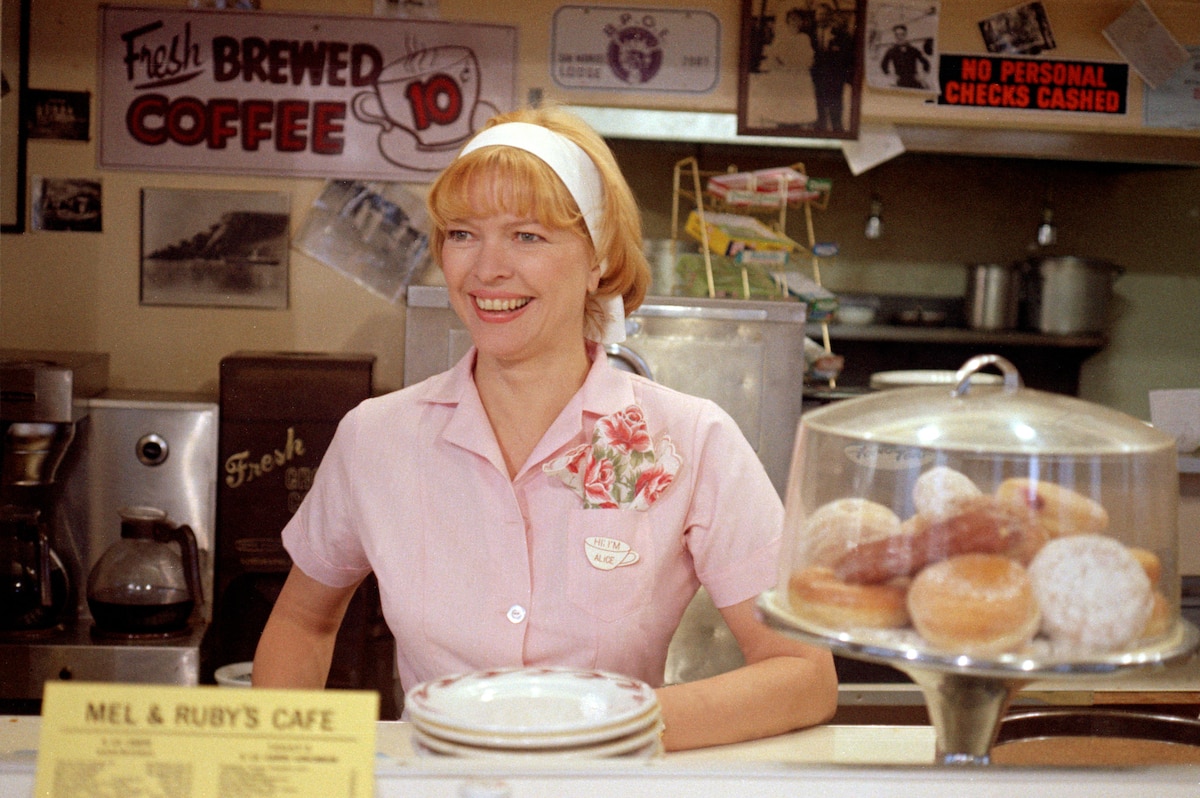
In the process of rehearsal and shooting, it became apparent the biggest snag in Alice Doesn't Live Here Anymore was going to be the ending. Screenwriter Robert Getchell had Alice marry David in the original draft. Burstyn thought that was too conventional and wanted it changed, but Warner executive John Calley rejected the notion that Alice would leave David and go off on her own: "We already made a movie last year with an unhappy ending, Scarecrow [1973], and it didn't make any money." Burstyn bridled: "Are you telling me that if she ends up with a man, it's a happy ending, and if she doesn't, it's an unhappy ending?" She thought the film should end with David proposing marriage, Alice saying maybe, and then continuing on the road. Getchell told her point blank that if she didn't end up with David, they weren't making the movie. The scene was rewritten many times, generally to no one's satisfaction, and up to the day before shooting the final diner scene, the problem still wasn't resolved. As they were rehearsing the next day's scene (something that was done every day, according to Burstyn), they tried improvising so she could find a way to make it work for the studio without compromising the theme of a woman's search for independence. In the course of the improv, Kristofferson blurted out "Come on, I'll take you to Monterey." The smile on Burstyn's face in response to this was genuine. She was happy with this solution, although in her autobiography she lamented that it came from the man she was working with and not herself.
According to Scorsese in an interview with Tony Macklin, the shot of Alice and Tommy walking off together with a big sign saying "Monterey" ahead of them was not planned. It was only when cinematographer Kent Wakeford alerted him that it was in the shot that Scorsese became aware of it and very excited by it, instructing Wakeford not to crop it out of the frame.
The set for the opening sequence, modeled on the look and feel of The Wizard of Oz (1939) and other movies, cost $85,000. Scorsese called it "the first time in my movie career that I was able to build a proper set." According to Scorsese, he had the services of Darrell Silvera, set decorator of Citizen Kane (1941), The Magnificent Ambersons (1942), and Cat People (1942), along with other pictures from Val Lewton's legendary horror unit at RKO in the 1940s. Silvera, however, is not credited on Alice.
Scorsese also said that veteran cinematographer Russell Metty, who worked multiple times with John Huston, Orson Welles, Douglas Sirk, and Stanley Kubrick (winning an Oscar® for Spartacus, 1960), happened to be present at the studio and shot the tests for that sequence.
The purpose for the highly stylized opening, according to Scorsese, was to find a way to represent how Alice saw her past. "In her mind, Monterey is fantasy, pure illusion. So I shot a flashback [to the late 1940s] as if it were a Hollywood movie being made on a soundstage. Unreal. Because that's where Alice is at."
According to Ellen Burstyn, Warner Bros. executives wanted to cut the opening sequence of Alice as a little girl in Monterey but Scorsese told them they would have to take his name off the picture if they did.
The first cut of Alice Doesn't Live Here Anymore was three hours and sixteen minutes. Scorsese trimmed it down to just under two hours for its release, losing entire sequences and characters. He was especially unhappy about losing so much of the Socorro sequence, which he believed would have made Alice's husband into a more fleshed-out character. He wanted this part of the movie to be about a third of the picture's running time, but preview audiences were bored with it and felt the movie really didn't get started until she and Tommy hit the road.
by Rob Nixon
Behind the Camera - Alice Doesn't Live Here Anymore
by Rob Nixon | December 30, 2011
SIGN UP FOR OUR NEWSLETTERS

CONNECT WITH TCM