Filming began on Camille during the late summer of 1936. From the very beginning of the production, there was a feeling in the air that the film would be something very special.
Greta Garbo gradually relaxed enough to be able to trust that her first experience being directed by George Cukor would be a good one. It helped that her longtime cinematographer William Daniels was also behind the camera. Daniels, known as "Garbo's Cameraman," was brilliant at his craft and seemed to know better than anyone how to best capture Garbo's luminescent beauty on film.
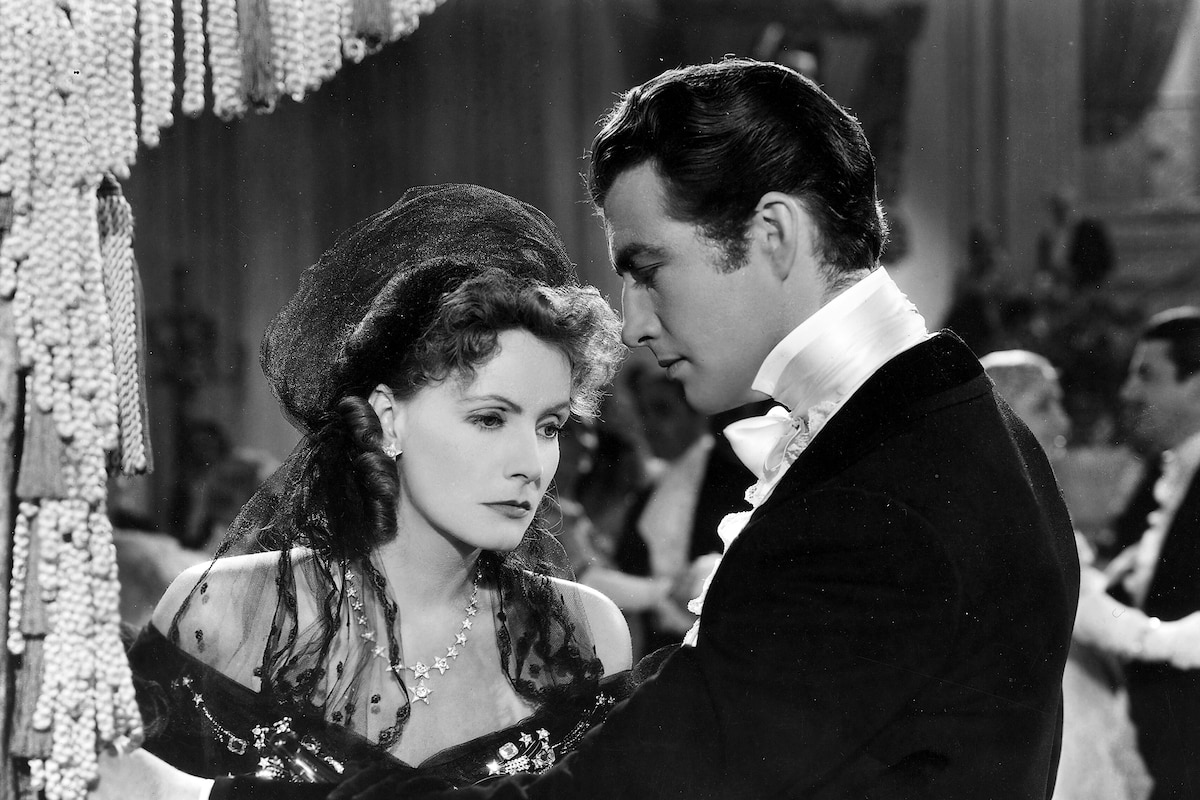
As was her nature, Garbo didn't like having a lot of people around the set, and she kept those who were there at arm's length. However, she did make an effort to put co-star Robert Taylor at ease, even if she wasn't exactly warm. It was all part of her method. "Garbo didn't talk much to Robert Taylor," remembered George Cukor. "She was polite but distant. She had to tell herself that he was the ideal young man, and she knew if they became friendly she'd learn he was just another nice kid."
Garbo's approach to playing Marguerite was different from her predecessors. Her natural instincts and choices were a testament both to her talent and the skilled contributions of screenwriter Zoe Akins, to whom George Cukor gave much credit. "[Akins] managed to create a whole language, a kind of argot for the story," said Cukor. "She wrote one very good scene of a party at Marguerite's house. All these tarts were sitting around, and Zoe had the idea they told rather coarse jokes in front of each other and Armand was shocked by it. In the middle of all these tarts being so raucous and common, Marguerite has a coughing spell. It was the only time she really coughed in the film. Most of the time she suggested her tuberculosis by little dry clearings of the throat and touching her mouth. Most ladies cough and splutter their way through this part...What Garbo did in that scene was she suddenly lost her breath and went into the other room. Armand comes in and he's revolted by the coarseness he's just heard, and I'll never forget how beautifully Garbo played the next moment. She has a line that Zoe Akins wrote -- 'Oh, I'm just a girl like all the rest' -- as if to warn him not to put her on a pedestal and sentimentalize her."
Many people found Garbo's process as an actress inscrutable, though no one questioned it because the results spoke for themselves. Her habit was to work out a performance ahead of time in private as much as possible. Too many eyes on her in front of the camera made her uneasy. As Cukor once explained, "[Garbo] said that when she was acting she had some sort of an ideal picture in her mind -- something she was creating -- and she never saw the rushes because she was always disappointed in what she saw. But she said while she was acting she could imagine certain things and if she saw people just off the set staring at her, she felt like an ass, like somebody with a lot of paint on her face making faces. It stopped her imagination."
Sometimes Garbo's choices while making Camille surprised Cukor. For instance: the scene early on in which Marguerite kisses Armand all over his face. It was an undirected action Garbo took that Cukor called "memorable" and "erotic." At other times, Cukor was able to use his own directing instincts to use Garbo's natural aloofness to the film's advantage, such as during the scene at the beginning of the film when Marguerite goes to the theater. "I wanted to show that Marguerite was a public woman, that she went to the theater to be seen," explained Cukor. "She had to walk through a crowded lobby of men...I wanted her to walk through to show herself, as if on parade for clients. At first Garbo walked through rather quickly, as if she didn't want to be seen. I might have said, 'Walk through a little more brazenly, a little more slowly,' but I didn't. I realized she was right. She could slip through, and you knew damn well the men would look at her anyway."
Even though Garbo liked Cukor, he did have one behavior on the set that annoyed her. He had the habit of sitting behind the camera during a scene and mouthing the words along with the actors, sometimes making hand and facial gestures as well. Garbo didn't waste any time telling him that she found it extremely distracting and asked him to stop. Nevertheless, she and Cukor worked remarkably well together, and over the course of filming they developed a deep respect for each other.
When MGM production head Irving Thalberg saw the rushes, he could barely contain his enthusiasm. He was sure that Camille would be a great success and had nothing but praise for his leading actress. "I think we have caught Garbo as she should be caught," said Thalberg. "She will be the most memorable Camille of our time."
In the middle of production, however, Thalberg, who had always suffered from congenital health problems, suddenly died of a heart attack at age 37. Thalberg had been a much beloved figure at the studio who had overseen some of MGM's greatest triumphs. His death sent a wave of shock and grief throughout the studio and left some productions in precarious question. A short time later, however, production did resume on Camille, though hearts were heavy.
Thalberg's death came on the heels of George Cukor losing his own mother earlier during production, and the sense of grief was palpable. The loss inevitably hovered over the remaining time on Camille, especially while Garbo filmed Marguerite's famous death scene. The emotions that everyone brought to the moment helped make the scene memorable and deeply moving.
by Andrea Passafiume
Behind the Camera - Camille
by Andrea Passafiume | December 30, 2011
SIGN UP FOR OUR NEWSLETTERS

CONNECT WITH TCM