In 1848 French writer Alexandre Dumas, fils. published the novel La Dame aux Camelias about the doomed romance between Marguerite, an ailing courtesan, and Armand, her devoted lover. In 1852, the novel was turned into a celebrated play on whose success Dumas made both his name and fortune. The fictional story was reportedly based on the author's own ill-fated love affair with famed Parisian courtesan Marie Duplessis who died of tuberculosis in 1844 at the age of 23. In English speaking countries, La Dame aux Camelias became loosely translated into the new title Camille.
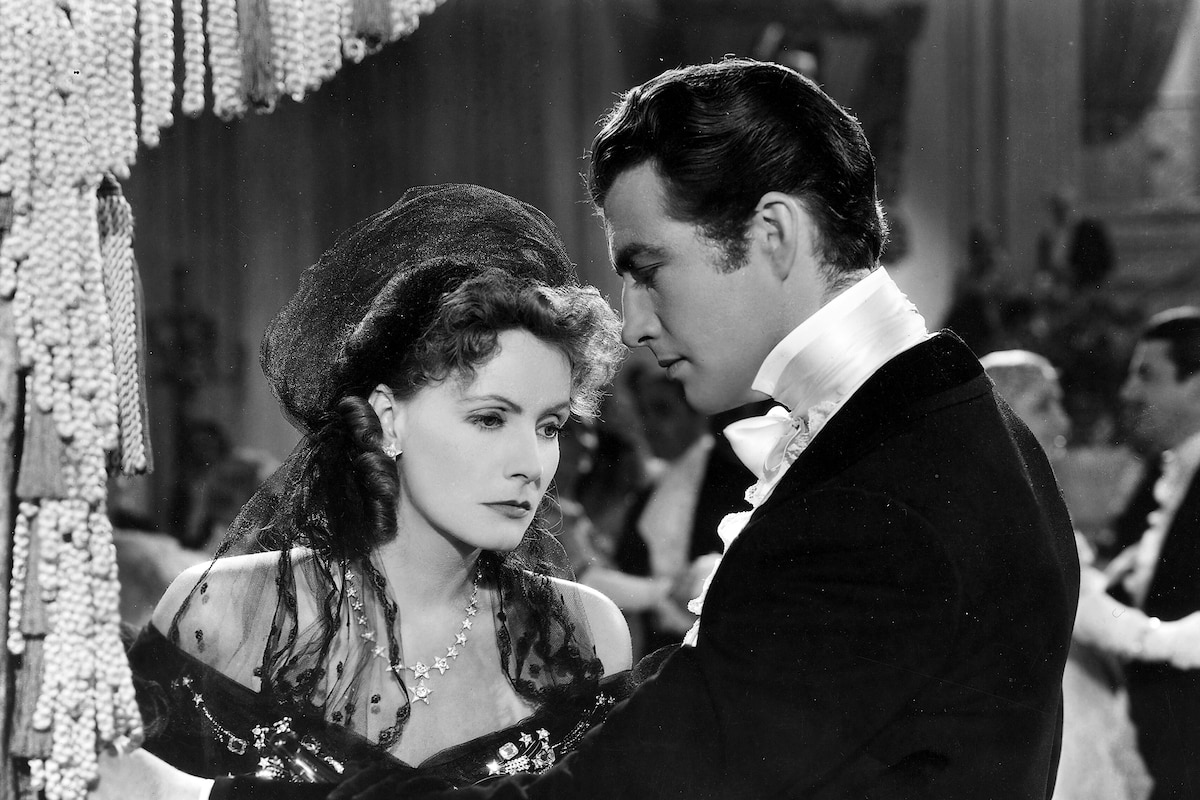
During the silent era, the story of Camille was filmed several times, most famously in 1926 with actress Norma Talmadge in the title role. The sentimental love story was proving to be one of great endurance, tugging on the heartstrings of every new generation. In 1936, the most powerful studio in Hollywood, MGM, was ready to invest in a lavish big budget production of Camille with their highest paid star, Greta Garbo, in the lead.
Garbo was at the peak of her remarkable career as well as her unique beauty in 1936. MGM was actually planning to make two films with her that year -- Camille and Conquest, about the love story between Napoleon and Marie Walewska. Garbo's frequent director Clarence Brown would only be making one of them, and MGM subsequently gave George Cukor a chance to direct the other. He had a choice between the two projects. Cukor, who had already proven his mettle at the studio with such films as Dinner at Eight (1933), David Copperfield (1935) and Romeo and Juliet (1936), chose Camille. It would be the first time that he and Garbo worked together.
Even though the story of Camille had endured since 1848 and become a classic, in 1936 it was beginning to show some dust around the edges. George Cukor was faced with the challenge of making the dated melodrama relevant and appealing to modern audiences. "The play presented some enormous problems," said George Cukor according to the 2005 book Greta Garbo: A Cinematic Legacy by Mark A. Vieira, "because you had to make a modern audience understand its conventions. It came from a time when a woman's reputation, her virtue, was a terribly important thing and a big bonanza for drama." The trick would be in getting audiences to look past the period costumes and manners and still be moved by a love story that was timeless.
The first order of business for MGM's new production of Camille was to have a fresh screenplay adaptation written. Cukor brought in noted screenwriter Frances Marion, who was well versed in the story. She had penned the 1915 silent scenario starring Clara Kimball Young and also contributed to the 1926 silent version starring Norma Talmadge. Marion was also no stranger to working with Garbo, having written the screenplay for the Swedish silent star's first talking picture, Anna Christie (1930).
Frances Marion and colleague James Hilton pounded out a draft of the new screenplay. Eventually a third writer, Zoe Akins, was brought in to do a polish, and all three ended up being credited on the film.
Garbo was reportedly excited to tackle the role of Marguerite, although her legendary mystique and inscrutability often left George Cukor scratching his head over what she was really thinking. "I sensed that she was a little distrustful of me," said George Cukor. "Having her own very clear idea of how La Dame aux Camelias ought to be played on the screen, she was not unnaturally afraid that I, too, would have ideas on the subject, and that a clash would develop when we faced each other...on the studio stage."
Garbo also made an impression on Frances Marion, with whom she had worked several years before. "[Garbo] gave no impression of having aged, but she had lost that darkly brooding look in her eyes which was so unfathomable when she was young," said Marion in her 1972 autobiography Off With Their Heads!. "If you spoke to her, even a casual greeting, she gave you a look at once watchful and shrewd. Curiously, it was never a direct look, but seemed to bypass you and focus upon some distant object. This was Garbo's way of rejecting you; she did not want to be burdened with too many friends."
With such a larger than life star as Garbo, the biggest challenge was to find a male co-star who could hold his own opposite her. "There was more parleying about the selection of her leading man," said Frances Marion, "than electing a senator." Everyone wondered if Armand should be played by a European actor or an American. Eventually, George Cukor settled on Robert Taylor, who had almost been rejected for being "too handsome," according to Marion. Taylor was a fresh new face at the time, having been slowly groomed by MGM for stardom. After being loaned out to make Magnificent Obsession (1935) at Universal opposite Irene Dunne, Taylor was finally making a name for himself and ready to take on the daunting task of sharing the silver screen with MGM's top actress. He was admittedly intimidated and "scared to death," but he rose to the challenge of playing Armand.
"Armand is historically a terrible part," said Cukor. "It was usually played by middle-aged men. As a result he seemed stupid doing the things he did. When you get someone really young playing Armand, you understand him; he becomes appealing, with a kind of real youthful passion; whereas if he were thirty-eight years old, you'd think, 'Oh, you ass, why do you do that?' So that very crudity, that intensity of young passion made Robert Taylor an extremely good Armand."
With cameras set to roll in the late summer of 1936, MGM was ready to realize one of its most lavish productions. When MGM production head Irving Thalberg got a look at Greta Garbo together with Robert Taylor, he exclaimed with supreme confidence, "We can't miss with these two!"
by Andrea Passafiume
The Big Idea - Camille
by Andrea Passafiume | December 30, 2011
SIGN UP FOR OUR NEWSLETTERS

CONNECT WITH TCM