When Close Encounters of the Third Kind was first released, Steven Spielberg asked Ray Bradbury, the legendary author of such works The Martian Chronicles and Fahrenheit 451, "How do you like your film? Close Encounters wouldn't have been born if I hadn't seen It Came from Outer Space six times when I was a kid." Bradbury had written the original treatment for that 1953 film. Indeed, Close Encounters and other Spielberg works would seem to owe a lot to Bradbury, not only to his sci-fi novels but to such stories of almost magical everyday life as Dandelion Wine and Something Wicked This Way Comes.
According to a 1994 Entertainment Weekly feature, "A Viewer's Guide to Sci-Fi's Greatest Hits," author Ray Bradbury declared this the greatest science fiction film ever made. In the Los Angeles Times in November of 1977, the renowned science fiction author called Close Encounters, "The most important film of our time. ... For this is a religious film, in all the great good senses, the right senses, of that much-battered word ... because for the first time someone has treated all of us as if we really did belong to one race."
According to film historian and critic Joseph McBride, Jean Renoir compared Spielberg's storytelling in this picture to Jules Verne and Georges Meliés.
As to be expected with a director so immersed in movies of all kinds, many viewers have noted what they believe to be several references to other movies, some direct and obviously intentional, others more oblique:
- the use of the song "When You Wish Upon a Star" from Pinocchio (1940), the Disney movie Roy Neary (Richard Dreyfuss) unsuccessfully tries to talk his kids into seeing instead of going to play Goofy Golf
- the Neary kids watching The Ten Commandments (1956) on television
- a resemblance between the shot of the people in India pointing en masse to the sky and the shot of throngs reaching up to the Tower of Babel in Fritz Lang's Metropolis (1927)
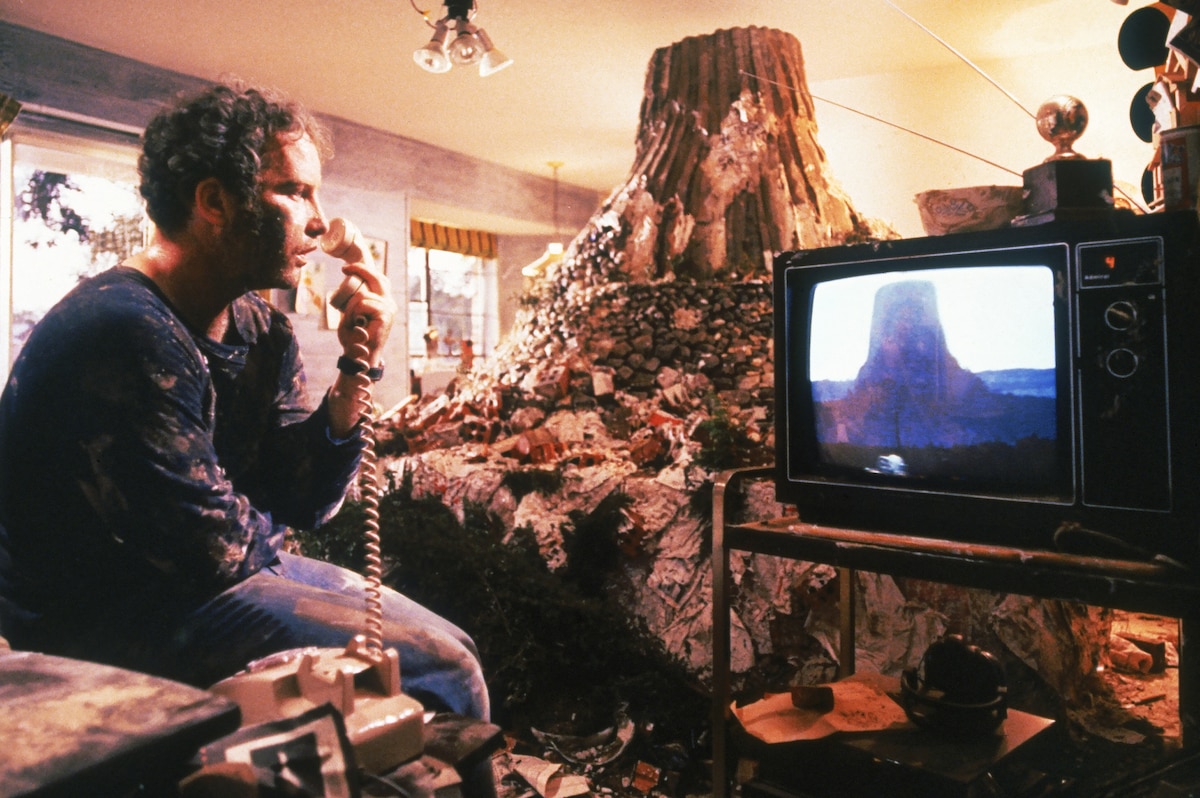
- Dreyfuss sliding down the slope of Devil's Tower as Melinda Dillon reaches out to help him, with their fingers touching, similar to shots from the Mount Rushmore sequence in Hitchcock's North by Northwest (1959), an allusion bolstered by a line a short time later in the mother ship landing sequence, when the Project Leader talks about "uncorrelated targets approaching from the north-northwest"
- an homage to Spielberg's friend George Lucas's Star Wars (1977), with a barely discernible glimpse of the R2D2 character from the Lucas film "hitchhiking" on the underside of the mother ship
The connection to Pinocchio was reinforced by Spielberg's statement that when Roy realizes his dream by entering the mother ship at the end, he is symbolically reborn. He "becomes a real person. He loses his strings, his wooden joints." The rebirth is also similar to that of the astronaut at the end of 2001: A Space Odyssey (1968).
Spielberg biographer Joseph McBride has noted several other works that likely influenced Spielberg in creating this story:
- the theme of aliens helping humans to a higher spiritual state from the novel Childhood's End and the story "The Sentinel" (the source of the Kubrick movie 2001: A Space Odyssey by one of Spielberg's favorite sci-fi writers Arthur C. Clarke), not to mention a similar theme in the movie The Day the Earth Stood Still (1951)
- the kidnapping of the child Barry by the aliens, credited by Spielberg to writers Hal Barwood and Matthew Robbins, but reflective of the same theme and some of the visual elements in John Ford's The Searchers (1956), a film Spielberg watched twice while on location with Close Encounters
- the idea of ordinary people beginning to act strangely after apparent contact with aliens as in the Bradbury-penned film It Came from Outer Space, which also posited the idea of aliens being benign
Some critics have dug for biblical analogies. If they do, in fact, exist, they may be evidence of Paul Schrader's hand in the script development, since he claimed his draft had much more of a biblical character (modeled after St. Paul) and planted the idea of a spiritual quest in the desire to contact aliens. In this respect, Devil's Tower has been compared to Mount Sinai with the aliens as God and Roy Neary as Moses. Others have likened Roy's entrance into the spaceship to Elijah being borne away in a chariot of fire and his urging to Jillian not to look back as they climb the mountain to Lot's command to his wife as they leave Sodom.
The story "Dulcie and Decorum" by Damon Knight has been cited as an influence on Close Encounters of the Third Kind and several others. The aspects relevant to Close Encounters are the central premise of an obsession the main character has with an idea implanted in his head by an alien intelligence, the character's construction of a structure in his garage resembling a maze, and the marital discord and gradual loss of contact with his wife resulting from these obsessions.
Close Encounters has also been directly referenced in other works. In the James Bond adventure Moonraker (1979), the five note sequence is heard when a scientist enters a combination into an electronic door lock. In an episode of the animated TV comedy series South Park entitled "Imaginationland," a scientist similarly uses the five notes to try to open a portal.
Although the title actually comes from a term coined by astronomer and ufologist J. Allen Hynek, its frequent, often satirical use is more likely traceable back to the movie's popularization of the notion of close encounters. Among the examples: a review of the animated film Arthur Christmas (2011) on The Bloodshot Eye film blog entitled "Close Encounters of the Santa Kind" and, more to the point, a review of the Spielberg film War Horse (2011) by Stephen Whitty of the Star-Ledger entitled "Close Encounters of the Herd Kind." The title has also been parodied as "Close Encounters of the Worst Kind" (the Alice TV series), "Luncheon Counters of the Third Kind" (Saturday Night Live), "Cone Encounters of the Third Kind" (another SNL with guest host Richard Dreyfuss), and "Close Encounters of the Frog Kind" (Muppet Babies). The list goes on and on, including a number of twists on the title in the old-movie spoof series Mystery Science Theater 3000, which also made frequent sport of the five-tone musical motif and the notion of sculpting mountains out of mashed potatoes, both of which have been repeatedly spoofed in movies and on television.
One of the strangest, but probably most inevitable, pop culture offshoots to come directly from Close Encounters of the Third Kind was the rumor that, because of the secrecy under which the film was shot, it was being financed by the government as part of the training needed to prepare humans for an actual alien landing. In fact, NASA and the Air Force refused to cooperate with the production, fearing it would spread panic about UFOs just as Spielberg's Jaws had caused an inordinate amount of public anxiety about "killer" sharks. Spielberg said his faith in the possibility of UFOs was boosted when he received a 20-page letter from NASA stating their opposition to the film: "I knew there must be something happening." The rumor about the government's sponsorship of the film persisted and grew when Spielberg released E.T.: The Extra-Terrestrial (1982). In fact, a story circulated that when the director screened the film at the White House, President Ronald Reagan confided to him, "You know, there are fewer than six people in this room who know the real story."
Underground filmmaker and movie historian Kenneth Anger, author of the book Hollywood Babylon, claimed that Close Encounters ripped off elements of his movies Scorpio Rising (1964) and Lucifer Rising (1972), and he went to see it six times to determine that. He even wrote, in a short review of the film, that in the burst of static in the air traffic control tower he could hear his name as "kenanger," as if being taunted by Spielberg.
It would be a pointless discussion to determine how much Spielberg's physical depiction of the aliens was influenced by earlier images and how much it influenced, or at least perpetuated the popular image of extra-terrestrials. They closely resemble the reborn embryonic character at the end of 2001 and the photos of alleged alien corpses said to have been found in a crashed spaceship near Roswell, New Mexico. They also bear close resemblance, of course, to the eponymous creature of Spielberg's later E.T..
During production, Francois Truffaut, whose film Small Change (1976) is one of the best cinematic depictions of childhood, suggested to Spielberg that he should make a film about kids "because you are a kid yourself." This suggestion quite likely blossomed into E.T. a few years later.
Of all the many influences Close Encounters has had on popular culture, perhaps the most important is Spielberg's bold and unprecedented decision to re-cut and re-shoot parts of his film and re-release it only three years later as the Special Edition. Other directors (such as Hitchcock) remade older works, many directed sequels, and others have spoken about what they would do differently if they had the chance. In the old studio area, a film might be pulled from release, recut and reissued by the studio, but no director up to this time had re-vamped a hit movie for re-release after its original run. Now in the age of films on DVD, it's quite common to see new or alternate versions of a film, often called "director's cuts," such as the multiple versions of Blade Runner (1982) available for viewing.
by Rob Nixon
Pop Culture 101 - Close Encounters of the Third Kind
by Rob Nixon | December 30, 2011
SIGN UP FOR OUR NEWSLETTERS

CONNECT WITH TCM