Director Carol Reed was the illegitimate son of famed British actor-impresario Sir Herbert Beerbohm Tree, who dominated the British stage in the Edwardian Era. Reed was fascinated by his larger-than-life father and determined to follow him into show business, a desire Tree encouraged. He used to allow the boy to watch him rehearse and to stand in the wings during performances. Years later, Reed would call on some of the actors he met in these childhood experiences to be character players in his movies.
Reed started out as an actor before working behind the camera. After a stint as a dialogue director at Ealing Studios, he made his feature debut with Midshipman Easy (1935).
Author Graham Greene, two years older than Reed, began reviewing films for the Spectator in 1935, the same year Reed made his directing debut. Greene was well impressed with Reed's filmmaking skills, saying he thought he had "more sense of the cinema than most veteran British directors." Over the next few years, Greene gave Reed a number of glowing reviews for his "fine film and literary intelligence."
Reed's experience with young Bobby Henrey and his skill in directing the boy in The Fallen Idol paid off well years later when he made the musical Oliver! (1968), based on Charles Dickens's Oliver Twist. It was to be Reed's only Best Director Academy Award. The film also won Best Picture. Reed never won a British Academy Award (BAFTA), and Oliver! was his only nomination in his own country.
After The Fallen Idol, Bobby Henrey reportedly signed a lucrative contract with producer Alexander Korda to make four more films before 1952. He made only one, the comedy Wonder Boy (1951), before retiring from acting at the age of 11. He worked as a tax consultant for most of his adult life while also pursuing studies toward the ministry. After retiring from his financial career, he became an interfaith chaplain at a Greenwich, Connecticut, hospital.
Ralph Richardson made several acclaimed film appearances, including his Oscar®-nominated roles in The Heiress (1949) and Greystoke: The Legend of Tarzan, Lord of the Apes (1984), but his first love always remained the theater. He once said, "I find I cannot increase my talent by working in pictures any more than a painter can do so by increasing the size of his brush."
While this picture was in production, it was announced that Reed's next project would be in Hollywood, a film based on the play Portrait in Black to star Joan Crawford. The project never happened. Portrait in Black was eventually made in 1960, starring Lana Turner and Anthony Quinn.
As production on The Fallen Idol was drawing to a close, Korda mentioned to Greene that he thought a great film could be made in the bombed out ruins of postwar Vienna. Greene knew just the story, one he had already begun to think about after scribbling the first paragraph on the back of a napkin: "I had paid my last farewell to Harry a week ago, when his coffin was lowered into the frozen February ground, so it was with incredulity that I saw him pass by, without a sign of recognition, among the host of strangers in the Strand." The story would become The Third Man (1949), the most famous of the collaborations undertaken by Korda, Greene, and Reed.
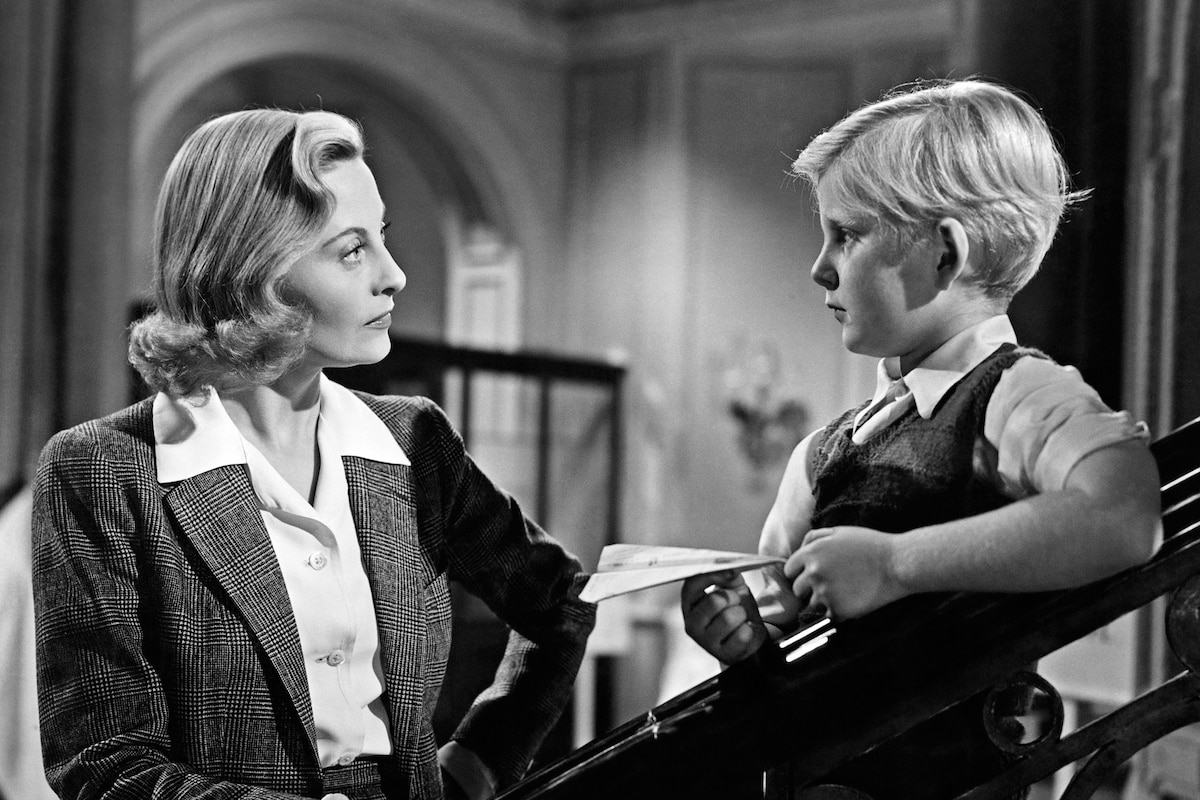
Leading lady Michèle Morgan was already a big star in her native France when she was cast in The Fallen Idol, having appeared in such major productions as Marcel Carné's Quai des Brumes (1938) and La Symphonie Pastorale (1946). She had also appeared in a few Hollywood films, including Joan of Paris (1942) and Passage to Marseille (1944). Morgan received top billing for The Fallen Idol on many posters and lobby cards but second billing in the on-screen credits, after Ralph Richardson. Morgan continued to act through the late 1990s. She also became an author and the designer of a line of neckties.
Jack Hawkins, who played Detective Ames, became one of England's most popular stars of the 1950s and 1960s and a frequent player in big international productions, including Howard Hawks's Land of the Pharaohs (1955), Ben-Hur (1959), Zulu (1964), and David Lean's The Bridge on the River Kwai (1957) and Lawrence of Arabia (1962).
Bobby Henrey's mother, Madeleine, was hired at the last moment to play his mother in the film's final scene.
Dandy Nichols, who played one of the cleaning women, Mrs. Patterson, was a longtime stage actress and later the star of Til Death Us Do Part, the comedy television series that was adapted in the U.S. as All in the Family.
Georges Perinal had a distinguished career in his native France, England, and occasionally Hollywood. He was the cinematographer on René Clair's Under the Roofs of Paris (1930), Le Million (1931), and À Nous la Liberté (1931); Jean Cocteau's The Blood of a Poet (1932); No Highway in the Sky (1951) and Otto Preminger's Saint Joan (1957). In addition to frequent work with Korda, including The Four Feathers (1939), for which he received an Academy Award nomination, he was also in demand in the U.K. for his great facility with color, a skill much appreciated by director Michael Powell on The Life and Death of Colonel Blimp (1943) and the Korda-produced The Thief of Bagdad (1940), which brought Perinal an Oscar® for Best Color Cinematography.
The press book for The Fallen Idol that was sent to exhibitors upon the film's release suggested several tag lines to promote it: "Graham Greene's story of an eventful weekend;" "Stately triangle melodrama;" "Unusual and intriguing sex melodrama;" and the rather disturbing "Bobby Henrey...the child discovery of the age--may he never grow."
Even before the release of The Fallen Idol, and despite efforts to keep Bobby Henrey's name out of the press and to ban reporters on set when he was present, reports started leaking that the boy's performance, under Carol Reed's expert handling, was exceptional. Critic Dilys Powell wrote, "[Reed's] admirers have waited for The Fallen Idol with an eagerness for which impatience is too soft a word."
Author Graham Greene never liked the title The Fallen Idol, calling it "meaningless...for the original story, and even for the film it always reminded me of the problem paintings of John Collier." Handling its American release, David O. Selznick considered retitling the film "The Eye Witness" but finally settled on "The Lost Illusion," the working title during production. Some sources list this as the U.S. release title, but it's debatable how widely it was used, since Bosley Crowther's New York Times review of 1949, following its opening in New York, called it The Fallen Idol.
The U.S. release of The Fallen Idol was delayed until November 1949 because of demands from American censors to cut bits of dialogue. Reed, who had previously tangled with Joseph I. Breen over Odd Man Out (1947), was determined that any needed cuts be done by him in London, in order to preserve the integrity of Greene's dialogue and the actors' performances, but he knew that the picture's distribution in the States depended on compromising to an extent. Breen particularly wanted two things cut: any suggestion that Rose was a prostitute, and the scene of Julie being interrogated in the bedroom that indicated she and Baines had been in bed together. The chief censor also objected to Rose's line to the boy, "I know your daddy," implying the ambassador might have contracted her "services" at some point. Pushed by Selznick to get the problems resolved and The Fallen Idol into theaters quickly, plus banking on the American censor's unfamiliarity with nuances of British speech, Reed made minimal cuts and released the film to great acclaim from U.S. reviewers. The few pieces that were eliminated were restored in the film's American re-release many years later.
"Heartiest congrats on your brilliant directorial job on Fallen Idol. You know how many years I have been a fan of yours and of your work but it has now reached a new high." - producer and American distributor David O. Selznick, 1948
"The Fallen Idol is my favourite screen work because it is more a writer's film than a director's. The Third Man, although it was more popular because of the song, "The Third Man Theme," is mostly action with only sketched characters. It was fun doing, but there is more of the writer in The Fallen Idol." - Graham Greene, quoted in Graham Greene: Man of Paradox, edited by A.F. Cassis (Loyola Press, 1994)
Memorable Quotes from THE FALLEN IDOL
MRS. BAINES (Sonia Dresdel): You know what happens to little boys who tell lies.
MRS. BAINES: Lying again, Master Phillipe?
BAINES (Ralph Richardson): There's lies and lies.
MRS. BAINES: What do you mean by that?
BAINES: Some lies are just kindness.
PHILLIPE (Bobby Henrey): I hate you.
MRS. BAINES: Master Phillipe, say you're sorry for that.
PHILLIPE: I'm not sorry.
PHILLIPE: What kind of man is he?
JULIE (Michèle Morgan): Good. Kind. Couldn't hurt anyone.
BAINES: What a fool the man is.
PHILLIPE: That's what I think, too.
PHILLIPE: You can trust me, Baines.
BAINES: Mrs. Baines will get it out of you if she can.
PHILLIPE: Oh, I'll never let you down, Baines. Funny, isn't it? Julie working at the embassy and all this time she was your niece.
BAINES: Yes, it's a scream.
MRS. BAINES: You want your freedom?
BAINES: You don't want me around anymore.
MRS. BAINES: You're not such a child as you pretend to be. You've got a nasty, wicked mind and it ought to be beaten out of you.
POLICE SERGEANT (George Woodbridge): Does your father work at the embassy?
PHILLIPE: No, he's the ambassador.
ROSE, THE STREET WALKER (Dora Bryan): Oh, I know your daddy!
INSPECTOR CROWE (Dennis O'Dea): Why did the boy ask you if it was in self-defense as in Africa?
BAINES: I've never been out of the country. Except once, to Oostende.
PHILLIPE: We've got to think of lies and tell them all the time and then they won't find out the truth.
BAINES: There are faults on both sides, Phil. We don't have any call to judge. Perhaps she was what she was because I am what I am. We have to be very careful, Phil, because we make one another.
PHILLIPE: I thought God made us.
BAINES: The trouble is, we take a hand in the game.
INSPECTOR CROWE: Shall I tell you a secret?
PHILLIPE: No!
Compiled by Rob Nixon
Trivia - The Fallen Idol - Trivia & Fun Facts About THE FALLEN IDOL
by Rob Nixon | December 29, 2011
SIGN UP FOR OUR NEWSLETTERS

CONNECT WITH TCM