Behind the Camera On THE RAZOR'S EDGE
Edmund Goulding was a director actors either loved or hated. He had a habit of asking to "be" the actor to get what he wanted. In her autobiography, Self-Portrait, Gene Tierney relates exactly how Goulding did it:
"When he wanted to describe to you how a particular scene should be played, he would step in front of the camera and say, 'May I be you?' Then he would promptly act out the entire scene."
Tierney found it delightful and even wrote, "I don't recall a set where there was more cheerfulness." Others, like Clifton Webb, adamantly disagreed, remarking, "He had everybody entranced but me, and I'm afraid I remained cold to this type of thing to the very end."
The Razor's Edge was to be Tyrone Power's first movie after returning from service overseas and Power was thrilled to be working on such a prestige production with such a great cast. He especially got along well with director Goulding. He later remarked that Goulding was his personal favorite even after Goulding made a strange request of him on the set. To capture the essence and mindset of Larry Darrell, the film's protagonist, Goulding asked Power not to have sexual relations until after the scenes with the Yogi in the east had been shot. Power happily agreed and later said, "I know by personal experience that in nothing are the wise men of India more dead right than in their contention that chastity intensely enhances the power of the spirit." Later, when Power found out Goulding asked this of all his leading men as a way of achieving a certain look, he broke into laughter.
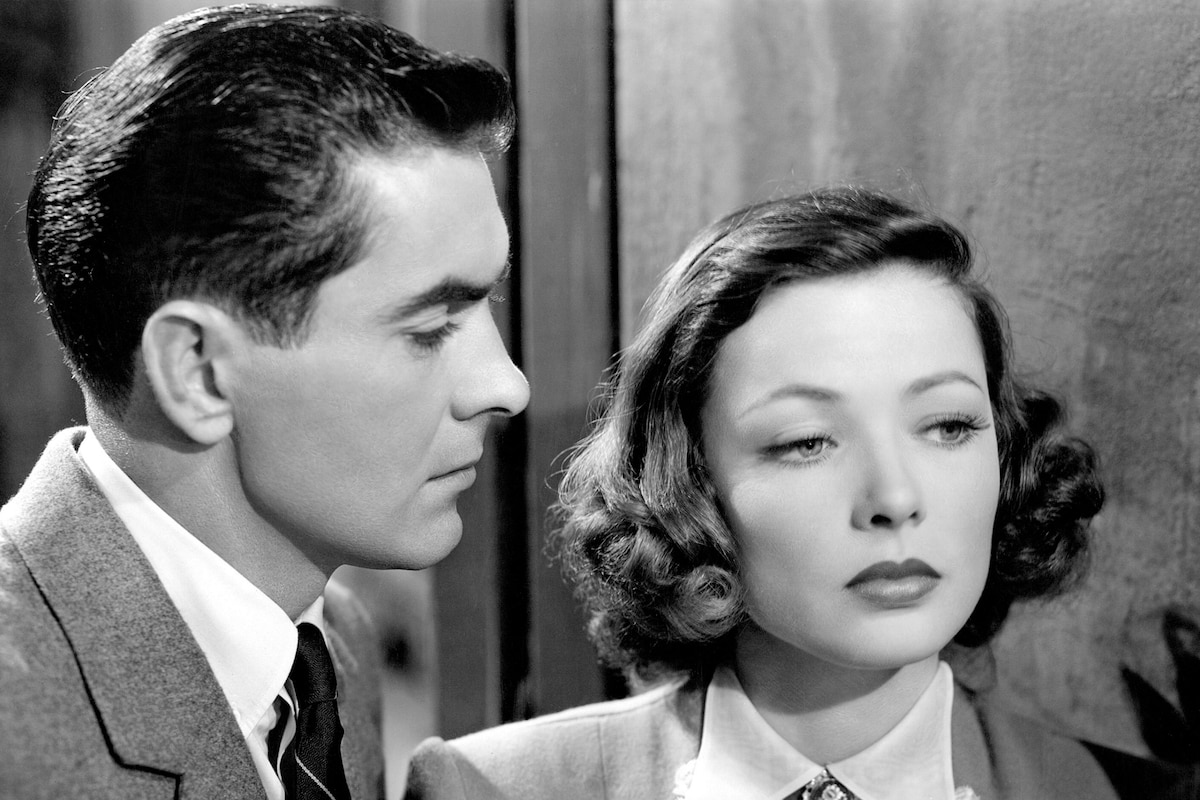
Power got along well with Gene Tierney too. In the movie, Tierney's character falls for Power's character but on the set, it was Power who fell for Tierney. As soon as this was noticed, rumors began to fly that the two were romantically involved in real life. After the premier, Power brought her a scarf with the word "Love" embroidered on it as a gift and she had to tell him she was seeing John Kennedy, one of the sons of Joseph Kennedy, still years away from his political victories in the U.S. Senate and the Presidency. Power understood and made no more advances. Tierney's own husband, Oleg Cassini, was working on the movie too, designing her dresses but the two had already decided to divorce and there was no tension between them at any point during the shoot.
Anne Baxter had to leave the set of The Razor's Edge for several weeks and when she returned found she felt like an outsider, everyone else having developed working relationships in her absence. She liked this and used it, since her character Sophie is also on the outs and not able to cope with the loss of her husband and child. Whatever she did, it worked. Baxter would be the only person involved with the film to walk away from it with an Oscar®.
Of course, most people in the community felt Clifton Webb should have won one too but had the bad luck to run up against Harold Russell, a real-life war veteran amputee who took home Best Supporting Actor for The Best Years of Our Lives (1946).
After principal shooting, Darryl Zanuck took over, instructing editor J. Watson Webb on what to cut and how to cut it. The Fox mogul took control of post-production like few producers today and directors working with him understood, implicitly, that once the principal photography was done, the movie was out of their hands. It wasn't a bad deal, as Zanuck had a good feel for pacing and the final result, coming in at almost two and half hours, moves along at an easy pace. It wasn't the Oscar® hit Zanuck wanted, but it was a box office success all the same, with almost everyone who worked on it, even Clifton Webb, expressing delight with their experience.
by Greg Ferrara
Behind the Camera - The Razor's Edge
by Greg Ferrara | December 29, 2011
SIGN UP FOR OUR NEWSLETTERS

CONNECT WITH TCM