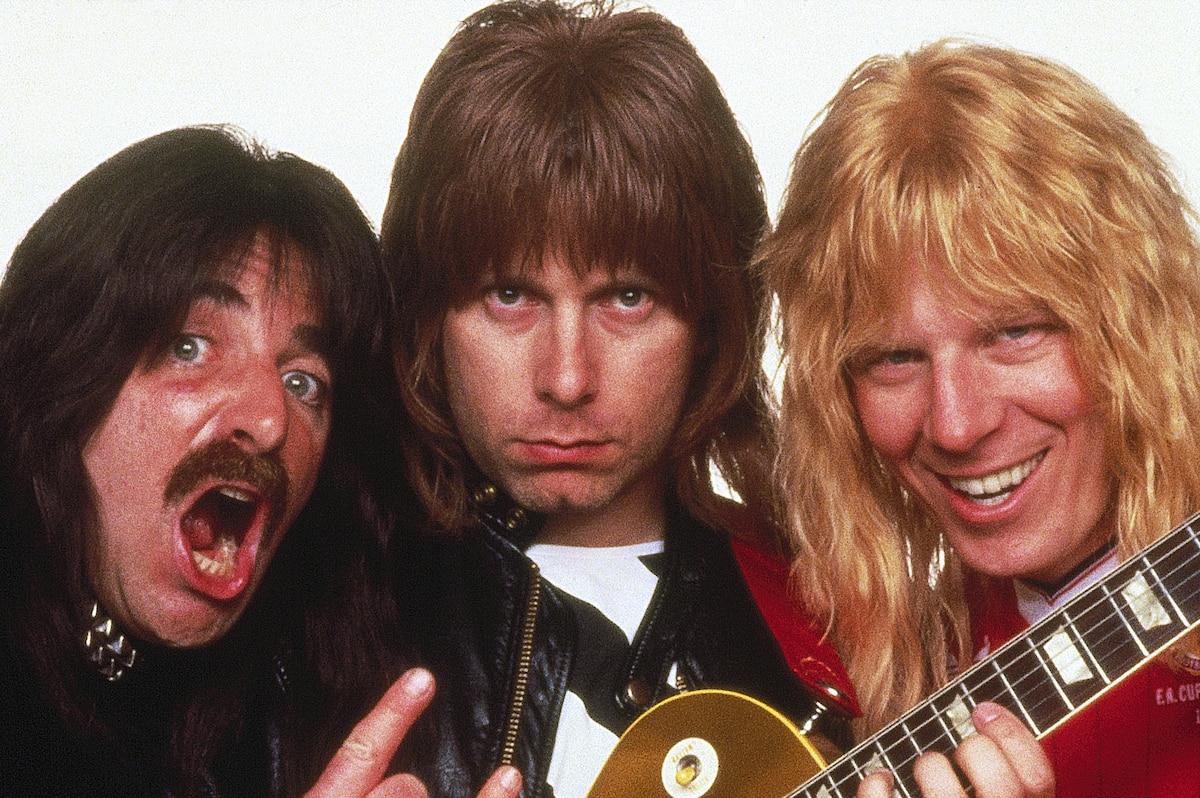
This Is Spinal Tap was only a moderate financial success when it first came out in theaters in March 1984. Director Rob Reiner said the initial lukewarm reaction was due to the perception on the part of many audience members that this was a real band they had never heard of. It wasn't until the video release a short time later that the picture gained fans and a devoted cult following in the years since.
Poseable Derek, Nigel, and David action figures were marketed in 2000. Over the years, the This Is Spinal Tap cult has given rise to a number of related products, including a Spinal Tap zine, t-shirts, posters, sheet music, and a "cultography" by Ethan De Seife. There are also many web sites dedicated to the film and the band.
Spinal Tap has appeared in a number of "sequels" over the years, including a television special, A Spinal Tap Reunion: The 25th Anniversary London Sell-Out (1992), many comedy shorts and music videos, late night talk show appearances, comedy festivals, even news shows.
Spinal Tap appeared as characters on the long-running animated TV series The Simpsons. Harry Shearer, who plays Tap bassist Derek Smalls, voices the characters of Mr. Burns, Ned Flanders, Principal Skinner, and many others on the show.
The DVD release of the movie takes the mockumentary trope several steps further by including fake behind-the-scenes documentaries and having the customary audio commentary coming from the actors still in character as the band members. Anyone seeking to know what really happened while the movie was being made is instead taken back into the world of the movie for fictional "insights" into the film's background. The commentary comically reveals the band's distaste for the movie and just about everyone involved with it.
The band actually toured and released albums after the success of This Is Spinal Tap.
Many people have made guesses about who the characters are supposed to be based on. Nigel Tufnel, according to one rumor, is a take-off on English rock musician Jeff Beck. The relationship between David and Nigel has overtones of Lennon-McCartney, especially in their rift over David's girlfriend's influence in management and creative decisions, which some have compared to Yoko Ono's relationship to the Beatles (or at least the legend, however off base, that grew around it). Finally, the lurid cover art of the band's "Smell the Glove" album is said to have been inspired by the 1978 LP "Lovehunter" by the heavy metal band Whitesnake. Bands ranging from the Rolling Stones to Foghat to Journey have been named as inspirations for Tap, but the writers of this film insist the characters and story are simply amalgams of many people and a wide variety of legends and stories that have come out of the rock era.
Rob Reiner's appearance on film and as narrator in the character of documentary director Marty DiBergi is a nod to Martin Scorsese, who inserted himself into the documentary he directed about The Band's last concert, The Last Waltz (1978). "The Scorsese model was there," Harry Shearer said. "It was something we were aware of, and we were certainly taking it into account." That earlier movie can be seen as an inspiration for the style and satire of This Is Spinal Tap, along with such music documentaries as Don't Look Back (1967) and Gimme Shelter (1970).
The movie bears other similarities to The Last Waltz. In both films, the band members are introduced by superimposing their names over their images during an on stage performance. Like the members of The Band, the members of Spinal Tap recount the various name changes the group has gone through.
The scene in which bassist Derek Smalls is trapped inside a pod is said to have come from an incident in which Screamin' Jay Hawkins was trapped inside a prop coffin on stage at the Apollo Theater in 1956 during a performance of "I Put a Spell on You."
Many musicians claim to have had very similar experiences as the group in This Is Spinal Tap, among them Led Zeppelin's Jimmy Page and Robert Plant, Twisted Sister's Dee Snider, and Ozzy Osbourne, all of whom claim to have gotten lost in backstage mazes just as Spinal Tap does. Others who have noted similarities between their experiences and situations in the movie are Lars Ulrich, whose band, Metallica, claimed their "black album" was an homage to Spinal Tap's ill-fated "Smell the Glove" LP. Eddie Van Halen says he was laughed at by others when he failed to see the humor in the movie. "Everything in that movie had happened to me," he said.
Other connections to real-life musicians and groups abound. R.E.M.'s Mike Mills once noted how his band also played a gig on an Air Force base, as had the group Uriah Heep. Harry Shearer said he used the story about Heep's experience in the film.
The success of This Is Spinal Tap led to a series of critically acclaimed mockumentaries by Christopher Guest, with equal blends of lampooning and affectionate observation. Guest has taken on small-town community theaters in Waiting for Guffman (1996), dog show competitors in Best in Show (2000), the folk music scene of the 1960s in A Mighty Wind (2003), and B-movie actors and film awards in For Your Consideration (2006).
The fake documentary has since become a popular and recognizable form in movies and television. Some horror movies have been based on what purports to be real found footage, such as The Blair Witch Project (1999) and Paranormal Activity (2007). In comedy, the form is most often seen on television, where it was pioneered on the British series The Office and its subsequent American counterpart, and can now be seen on such shows as Modern Family and Parks and Recreation. The format on these latter shows, however, almost jettisons the notion of a film crew working to make a recognizable documentary in favor of merely providing a means for direct address to the camera and, by extension, the viewing audience. One of the best uses of the style in recent years has been the HBO Lisa Kudrow series The Comeback, in which the documentary crew is very much a part of the action.
The film is one of the most quoted of all, with lines like "there's a fine line between stupid and clever" and "this goes up to 11" repeated frequently by devoted fans and casual viewers alike.
Talking about his own film School of Rock (2003), Jack Black noted that the key is to both make fun of something like rock music and embrace it at the same time, much as he did with his own band, Tenacious D. "That's what Spinal Tap did, and that's why it's so great," Black said.
Marty DiBergi's Coral Sea navy cap appears briefly in the opening sequence of Reiner's film The Princess Bride (1987), just off to the side of Fred Savage's character as he sits up in bed.
A popular music venue in Milwaukee, Shank Hall, is named after the fictitious Milwaukee bar at which the band appears midway on their tour.
"You're not going to make us into Spinal Tap, are you?" - Members of the band Depeche Mode to filmmaker D.A. Pennebaker
by Rob Nixon
Pop Culture 101 - This Is Spinal Tap
by Rob Nixon | December 29, 2011
SIGN UP FOR OUR NEWSLETTERS

CONNECT WITH TCM