George Cukor entered a new phase in his career - some critics would call
it his creative peak - when he joined forces with the husband-and-wife writing team of
Ruth Gordon and Garson Kanin for A Double Life (1947), a melodrama set in the world of the theatre. Over the next seven years, he would direct seven films for one or both of the
Kanins, including such popular hits as Adam's Rib (1949) and Pat and
Mike (1952). In essence, they created their own mini-studio, assembling a
production team and even a few recurring cast members who would help them
make some of the most intelligent films in Hollywood history.
The Kanins had written their story of an actor who confuses his off-stage
life with his on-stage performance as Othello years earlier and sold it to
Columbia Studios. Then Harry Cohn, head of the studio, decided not to make
the picture and refused to even pay for the script. So the Kanins sold it
to Universal-International and arranged to borrow their friend Cukor from
MGM. Originally they had hoped to cast Laurence Olivier in the leading
role, but when he proved unavailable they went after Ronald Colman. But although
Colman had started his career on the stage, he had never been comfortable
doing Shakespeare and almost turned the script down for fear of making a
fool of himself. Cukor and the Kanins finally won him over by convincing
him that the role was going to win somebody an Academy Award®, an honor
that had escaped Colman even though he'd been nominated three other times.They also promised to do everything they could to help him win. To assist
with the Shakespeare scenes, Cukor hired Walter Hampden, a noted stage star
from the earlier part of the 20th century, to coach Colman and stage the
scenes from Othello. He then shot those scenes in sequence, as
though they were from a different picture, so that Colman could focus
solely on the Shakespearean role.
Knowing that Cukor's talents were primarily in script interpretation and
coaching actors, the Kanins arranged for art director Harry Horner and
editor Robert Parrish to work on the set every day during shooting. While
Cukor worked with the cast, Horner would set up the day's shots and Parrish
would plan out the editing in advance, all of it subject to the director's
approval. The result was one of Cukor's most visual films ever and the
start of a more cinematic approach to filmmaking for him. For the stage
scenes, he suggested to cameraman Milton Krasner that they capture the
way stage lights exaggerate an actor's features, creating a blinding display that
perfectly counter pointed Colman's madness. Throughout the film he used
shots of Colman standing near mirrors to capture the growing division
between his sane exterior and his growing insanity.
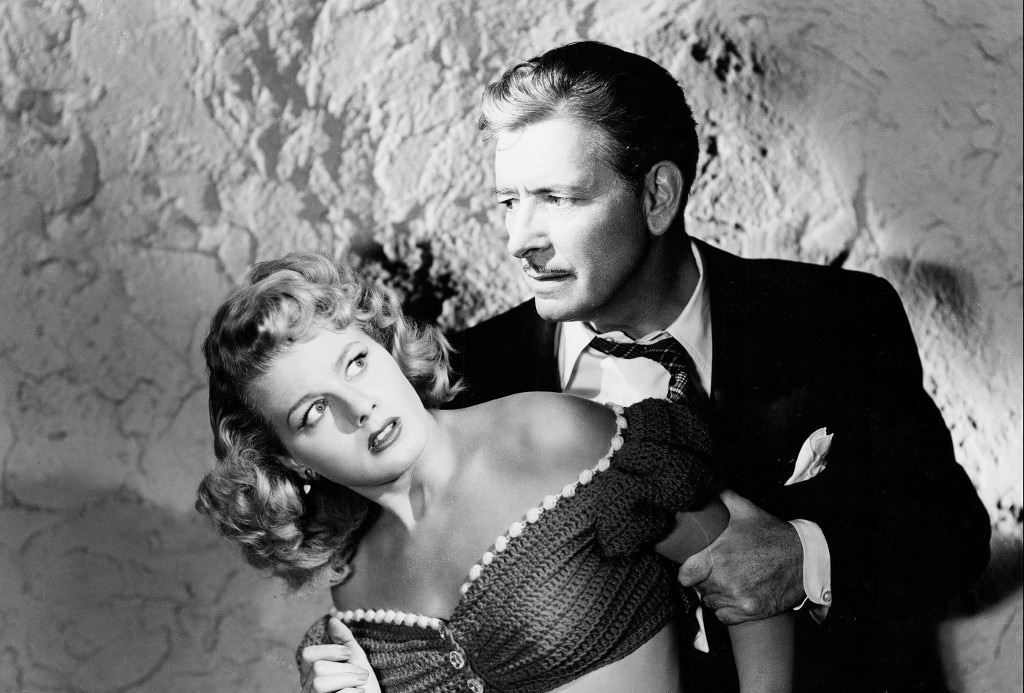
One key role was the waitress Colman's character confuses with Desdemona
and eventually kills in a fit of jealousy. Shelley Winters was doing
mostly chorus work in films when she came in to read for the role and
arrived dressed to the nines. Cukor told her to go to the ladies' room and
remove her girdle, bra and false eyelashes. Then he left her to read the
script. He was so impressed with the look and her understanding of the
material that he set up a screen test without even reading her. Then, to
put her at ease, he shot one of her rehearsals without telling her. Once
she was cast, however, she was so nervous that she needed over 100 takes for her first scene with Colman. Finally, the actor took her to lunch to try to get her to calm down. The results were a triumph that established
her as a major young star.
A Double Life was a hit for all involved. Colman won rave reviews,
and, true to their promise, Cukor and the Kanins mounted a major campaign
to win him the Oscar®. As soon as the film was assembled, they
arranged a series of screenings for Academy® members. One of them
would personally invite each member to the screening, while another one was there to
greet them as they arrived and one of them was there at the end to thank
everyone for attending and to praise Colman's performance. For his part, Colman
took out a series of trade paper ads featuring previous Oscar® winners
endorsing his performance. As a result, he was clearly the front-runner on
Oscar® night. In his acceptance speech, he credited all involved with
the film, particularly Cukor. Also nominated for the picture was composer
Miklos Rozsa, who won for musically mirroring Colman's descent into
madness; the Kanins, who would never win an Oscar® for writing (though
Ruth Gordon would be named Best Supporting Actress for Rosemary's
Baby in 1968); and Cukor, who would have to wait until 1964 to win for
My Fair Lady.
Producer: Michael Kanin
Director: George Cukor
Screenplay: Ruth Gordon, Garson Kanin
Art Direction: Harvey T. Gillett, Bernard Herzbrun
Production Design: Harry Horner
Cinematography: Milton Krasner
Costume Design: Travis Banton, Yvonne Wood
Film Editing: Robert Parrish
Original Music: Miklos Rozsa
Principal Cast: Ronald Colman (Anthony John), Signe Hasso (Brita), Edmond O'Brien (Bill Friend), Shelley Winters (Pat Kroll), Ray Collins (Victor Donlan), Philip Loeb (Max Lasker), Joe Sawyer (Pete Bonner), Whit Bissell (Dr. Stauffer), Betsy Blair (Girl in Wig Shop).
BW-105m. Closed captioning.
By Frank Miller
A Double Life
by Frank Miller | October 22, 2002
SIGN UP FOR OUR NEWSLETTERS

CONNECT WITH TCM