Like Fritz Lang alongside him, Max Ophuls saw his career fall into a three act structure - European
beginnings, Hollywood middle stretch, and then an ironic return to the post-Nazi continent, which is
where, for Ophuls, the reputation grew most extravagantly. From La Ronde (1950) to his last,
Lola Montes (1955), Ophuls orchestrated a new kind of ironic, mega-cinematic eye-candy, full of
dizzying wide-screen costume opulence and compositions so baroque that Andrew Sarris once claimed that
Lola was the greatest film ever made. Today, Ophuls' reputation rests largely on these gigantic
butterflies, which are, by any standard, difficult to resist.
Still, just as some critics favor Lang's midcentury American noirs over his famous German silent
masterpieces, I prefer Ophuls' moment-in-the-sun Hollywood output, particularly his twin femme-noir
home-runs of 1949, Caught and The Reckless Moment. The latter of the two may be, in fact,
one of its decade's greatest forgotten movies, a stock melodramatic programmer (adapted from a Ladies
Home Journal story, yet) that is reconceived and crafted with such deftness and attention to emotional
detail that it shutters scores of contemporaneous noirs and dramas out of the memory. This was not how
studio product was mass-manufactured in the immediate postwar years - here we see Ophuls, almost as far
from his native element as he could be, find depths in the abyss of the American family virtually no
filmmaker had before.
The film's surprising tractor-beam effect emanates from Joan Bennett's SoCal uber-Mom, finicky and harried
and gently domineering, and swamped from the very first scene with the unholy pressures of trying to keep
her beach-resort-town nuclear family in one piece. Her slut daughter (Geraldine Brooks) has, apparently,
been dallying with a middle-aged, quasi-criminal skeeveball boyfriend (a frank and reprehensible Shepperd
Strudwick); Ophuls' first scene has Bennett's Mom face off against this guy in a hotel bar with a palpable
sourness in her mouth, and the unabridged, untempered honesty of the two characters' self-knowledge and
mutual contempt is mesmerizing. Soon, the plot gells: when the slick jerk shows up dead on the family
beach, Mom kicks into protective gear and dumps the body, which of course is merely the beginning of her
troubles. Constructed with world-class plot glue (and remade as the Tilda Swinton suspenser The Deep
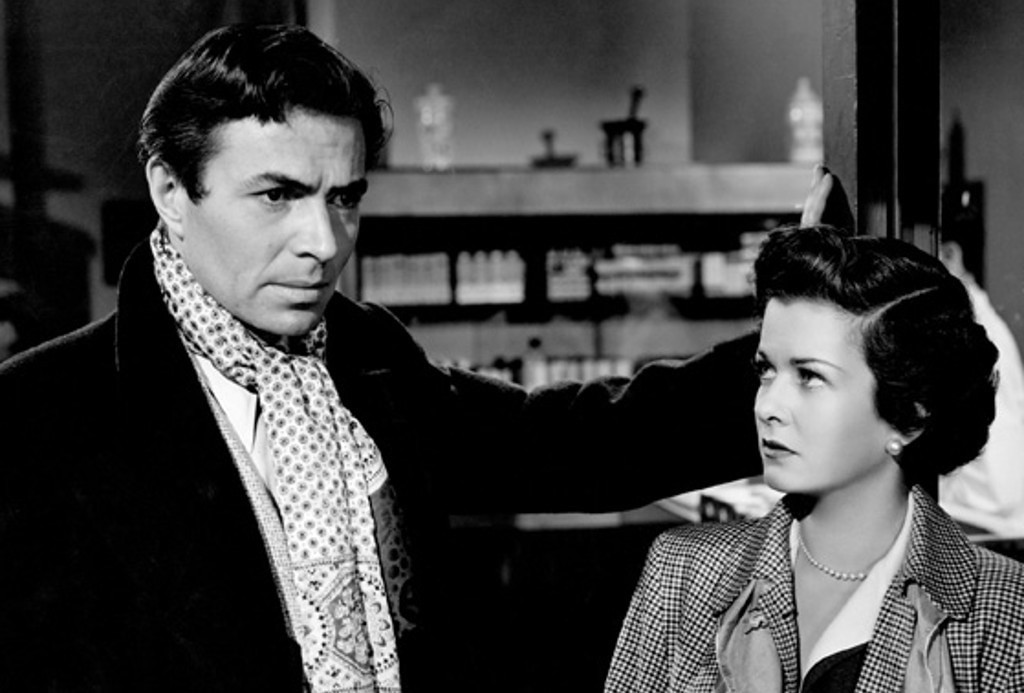
End [2001] over 50 years later), the narrative quickly folds in James Mason as a smooth but
guilt-ridden blackmailer, and it's up to Bennett's suburban matriarch to keep the balls in the air.
The devil is in the details: Ophulsian compositions tell the story all by themselves, and the master pays
close attention to Hitchcockian tension, especially with the breathtakingly physical five-minute-long
sequence in which Bennett finds the corpse, drags it down the beach and loads it into the family dinghy,
all of it executed without a word spoken and, indeed, in almost complete soundtrack silence. In the scene
where Bennett must cross the tracks and go to a shoddy low-rent loan office, her alienated horror is
silhouetted, figuratively, against what's glimpsed happening in the next glass cubicle - an entire family
crammed into the tiny office, begging for money, at each other's throats. Even the film's locale - Balboa
Island, a bridge-accessible hamlet belonging to Newport Beach - is conjured with fabulous specificity, not
the noir anonymity we're used to. With Ophuls, there's no ignoring the backgrounds or ancillary action -
it all means something, and is all as complex and textured as the foreground drama.
As if the bitter cologne of Lang lingered on Bennett from their '40s fraternization (four films, from
1941's Man Hunt to 1947's Secret Beyond the Door) and rubbed off on Ophuls, the machinery of
bad luck and bitter consequences is inexorable, and a good deal of the movie's electricity comes from the
fraying tension Bennett must manage in dealing with murder and blackmail while still maintaining a busy
household. But Lang was by comparison no master at mature realism, and Ophuls gets even more mileage out
of the illicit relationship Mason and Bennett's odds-bodkins pair must maintain in order to find the money
to pay off the crime boss pulling the strings; because she's a Mom, she accepts his nefarious
presence and quickly starts treating him like an ill-fitting husband (her husband's away on a business
trip, inconveniently enough). But he falls for this chain-smoking, indefatigable housewife because
she's an indefatigable housewife (she's named Lucia, but he, being Irish, insists on calling her Lucy),
albeit one that looks like Joan Bennett, and the tumultuous, messy, spirited house she rules over looks a
lot like heaven.
What's even less Langian is the startling and singularly grown-up attention paid to Bennett's character,
undoubtedly the best and most rounded she ever had in a career that lasted almost 60 years, a fashionable
modern woman forced to engage in cold-blooded crime to save her spoiled children, and keeping her lid on
so tight she can nag the kids about manners and wrangle the underworld practically in the same breath.
It's difficult to think of a single other film from that era that attends so realistically to a homegrown
bourgeois mother - the way she hovers over her shame-sick daughter, or shops in an impatient hurry, or
lays out bills on the bed when working out finances, or briskly dishes out familial commands while clearly
troubled with darker business. The anxiety and social stress carrying on underneath the surface of The
Reckless Moment is hypnotic, and Mason's brooding hood is fascinatingly out of place, but this is
Bennett's show, and hers is one of the most nuanced and resonant lead performances of the '40s.
Producer: Walter Wanger
Director: Max Ophuls
Screenplay: Robert W. Soderberg, Henry Garson; Mel Dinelli, Robert E. Kent (adaptation); Elisabeth Sanxay
Holding (story "The Blank Wall")
Cinematography: Burnett Guffey
Art Direction: Cary Odell
Music: Hans Salter
Film Editing: Gene Havlick
Cast: James Mason (Martin Donnelly), Joan Bennett (Lucia Harper), Geraldine Brooks (Bea Harper), Henry
O'Neill (Tom Harper), Shepperd Strudwick (Ted Darby), David Bair (David Harper), Roy Roberts (Nagel).
BW-95m.
by Michael Atkinson
The Reckless Moment
by Michael Atkinson | November 30, 2011
SIGN UP FOR OUR NEWSLETTERS

CONNECT WITH TCM