Alfred E. Green's 1949 Cover Up, a mystery thriller in which Dennis O'Keefe plays a big-city insurance man who arrives in a small town to investigate the suicide of one of the burg's citizens, doesn't qualify as a film noir, or even as a neo-noir. But it's a little like It's a Wonderful Life (1946) brushed with noir dust, a picture that celebrates the coziness and comfort of small-town life even as it casts a suspicious eye over them. In the end, coziness and comfort win out, but there are stretches of Cover Up that expose one of the chillier aspects of living in a place where the streets are lined with houses nestled behind picket fences and where the sheriff, the bus driver and the local jeweler all know your name: Chiefly, that everyone knows your business, even when that business is murder.
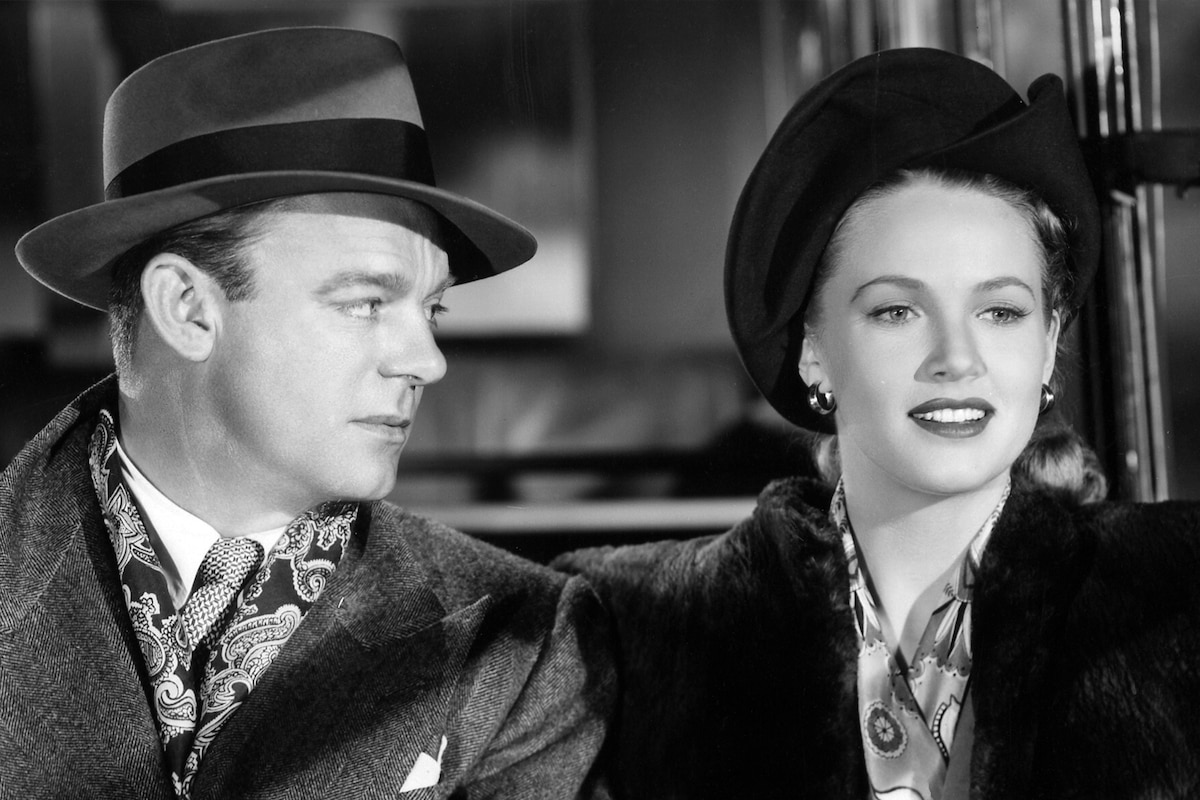
Cover Up is one of those thrillers where everything is hiding in plain sight; the town's secrets are there for the taking, if you just know where to look. Dennis O'Keefe's insurance man, Sam Donovan, may seem like a sharp guy, but knowing where to look -- at least in a town like this one -- isn't his strong suit. He also happens to be distracted by one of the locals, Anita Weatherby (Barbara Britton, fetching in an understated way): The two meet as their train is pulling into the station. It's Christmastime, and Anita has been doing some shopping, ostensibly in the big, bad city; Sam helps her with the packages that are tumbling out of her arms. As they board a local bus together, the driver, a puzzling grin plastered across his face, makes pleasant chit-chat with Anita and informs her that Roger Phillips has committed suicide. We don't yet know who Roger Phillips is or why the announcement of his self-imposed demise would cause anyone to smile from ear to ear. Anita, for her part, looks rattled and surprised by the news, but not exactly grief-stricken.
Sam wants to know if Roger Phillips really did commit suicide; if he was murdered, his insurance policy will pay out a much larger sum, thanks to a double-indemnity clause. It's not quite clear why Sam's company is so anxious to pay out more money rather than less, but the chief point is that Sam's curiosity gets the better of him. He can't not investigate this case, particularly when he's repeatedly stymied by the local sheriff, Larry Best (William Bendix), and eventually has reason to wonder if Anita's father, town banker Stuart Weatherby (Art Baker), might have something to do with this mysterious death that no one seems too broken up about.
Cover Up is a solid, appealing, not-really-a-noir, and the Christmas setting -- complete with banker Weatherby grousing good-naturedly about how much he had to pay for the family Christmas tree -- makes the unfolding murder scenario seem just a little bit sordid. But not too sordid: Director Alfred E. Green keeps firm control over the movie's tone. Green, who started out as an actor, had been making movies since 1917. By the time his film-directing career ended, just five years after Cover Up, his resume included more than 100 titles, including a number of pre-code classics, among them Baby Face (1933), with Barbara Stanwyck. Green's efficiency at churning out movies didn't necessarily mean he gave actors short shrift: He directed Bette Davis in the 1935 Dangerous, a role that brought the actress her first Oscar®.
Green may have liked working with actors, and he keeps the gears between them running smoothly throughout Cover Up. William Bendix has star billing, but his taciturn, secretive sheriff is really just a foil for O'Keefe's dogged, if somewhat clueless, Sam. The first exchange between the two is a marvelous bit of wary banter. When Sheriff Best notes that Sam smokes too much -- "one cigarette after another" -- Sam brushes him off coolly: "I know -- it saves a lot of time."
By the time Cover Up was released, O'Keefe had already appeared in Anthony Mann's T-Men (1947) and Raw Deal (1948), and his timing had already made him, as Robert Porfirio notes in Film Noir: The Encyclopedia, a "noir icon known for his fast-paced delivery." Notably, O'Keefe was one of the writers of Cover Up -- credited as Jonathan Rix -- which suggests he may have had a feel for writing dialogue as well as slinging it.
And as an actor, O'Keefe fits right in with the darker undertones of Cover Up, which is intriguing for the way it balances the idea of small-town postwar contentment with the more noirish notion of creeping dread, a sense that life could never again be the same. If, in the end, the small-town comforts -- the coziness of the family hearth, the lit-up Christmas tree in the town square -- win out, it's not because O'Keefe's Sam didn't try to keep himself suitably skeptical about the motives of mankind. It's just that the warmth of the Christmas lights, and of the people who lit them, was just too alluring to resist.
Producer: Ted Nasser
Director: Alfred E. Green
Screenplay: Jerome Odlum, Jonathan Rix (original screenplay); Francis Swann, Lawrence Kimble (additional dialogue)
Cinematography: Ernest Laszlo
Art Direction: Jerome Pycha, Jr.
Music: Hans J. Salter
Film Editing: Fred W. Berger
Cast: William Bendix (Sheriff Larry Best), Dennis O'Keefe (Sam Donovan), Barbara Britton (Anita Weatherby), Art Baker (Stu Weatherby), Ann E. Todd (Cathie Weatherby), Doro Merande (Hilda), Virginia Christine (Margaret Baker), Helen Spring (Bessie Weatherby), Ruth Lee (Mrs. Abbey), Henry Hall (Mayor).
BW-82m.
by Stephanie Zacharek (Stephanie is the chief movie critic for Movieline - www.movieline.com)
SOURCES:
Alain Silver, Elizabeth Ward, James Ursini, Robert Porfirio, Film Noir: The Encyclopedia, Overlook Hardcover, 2010
IMDB
Cover-Up
by Stephanie Zacharek | October 10, 2011
SIGN UP FOR OUR NEWSLETTERS

CONNECT WITH TCM