The Razor's Edge (1946) takes its title from one of the ancient Hindu Upanishads, which is quoted at the beginning of W. Somerset Maugham's eponymous novel: "The sharp edge of a razor is difficult to pass over; thus the wise say the path to Salvation is hard." Salvation is the theme of the story, and it's a difficult one to explore on film, since movies are better at showing the surfaces of things than at probing characters' minds and hearts.
Released in 1946, two years after Maugham's popular 1944 novel, the film succeeds surprisingly well, evoking the hero's quest for enlightenment through words and actions that indicate the large gap between his inner life and the contrasting behaviors of his superficial high-society friends. Directed by Edmund Goulding, the picture received an Academy Award nomination for Best Picture - it lost to William Wyler's masterpiece The Best Years of Our Lives - and Anne Baxter won the Best Actress Oscar® for her nuanced portrayal of Sophie MacDonald, a good woman brought low by tragedy and temptation. Oscar® nominations also went to Clifton Webb for his witty performance as Elliott Templeton, an effete socialite, and to the four-man art direction and set decoration team. Baxter and Webb won Golden Globes as well.
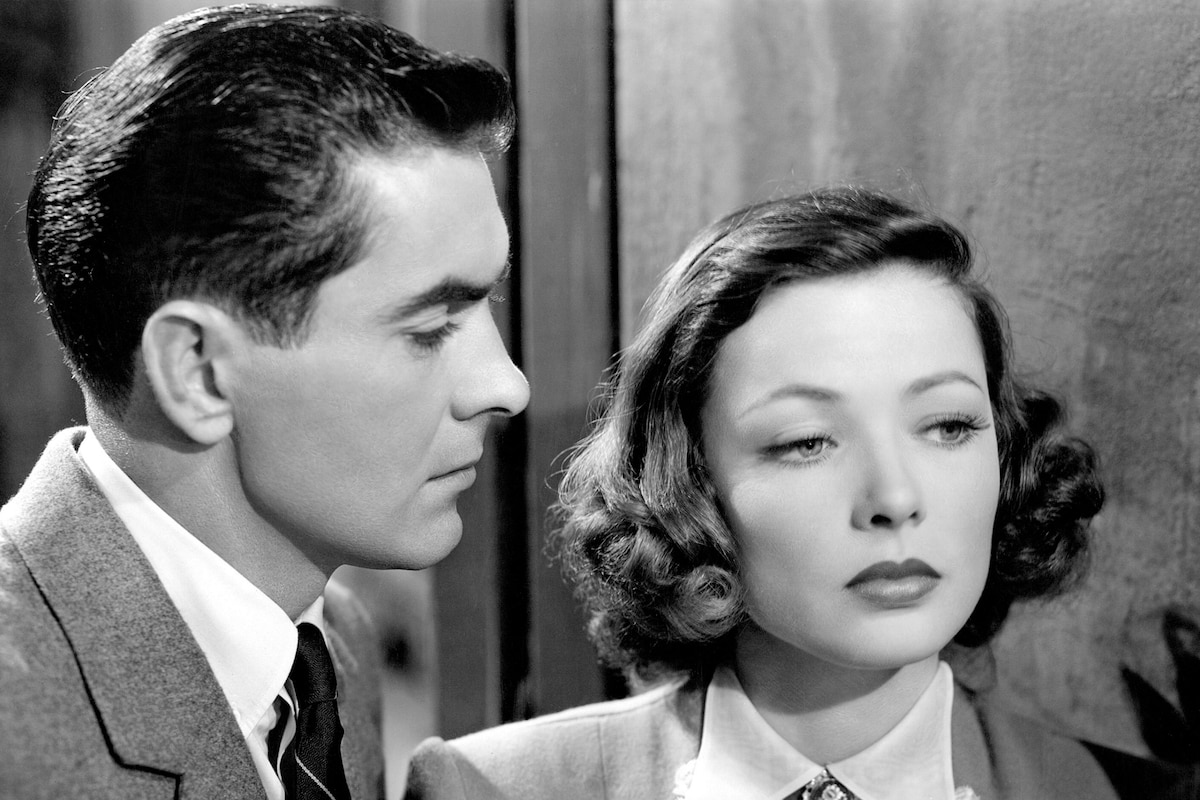
Like the novel it's based on, the movie puts Maugham himself into the story. Played by Herbert Marshall with his customary low-key charm, he enters at the beginning, hobnobbing with other swells at a stylish Chicago party where he meets young Larry Darrell, played by Tyrone Power with his own brand of understated charisma. Larry recently finished serving in World War I, and he's engaged to Isabel Bradley (Gene Tierney), the niece of Maugham's old friend Elliott Templeton (Webb), a playboy who does nothing but attend elegant soirees. Unlike the people around him, Larry has decided that wealth and glamour are not for him. Seeing his best friend killed before his eyes in the war has made him realize that life is precious and fleeting, and that true riches are found in the spirit, not the flesh. As much as Isabel loves him, she isn't prepared to give up her luxuries, so they part.
Heading overseas to find himself, Larry signs up for hard labor in a French coal mine. There he befriends a hard-drinking defrocked priest who steers him toward India, where a holy man teaches him ancient wisdom and sends him to await further illumination on a Himalayan mountaintop. It works. When the holy man comes to fetch him, Larry says he experienced a sense of union with God that has utterly transformed him. The guru says he must now return to society and use his new understanding to make the world a better place.
A lot has happened since he left. Isabel married a wealthy man who was ruined by the Depression and had a nervous breakdown. Sophie, another old friend, married her fiancé but lost him and their child in a car crash. Sophie is now a drunken prostitute in a low-grade Paris dive. Larry rescues her from despair by asking to marry her, but this enrages Isabel, who takes revenge by luring Sophie back to the bottle. Larry does a final good deed for Elliott and then leaves on a tramp steamer for America, where further enlightenment may await him.
Filming The Razor's Edge was a complicated affair. Fox honcho Darryl F. Zanuck paid Maugham a hefty $250,000 for the movie rights and budgeted the picture at $3 million, which grew to $4 million. The star was to be Gregory Peck and the director was to be George Cukor, whose recent hits included The Philadelphia Story (1940) and Gaslight (1944) for MGM, his home studio. Cukor didn't like Lamar Trotti's screenplay, however, complaining that the good bits from the novel were "sandwiched between all kinds of nonsense." He said he'd direct the picture if Maugham wrote a new script, and when Zanuck balked at the probable cost, Cukor himself called Maugham, who said he'd write it for nothing.
By now Zanuck wanted Power to play Larry, which meant waiting for the actor to finish his World War II service - he flew supplies into the Pacific Theater, receiving several decorations - and return to the studio. Power's recent military experience suited the role of Larry, who has been deeply changed by the wartime horrors he's witnessed. Beyond this, going through combat made Power and some other Hollywood stars, such as James Stewart and Cark Gable, want to leave behind the escapist vehicles they had starred in before the war, taking on weightier, more meaningful pictures.
As things turned out, Power couldn't get back to Fox until late 1945, when Cukor was no longer available. Zanuck was therefore free to choose a new director and retrieve Trotti's script, which he preferred to Maugham's version, from the drawer. To direct it Zanuck chose Goulding, who made Of Human Bondage, also from a Maugham novel, at Warner Bros. the same year with Eleanor Parker and Paul Henreid in the leads. According to Fred Lawrence Guiles's biography of Power, almost all of Fox's four thousand worldwide employees were involved with the project, and Zanuck "hovered around and over the production in a state of agitation, worry, and total possessiveness. It was this picture he wanted to be remembered by." When shooting was finished, Zanuck did the final editing and the great Alfred Newman wrote the score, except for Sophie's theme, which Goulding composed; it became a chart-topping hit under the title "Mam'selle."
The Razor's Edge opened late in 1946, earning $5 million and becoming Fox's biggest hit to date. Life magazine helped by running two big photo spreads on the picture - the first in August, describing how a four-minute scene was made, and the second in November, using pictures to show that "instead of confining itself in usual Hollywood manner to a simple problem of good and evil or of getting the girl," this drama "shows an absorbing interplay of character among natural, human adults." Life also ballyhooed the publicity campaign, noting that Fox was giving silver brooches to the press and building "the biggest electric sign" on Broadway for the premiere. Best of all, the magazine added, rumors were flying that Power and Tierney had fallen in love during production.
Reviews were mixed, however. New York Times critic Bosley Crowther found various shortcomings, including "specious situations" and "vacuous dialogue," but concluded that the picture would appeal to "a great many people who are sentimentally inclined to its vague philosophy." Variety loved it, calling it "all good cinematurgy" and saying the romance angle "is more than slightly on the sizzling side." Time deemed it "an earnest, overlong, impressively glossy, frequently dull movie" that "dawdles away several million dollars trying to make a great philosopher out of W. Somerset Maugham, and a great actress out of Gene Tierney."
Another movie version of The Razor's Edge appeared in 1984, starring comedian Bill Murray in his first serious role. Murray also co-wrote the screenplay with John Byrum, who directed. It's more picturesque and corny than Goulding's original, which is still enjoyable to watch for the quality of the production in general and for Baxter's fine performance in particular. Making a movie this ambitious is as hard as walking on a razor's edge, and the results are interesting even when they don't quite reach their destination.
Director: Edmund Goulding
Producer: Darryl F. Zanuck
Screenplay: Lamar Trotti, from the novel by W. Somerset Maugham
Cinematography: Arthur Miller
Film Editing: J. Watson Webb, Jr.
Art Direction: Richard Day, Nathan Juran
Set Decorations: Thomas Little; Associate: Paul S. Fox
Music: Alfred Newman
With: Tyrone Power (Larry Darrell), Gene Tierney (Isabel Bradley), John Payne (Gray Maturin), Anne Baxter (Sophie MacDonald), Clifton Webb (Elliott Templeton), Herbert Marshall (W. Somerset Maugham), Lucile Watson (Louisa Bradley), Frank Latimore (Bob MacDonald), Elsa Lanchester (Miss Keith), Fritz Kortner (Kosti), John Wengraf (Joseph), Cecil Humphreys (holy man), Harry Pilcer (specialty dancer), Cobina Wright, Sr. (Princess Novemali)
BW-145m.
by David Sterritt
The Razor's Edge
by David Sterritt | September 20, 2011
SIGN UP FOR OUR NEWSLETTERS

CONNECT WITH TCM