By the time of their third collaboration, producer Val Lewton and director
Jacques Tourneur (pioneers of the psychological horror film) had solidly
proven their theory that the unseen can be more frightening than the
obvious. Rather than relying on elaborate makeup and special effects,
films such as Cat People (1942) and I Walked with a Zombie
(1943) situate their horrors in the dark shadows and the mounting paranoia
that slowly engulf the films' characters.
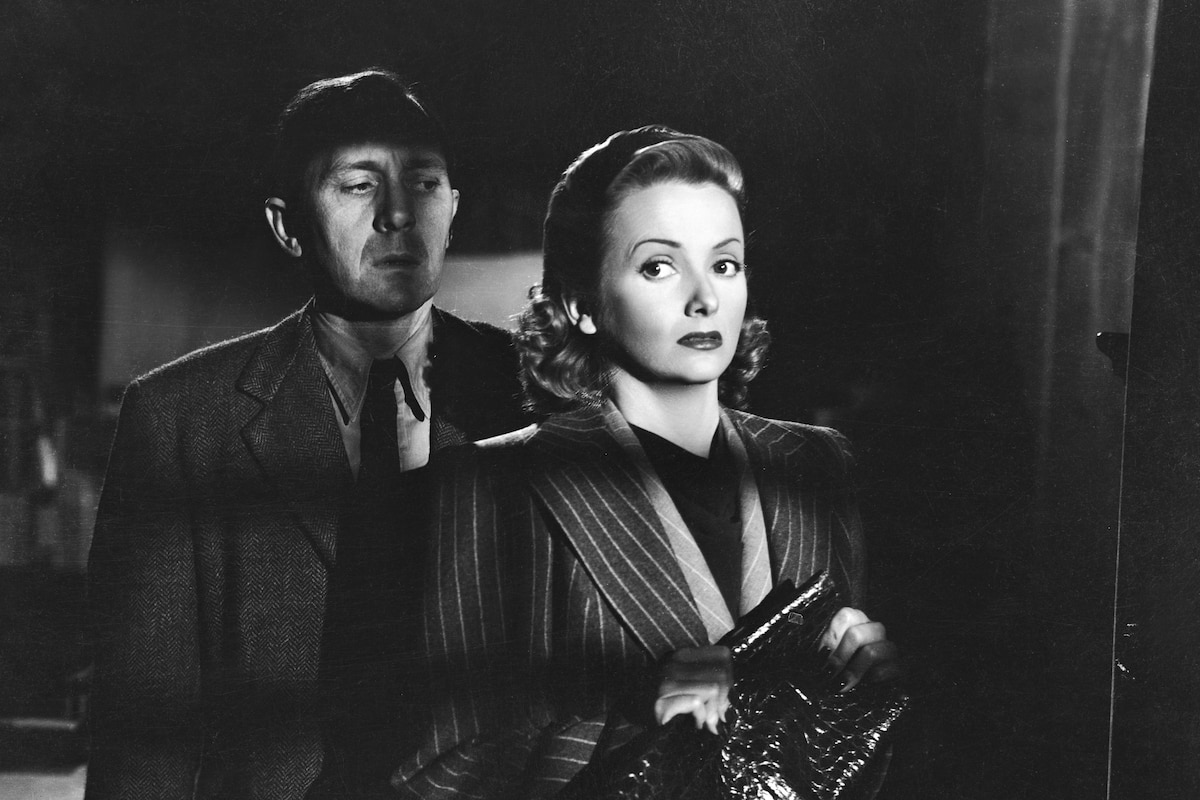
The Leopard Man (1943) stars Dennis O'Keefe (T-Men, 1947) as Jerry
Manning, a theatrical agent who convinces his songstress client Kiki (Jean
Brooks) to incorporate a black leopard into her nightclub act. The
publicity stunt backfires when the cat breaks free and later kills a girl
in a New Mexico village. Soon thereafter, another woman (Tula Parma) is
mysteriously killed while locked inside a cemetery, apparently mauled by
the escaped cat. Manning, however, begins to suspect that the culprit is
human rather than feline... a psychopath "with a kink in his brain," who is
using the leopard as a sort of alibi. Meanwhile, Kiki's fellow performer
Clo-Clo (Margo) is faced with omens of her own doom, and begins to wonder
if perhaps she will be the Leopard Man's third victim.
Based on Cornell Woolrich's hard-boiled novel Black Alibi (1942), the
screenplay was given a name change by RKO head Charles Koerner, who hoped
The Leopard Man would capitalize on the popularity of Cat
People, Lewton and Tourneur's first film together. Several of
Woolrich's stories and novels were adapted to the screen by such
filmmakers as Alfred Hitchcock (Rear Window, 1954), Mitchell Leisen
(No Man of Her Own, 1950) and Francois Truffaut (The Bride Wore
Black, 1968). But only Lewton and Tourneur succeeded in capturing the
grim brutality of Woolrich's prose and the oppressive night that is such a
vital ingredient of his work.
Screenwriters Ardel Wray and Edward Dein made many changes in Woolrich's
text in order to keep costs low and sidestep the censors. The
castanet-playing Clo-Clo was a part-time prostitute in the novel, and the
killer was unmasked as a police inspector who adorned himself in animal
parts cut from the carcass of the escaped jaguar (not a leopard) -- clear
violations of the Production Code. The novel was set in South America, in
"the third-largest city south of the Panama Canal," and the climax occurred
in the abandoned tunnels and cells that were once used as torture chambers
during the Inquisition.
With a budget of less than $150,000 and a tight four-week shooting schedule, there was little time for experimentation and extravagance on the set of The Leopard Man. Filming scenes on location was out of the question. To help flavor the film with authenticity, Lewton recruited screenwriter Wray to take an excursion to New Mexico to gather local color
and make snapshots of settings and buildings she found interesting. "First
day there I took pictures frantically, of anything and everything, and took
them to a shop for development," said Wray, a talented screenwriter but an
inexperienced photographer. "Miraculously, probably because it was a
nearly foolproof camera, it was all right." These amateur photos were then
given to staff of the RKO art department, who incorporated certain
architectural features into the modestly budgeted set designs. "Another
instance of Val's genius for improvisation."
Much credit for the Lewton/Tourneur successes is owed to the talented
craftsmen of RKO -- under the guidance of cinematographer Robert de Grasse
and art directors Albert D'Agostino and Walter Keller -- who were adept at
transforming cheap underlit sets into the stuff of nightmares, where every
darkened nook housed a potential menace. Some of these same technicians
had sharpened their cost-efficient skills two years earlier on Orson
Welles's Citizen Kane (1941), a textbook example of how shadows can
conceal budgetary limitations and a testament to the resourcefulness of the
RKO art department.
The only scene of The Leopard Man that clearly betrays its B-picture
status is its one attempt at spectacle: the pursuit of the killer into the
midst of an ominous religious procession. What was a brilliant concept
could not possibly have been done justice in the confines of a studio
soundstage. The images of monks garbed in black robes and pointed hoods,
bearing candles and crucifixes as they march into the desert was most
likely inspired by the controversial Penitente religious cult of New
Mexico, which was also the subject of the exploitation film Lash of the
Penitentes (1936).
The Leopard Man succeeds best when it relishes the mysterious power
of darkness, as was the case with its most memorable sequence. In an
unsettling dramatization of childhood fears, a teenage girl (Margaret
Landry) is forced to go on a late-night errand to buy cornmeal for her
family. After a terrified walk to the distant store, through empty streets
and a pitch-dark riverbed, she returns home only to be attacked by the
leopard on her own doorstep. Surprisingly violent for a film of 1943, the
murder is depicted from inside the house, with the sound of the girl's
screams outside, pounding at the locked door, the mother desperately trying
to unlock the rusted bolt, and finally silence...and a trickle of blood
flowing beneath the door. Tourneur never shows the cat or the attack, but
the scene couldn't have been more terrifying.
The Leopard Man marked the end of the Lewton/Tourneur partnership,
as RKO thought it wiser to double their productivity and assign them to
separate projects, a bit of logical reasoning that failed to take into
account the unique way in which the producer and director's talents
complemented one another. Tourner recalled, "We had the perfect
collaboration -- Val was the dreamer, the idealist, and I was the
materialist, the realist. We should have gone right on doing bigger, more
ambitious pictures and not just horror movies."
Working together, Lewton and Tourneur made three timeless horror films in
quick succession. Separately, they only occasionally ascended to such
heights of cinematic inventiveness. Lewton followed up The Leopard
Man with The Seventh Victim (1943), a moody thriller directed by editor Mark Robson that almost equals the Tourneur films. Two years later,
Lewton made several films with Boris Karloff at RKO: The Body
Snatcher (1945), Isle of the Dead (1945) and Bedlam
(1946). Tourneur, eager to escape the horror genre, went on to direct the
legendary film noir Out of the Past (1947), but later returned to his
roots with the supernatural thriller Curse of the Demon (1957).
Producer: Val Lewton
Director: Jacques Tourneur
Screenplay: Ardel Wray and Edward Dein
Based on the novel Black Alibi by Cornell Woolrich
Cinematography: Robert de Grasse
Production Design: Albert S. D'Agostino and Walter E. Keller
Set Design: Darrell Silvera and Al Fields
Music: Roy Webb
Principal Cast: Dennis O'Keefe (Jerry Manning), Jean Brooks (Kiki Walker), Margo (Clo-Clo), Isabel Jewell (Maria), James Bell (Dr. Galbraith), Abner Biberman (Charlie How-Come).
BW-67m. Closed captioning.
By Bret Wood
The Leopard Man
by Bret Wood | September 27, 2002
SIGN UP FOR OUR NEWSLETTERS

CONNECT WITH TCM