"Kiss me and I'll claw you to death!"
Tag line for Cat People
Producer Val Lewton taught Hollywood how to scare people on a budget when
he released Cat People, the first in his series of psychological
horror films at RKO Studios, in 1942. After years of cheap thrillers
dominated by hooded killers, men in gorilla suits, sliding panels and
low-grade shocks, Lewton proved that intelligent films that made viewers
imagine the worst rather than subjecting them to cheap fright effects could
unnerve even the toughest audience.
Lewton was a hot commodity in Hollywood when RKO production chief Charles
Koerner lured him away from a position as David O. Selznick's story editor
to produce for the studio's B-picture unit. All Koerner wanted was a
series of provocatively titled thrillers to fill out the studio's double
bills. What he got was a revolution. At first Lewton wasn't sure he'd
made the right move. When Koerner told him his first film would be called
Cat People, Lewton was so embarrassed he offered to let writer DeWitt
Bodeen, another Selznick alumnus, out of his contract. But then he and
Bodeen came up with an angle, a story that drew on some of Lewton's own
phobias to create an unsettling, ambiguous psychological thriller about
Irena (Simone Simon), a fashion designer who fears that giving into her
passions will turn her into a murderous panther. She marries nonetheless
but holds her husband at arm's length, afraid to consummate their relationship. Soon she grows suspicious of her husband and a sympathetic female co-worker and begins stalking them. Lewton wanted to leave some doubt as to whether Irena actually turned into a cat or simply behaved like one, but the studio's executives demanded some shots of a real cat. So director
Jacques Tourneur filmed the cat during one attack but kept the lighting so
low that it was barely discernible. For another sequence, the director
made shadow puppets on the walls to suggest the panther's presence.
With Cat People, Lewton established a formula for fear that he would
exploit in later films like I Walked With a Zombie (1943) and The Body
Snatcher (1945) (more lurid titles forced on him by Koerner). Lewton's films would start
slowly in familiar surroundings while establishing the characters, then begin building a sense of dread and imminent danger. Then there would be a series of frightening scenes using suggestion rather than overt shocks but growing in intensity until the climax. And just to keep audiences jumping, the horrific scenes would climax with an unexpected jolt that usually signaled a return to normalcy. In Cat People, for example, the unseen Irena stalks her
romantic rival through Central Park. Just as the cat seems about to attack, a bus pulls up, slamming on the brakes and opening its doors with a screeching sound that almost always sends audiences out of their seats. In honor of his first use of this gimmick, Lewton called such shocks "busses."
Cat People was shot quickly on a budget of less than $150,000. To
make the film look more expensive, Lewton had art directors Albert S.
D'Agostino and Walter E. Keller re-dress sets from more expensive films.
The scenes in the Central Park Zoo were shot on standing sets that had been
used in several studio films, most notably the Fred Astaire-Ginger Rogers
musical Shall We Dance (1937). For Irena's apartment building, they used
the staircase from Orson Welles' The Magnificent Ambersons (1942). When
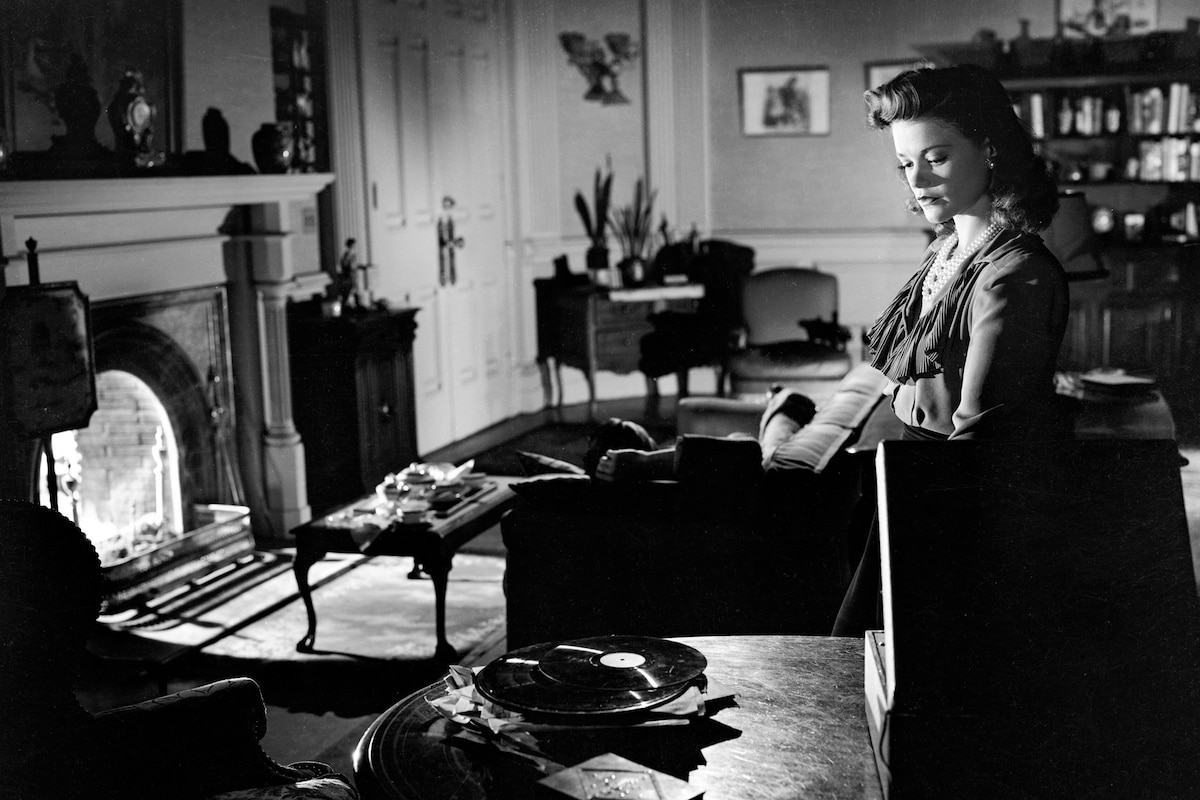
standing sets weren't available, cinematographer Nicholas Musuraca filled
the frame with shadows to hide the fact that they were working with the
bare minimum.
It's no surprise that Cat People was a bit too subtle for RKO's
management. Early in the shooting process, Lewton's immediate boss,
B-movie production chief Lew Ostrow, tried to get director Jacques Tourneur
fired. Lewton went over his head to Koerner to keep Tourneur on the film.
But when he screened the finished film for Koerner and the other
executives, they were so shocked nobody would even talk to him.
The film had its preview at a downtown LA theatre known for attracting a rough
crowd. Some genius decided to book a Disney cartoon about a lovable kitten
before the film, and the audience greeted the short with laughter and cat
calls. Lewton was fearing the worst when the feature started, fears that
were confirmed when the cat calls continued in response to the picture's
title. But then the film worked its spell, and the audience sat entranced.
The same thing happened wherever the film played. Despite mixed reviews,
it broke box-office records, even playing 13 weeks at a first-run theatre
in Los Angeles. Cat People didn't just turn a small profit. It
grossed $4 million worldwide and saved RKO from bankruptcy. In gratitude,
the studio gave Bodeen a new contract with a hefty raise. The director
they'd tried to fire was given a $5,000 bonus and the promise of top-budget
films as soon as he finished his obligation to Lewton. And Lewton got to
work with a lot less interference and a lot more cooperation, though he was
still stuck with the lowbrow titles. But in this case, the lowbrow proved to be highbrow as
he turned out a series of intelligent horror films that made film history.
Fifty years later, Cat People would earn a place on the National
Film Registry, giving it official status as a national treasure.
Producer: Val Lewton
Director: Jacques Tourneur
Screenplay: DeWitt Bodeen
Cinematography: Nicholas Musuraca
Art Direction: Albert S. D'Agostino, Walter E. Keller
Music: Roy Webb
Principal Cast: Simone Simon (Irena Dubrovna), Kent Smith (Oliver Reed),
Tom Conway (Dr. Judd), Jane Randolph (Alice Moore), Alan Napier
(Carver), Elizabeth Russell (The Cat Woman).
BW-73m. Closed captioning. Descriptive video.
by Frank Miller
Cat People
by Frank Miller | September 27, 2002
SIGN UP FOR OUR NEWSLETTERS

CONNECT WITH TCM