Adaptations of the plays of William Shakespeare were often discussed by the major studios after the advent of sound but rarely carried out. Max Reinhardt's all-star mounting of A Midsummer Night's Dream (1935) was a failure for Warner Brothers (an Academy Award nomination for Best Picture notwithstanding) and soured producers on the Bard's cinematic potential. It took a visionary such as Orson Welles to attempt the challenge but his quickie Macbeth (1948) was an epic disaster and so critically-reviled that, across the Atlantic, Laurence Olivier scrapped his plans to film the Scottish Play and made Hamlet (1948) instead; Welles later went abroad to shoot his self-funded Othello (1952) and Chimes at Midnight (1965), a condensation of five historical Shakespeare plays, neither of which found a receptive audience. Lauded over three hundred years after his lifetime as one of the greatest English language writers of all time, Shakespeare could not get arrested in Hollywood.
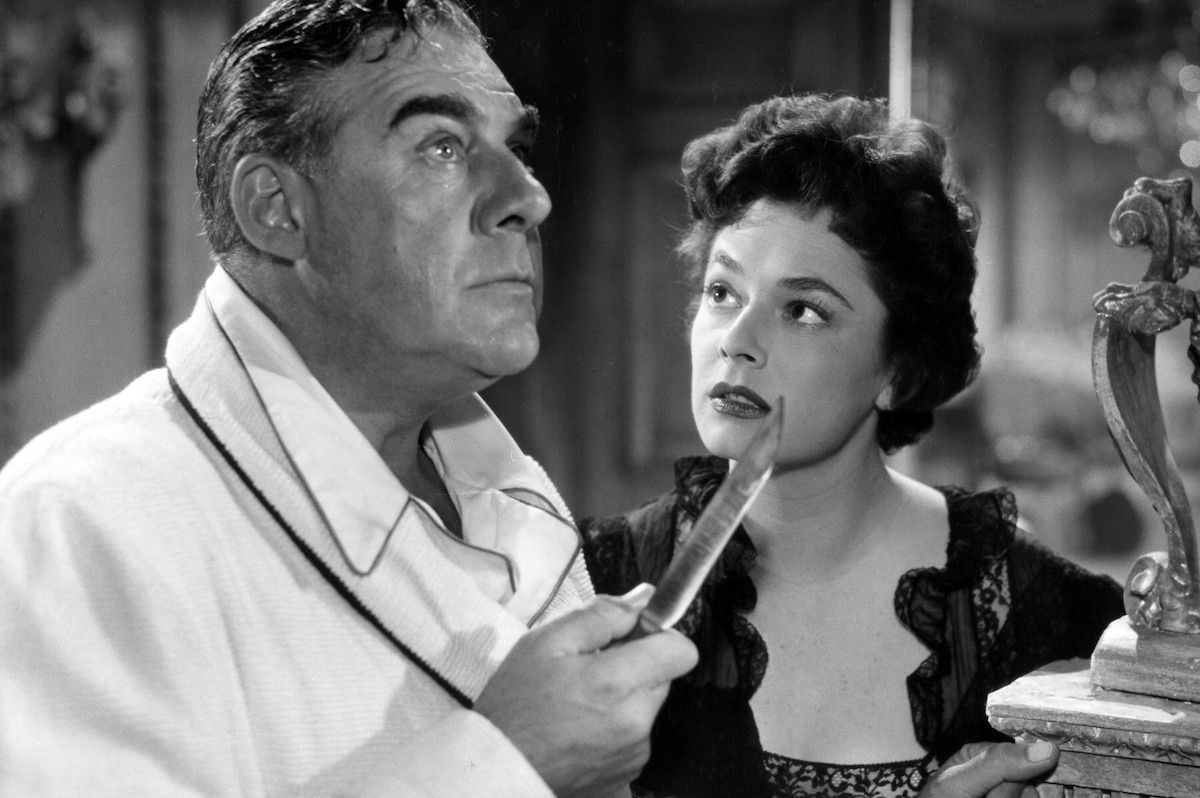
Philip Yordan's original story, Joe MacBeth (1955), which laid the events of Shakespeare's infamous tragedy within the context of the American underworld and recast its protagonist as a Chicago mobster, was an attempt to soften the culture shock by updating the material and allowing the principals to speak in unembroidered, modern day speech. In 1947, independent producer Eugene Frenke bought the property as a potential United Artists release, to star Robert Cummings. Two years later, the property passed to theater owner-turned-film backer James Nasser, who touted Lew Ayres and Shelley Winters as its stars. By the time producer Mike Frankovich seized control of Joe MacBeth, he announced that real-life married couple John Ireland and Joanne Dru would be his Lord and Lady Macbeth but when cameras began turning on the soundstages of Shepperton Studios in the United Kingdom the names above the title were Paul Douglas and Ruth Roman.
Pushing fifty, burly Paul Douglas was an awkward fit for Shakespeare's ambitious young Scottish general. Douglas had originated the role of gangster Harry Brock in the original Broadway production of Garson Kanin's Born Yesterday but allowed the part to pass to Broderick Crawford for Columbia's big screen adaptation. Douglas' size and working man mien vaguely channeled the ghost of Chicago's most famous racketeer, Al Capone, but in fact the Pennsylvania-born actor played more cops than crooks. Backing Douglas' play was Ruth Roman, who had risen from uncredited bits in Gilda (1946) and A Night in Casablanca (1946) to solid roles in Mark Robson's Champion (1949), Alfred Hitchcock's Strangers on a Train (1951) and Anthony Mann's The Far Country (1954). Career gains to one side, the dark-eyed beauty made more of an impression with the public when she and her four year-old son survived the sinking of the Italian ocean liner Andrea Doria, which had collided with the Swedish ship MS Stockholm in a fog bank off of Nantucket in July 1956.
Tapped to helm Joe MacBeth was jobbing British director Ken Hughes. Known as a reliable craftsman, able to squeeze the maximum yield out of the most miserly budget, Hughes specialized in crime films and mysteries early in his career but his enduring legacy rests on the strength of the discomfiting kiddie classic Chitty Chitty Bang Bang (1968). Hughes set to work on the film between May and July 1955, employing veteran cinematographer Basil Emmott, who later shot Don Sharp's similarly shadow-hagged Curse of the Fly (1965). Joe MacBeth's supporting cast is proud in such local talent as Sid James, Grégoire Aslan, and Kay Callard but buried on the call sheet in the role of the First Murderer is Canadian actor Al Mulock. At one time a theatrical impresario in his native Ontario, Mulock emigrated to England and later Italy and Spain, where he earned pop culture immortality with his iconic appearances in Sergio Leone's The Good, the Bad and the Ugly (1966) and Once Upon a Time in the West (1968) prior to his death, a presumed suicide, in 1968.
Producer: Mike Frankovich
Director: Ken Hughes
Screenplay: Philip Yordan, based on the play by William Shakespeare
Cinematography: Basil Emmott
Music: Trevor Duncan
Editor: Peter Rolfe Johnson
Cast: Paul Douglas (Joe MacBeth), Ruth Roman (Lily MacBeth), Grégoire Aslan (The Duke), Sid James (Banky), Bonar Colleano (Lennie), Minerva Pious (Rosie), Harry Green (Big Dutch), Kay Callard (Ruth), Beresford Egan (Sandwich Board Man).
BW-90m.
by Richard Harland Smith
Joe MacBeth
by Richard Harland Smith | August 30, 2011
SIGN UP FOR OUR NEWSLETTERS

CONNECT WITH TCM