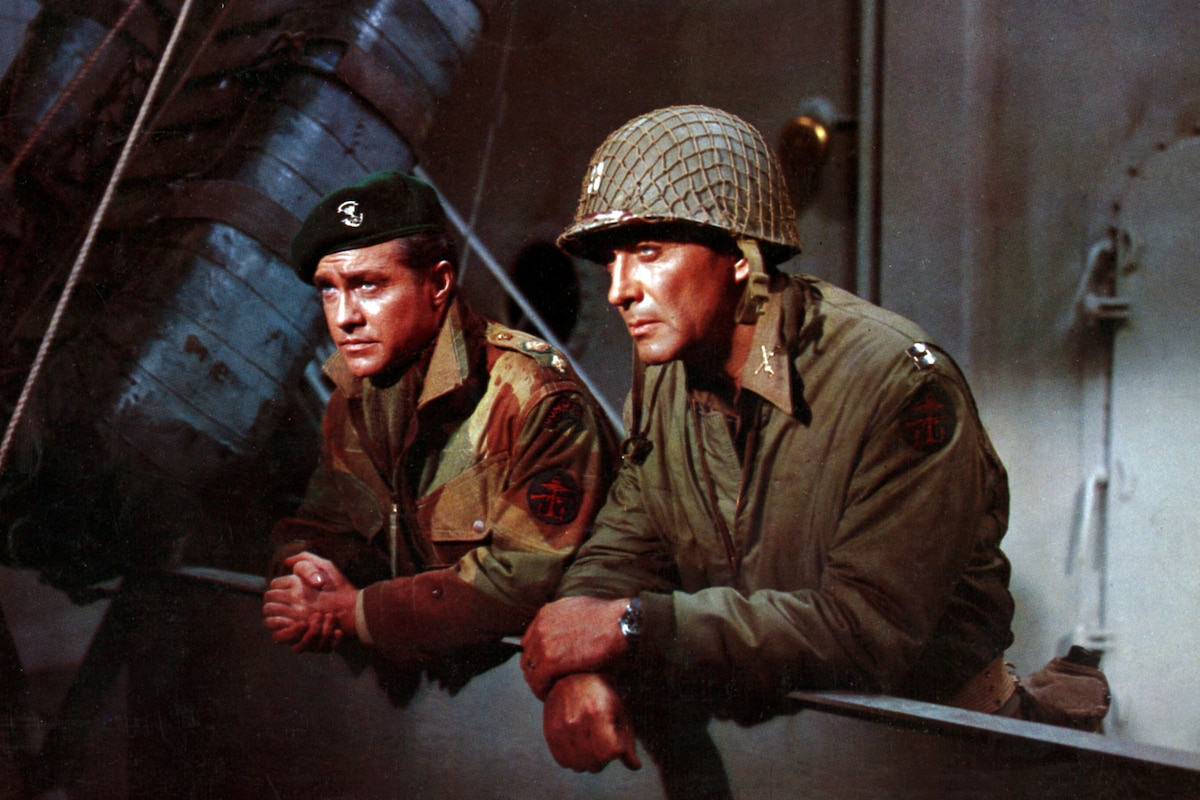
Most of the movie posters for Henry Koster's D-Day the Sixth of June (1956) show Allied soldiers advancing along the beaches of Normandy as they brave heavy fire and explosions. The dominant image, however, is of a soldier and an attractive brunette in an amorous embrace. Some of the posters add a tagline that heralds this moving picture attraction as containing "the greatest love story of the war!" If nothing else, these images are more honest than the subsequent DVD covers that came out that only show English Lt. Col. John Wynter (Richard Todd) and American Captain Brad Parker (Robert Taylor) as they stare grimly out over a hazardous battlefield. As a matter of fact, most of the battle sequences in the movie are packed into the last reel, thus leaving the agonies of a love-triangle to dominate the bulk of the story.
D-Day the Sixth of June is based on the award-winning romantic 1955 novel "The Sixth of June" by Lionel Shapiro. Shapiro was a World War II Canadian war correspondent who landed with the Canadian Armed Forces on D-Day for the Allied invasion of Juno Beach. He was not the only one with first-hand experience as Richard Todd, a parachutist during WWII, also took part in the invasion of Normandy.
Henry Koster, a director who would later obtain quite a bit of success with such films as The Bishop's Wife (1947), Harvey (1950) and The Robe (1953), had some war stories of his own. He was born Herman Kosterlitz in Berlin on May 1, 1905 and was introduced to movies in 1910 by his uncle who had a movie theater in Berlin where his mom would play the piano to accompany the films. At a young age, he was hired by a Berlin movie company, first as a scenarist, then assistant director, eventually directing two movies with his last German movie being a comedy he also co-wrote called Das häßliche Mädchen (1933). With the rise of Adolf Hitler he had already been the victim of anti-Semitism and his future would be radically changed when he found himself being insulted by a Nazi SA officer at a bank during his lunch hour. Kosterlitz knocked the Nazi unconscious. The young director then realized he needed to leave the country immediately and hopped on a train to France, then Hungary, and eventually migrated to America. In 1936, he signed on with Universal and he was with them until 1941. He would move on to MGM and later 20th Century-Fox - the studio that would release D-Day the Sixth of June.
The movie begins on the eve of D-Day with soldiers from both the U.S. and England aboard a war ship bracing themselves for the grim fight to come. Lt. Col. John Wynter flashbacks to a scene in 1942 with Red Cross worker Valerie Russell (played by Dana Wynter). John tells her he is going off soon, and she has orders to go to London. As they kiss goodbye, they also vow to keep each other in their thoughts.
We return to the war ship as Captain Brad Parker is asked how long he has been in England and when he responds to say two years and three months it's his turn for a flashback. He works in London at the headquarters of the European theater of operations for the United States Army and reports to Lt. Col. Alexander Timmer (Edmond O'Brien). Although it's clear Brad has a pretty wife back home that doesn't stop him from flirting with Valerie on a crowded train, which turns into a date at a nice restaurant where they share a dance and clearly have feelings for each other.
Although most of the movie's focus is on the relationship between Brad and Valerie, and Valerie and John, there are some interesting themes that surface regarding tensions between the U.S. and Great Britain. A stand-out performance by Edmond O'Brien as a hard-drinking and garrulous liability to the big military operation underway adds color and spark to the proceedings. California locations and the studio backlot do a suitable job of filling in the action as needed, which is filmed in Deluxe color and shot in CinemaScope.
When battle scenes finally hit the screen, leaving many dead and wounded, there is a surprising coda that gets topped off with yet another surprising conclusion. It would be a spoiler to give any more detail than that, other than to say that within the last shot might lie the reason why Dana Wynter has picked this, of all the movies she has starred in, as her favorite.
By Pablo Kjolseth
D-Day the Sixth of June
by Pablo Kjolseth | August 29, 2011
SIGN UP FOR OUR NEWSLETTERS

CONNECT WITH TCM