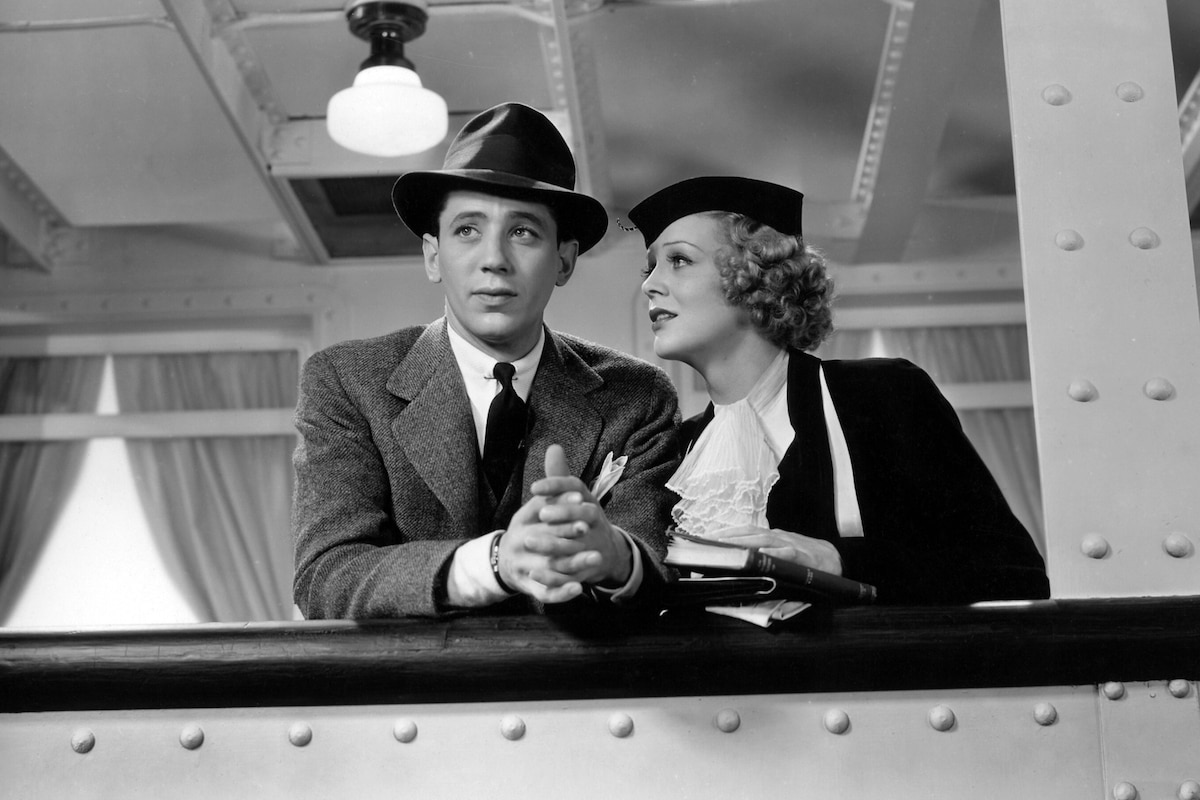
Bobby Halevy (Gloria Stuart) and Rims O'Neill (Ross Alexander) are in love, but, like many other modern couples, they can't quite agree on the next step in their relationship. Rims is especially put out by Bobby's overbearing parents and older sister Florrie (Ruth Donnelly) and her husband Willie Sands (Frank McHugh), who all live in the same cramped New York apartment together and tend to travel en masse, nosing into the couple's business at every opportunity.
Directed by William McGann from a tragicomic 1927 Broadway play by celebrated playwright Maxwell Anderson, Maybe It's Love (1935) looks at the complicated nature of romance when family, work and personal pride all come into play.
Bobby is a valued secretary in the office of a Manhattan business tycoon where she works alongside devoted boyfriend Rims, an ambitious type who longs for promotion to a more exciting assignment, preferably in Havana.
Things get complicated for Bobby and Rims when Adolph J. Mengle, Jr. (Phillip Reed), the handsome son of Rims' boss Adolph J. Mengle, Sr. (Joseph Cawthorn), shows up at the office. Since Adolph Jr. has already flunked out of four colleges, Adolph Sr. is hoping to offer him another chance by integrating his son into the family business. He enlists Rims to show Adolph Jr. the ropes. About as interested in business as he was in college, Adolph Jr. instead makes an immediate beeline for Bobby, who sees his infatuation as an opportunity to make Rims jealous and hopefully speed up their betrothal.
As Rims prepares to sail for a new company position in Havana, Bobby plays her hand, and convinces him that if he sails she will be forced to find love with another. Rims flees the ship, the couple marry and all would appear to be happily ever after. But marriage isn't all they imagined it would be with Bobby's family barging in at any time and bickering over money dividing the young newlyweds.
Full of wisecracks, clever writing and snappy dialogue, Maybe It's Love mixes the pace of 1930s screen comedy with a realistic treatment of a couple who can't seem to make marriage work for them; the movie has a very contemporary feel to it. Especially well-done is how Maybe It's Love conveys the frantic rush and overcrowding of city life, where Bobby and Rims can't have even a private conversation at a department store lunch counter without someone butting in, and where married children are forced to live in their parents' tiny apartment to save money. Making a relationship work in such a setting is a special challenge.
The New York Times saw Maybe It's Love as one more retread of Anderson's play, which had been adapted in 1929 as Saturday's Children with Corinne Griffith and Grant Withers in the lead roles and then again in 1940 as Saturday's Children starring John Garfield, Anne Shirley and Claude Rains. "It is this corner's guess that First National rather suspected it had a job on its hands and attempted to bolster its case with more comic relief than the original script required. That probably accounts for the presence, as triple-threat laugh getters, of Frank McHugh, Ruth Donnelly, Joseph Cawthorn, Maude Eburne and J. Farrell MacDonald. But it takes lots more that that to revive a dead horse," wrote the Times critic.
Maybe It's Love was adapted from prolific, Pulitzer Prize-winning playwright Maxwell Anderson's smash Saturday's Children. Over the course of his celebrated career, Anderson wrote several screenplays including Death Takes a Holiday (1934) and All Quiet on the Western Front (1930), and adapted one of his own plays Joan of Lorraine to Joan of Arc (1948), but Anderson is probably best remembered for the many adaptations Hollywood made of his plays including Mary of Scotland (1936), Key Largo (1948) and The Bad Seed (1956).
As Bobby, Gloria Stuart helped carry Maybe It's Love. Perhaps best known for her collaborations with director James Whale in The Old Dark House (1932), The Invisible Man (1933) and The Kiss Before the Mirror (1933), Stuart was often herded into lackluster programmers that did little for the beautiful blonde actress who was also one of the founding members of the Screen Actor's Guild. When her acting career fizzled, Stuart reinvented herself as a painter and exhibited at galleries around the world. With the death of her husband, screenwriter Arthur Sheekman, Stuart returned to acting most famously as the 100-year-old survivor of the Titanic disaster in James Cameron's 1997 blockbuster Titanic. At 87, she was the oldest person ever to be nominated for an Academy Award for her role.
Director: William McGann
Producer: Harry Joe Brown
Screenplay: Jerry Wald and Harry Sauber; adapted by Lawrence Hazard from a play by Maxwell Anderson
Cinematography: Arthur Edeson
Production Design: John Hughes
Music: Heinz Roemheld
Cast: Gloria Stuart (Bobby Halevy), Ross Alexander (Rims O'Neil), Frank McHugh (Willie Sands), Ruth Donnelly (Florrie Sands), Helen Lowell (Mrs. Halevy), Henry Travers (Mr. Woodrow Halevy), Joseph Cawthorn (Adolph J. Mengle, Sr.), Phillip Reed (Adolph J. Mengle, Jr.), Dorothy Dare (Lila), J. Farrell MacDonald (The Cop), Maude Eburne (The Landlady).
BW-63m.
by Felicia Feaster
Maybe It's Love
by Felicia Feaster | August 25, 2011
SIGN UP FOR OUR NEWSLETTERS

CONNECT WITH TCM