Dusan Makavejev's 1967 Love Affair: Or, The Case of the Missing Switchboard Operator is a picture concocted of many seemingly mismatched parts, some of them unapologetically prosaic, others strange and jarring: Makavejev, one of the key figures in the history of Yugoslavian filmmaking, shows us young lovers in Belgrade enjoying their first assignation and later setting up house together. We also see rows of female switchboard workers toiling at their jobs as a raffish postal worker strolls through their ranks, looking for a date. Tucked among these vignettes from everyday life are documentary footage of parades and rallies, portrayals of basic autopsy procedures, commentary from sexologists and forensics experts, erotic engravings, and the playing of the occasional patriotic song. It's nearly impossible to process all these bits and pieces as you're watching them. But the cumulative after-effect of Love Affair is something else: After you've allowed some time for the picture's strangeness to sink in, it hardly seems strange at all.
That said, if you find it baffling, you're hardly alone. "I am driven to desperation by attempts to describe the films of Yugoslavian director Dusan Makavejev," Roger Ebert wrote in his review for the Chicago Sun-Times upon the movie's release. After noting that another of Makavejev's films, Innocence Unprotected (1968), had failed to connect with Chicago audiences (though it did win the big prize at the 1969 Chicago International Film Festival), he suggested that Makavejev's films just need to find the right audience. "What Makavejev needs to reach," Ebert wrote, "is that specific American subculture consisting of old Bob and Ray fans, Marvel Comics readers, Realist subscribers, people who can recite scenes from 'Catch-22,' and people who write obscene letters to large corporations. They will share Makavejev's vision of the real world, where the grotesque and the hilarious are identical."
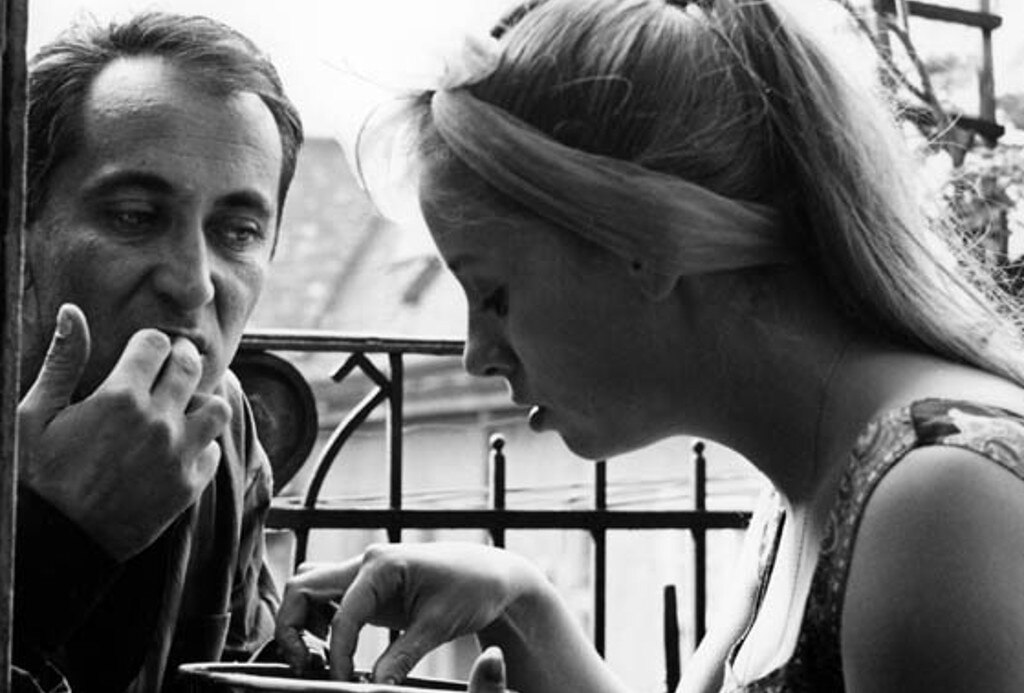
Understanding that balance between the grotesque and the hilarious is key to appreciating Love Affair. There's also a great deal of tenderness in the picture, and more than a few sarcastic jabs at old-school Communism. The basic story Makavejev tells in Love Affair is that of Izabela (Eva Ras), the switchboard operator of the title, and Ahmed (Slobodan Aligrudic), a professional rat-catcher who takes pride in his work and does it well. Izabela has invited Ahmed to her apartment, which she used to share with her recently deceased mother. They make small talk; Izabela offers Ahmed a shot of the brandy her brother has brought her from Hungary. Although Ahmed -- a party member, a former soldier, and a solid, hardworking citizen -- proclaims he rarely drinks, he takes a swig: "That's a real disinfectant!" he says brightly, even as he suppresses a slight grimace, for politeness' sake. He and Izabela end up in bed. Afterward, she tells him, "I haven't had a man in two months. Too long for a Hungarian like me." He's gentle and affectionate toward her, and clearly somewhat mystified by her too: "You're my first modern woman," he tells her.
But Makavejev isn't telling the story of Izabela and Ahmed in a straightforward, linear fashion, and we already know that somehow, something will go terribly wrong. Makavejev has already shown us a search team entering a sewer or well and bringing out the body of a young woman. She's brought to the coroner's office, where she's probed and examined. Her flesh looks soft, like live skin, but also cold, like marble: There's no life left in it. Earlier still, Makavejev has treated us to a mini-lecture on human sexuality, courtesy of one rather grandfatherly Dr. Alexander D.J. Kostic, who addresses the camera to ask brightly, "Are you interested in sex?" Already knowing the answer, he quickly adds, "It is good you are!" before launching into a discussion of ancient rituals involving phalluses.
There's sex in Love Affair, though it's more intimate and tender than it is graphic, and there's nudity as well. And while Makavejev does have a great sense of humor, he doesn't shy away from showing us coldness and cruelty, too -- he's most interested in capturing the texture of everyday experience in this particular time and place.
This is, in part, a movie about people feeling their way toward a kind of freedom, both political and personal. The filmmaking is rough and jagged in places, as if segments had been shot quickly on the street. Love Affair looks like guerrilla filmmaking, because it is: In her study of the films of Makavejev, Terror and Joy: The Films of Dusan Makavejev, Lorraine Mortimer explains that in the 1960s, studios in Belgrade and Zagreb were being used for big Hollywood movies, which limited opportunities for local filmmakers. While he was waiting to start shooting officially, Makavejev began working in empty rooms in the basement of one of these studios. Then he befriended an unemployed production manager who helped him acquire some film stock. "We got a camera from the camera department, and we went to the lab and got our film developed, because we told them we worked for the company," Makavejev said. "The people who did realize what we were doing loved us. We were young guys who were doing something interesting."
The adjective "interesting" is something of an understatement. While Love Affair is interesting, it's also, in places, perplexing, dislocating and occasionally dull. But it's also deeply moving, for the way it so lovingly captures the details of people's lives in late 1960s Yugoslavia, a place eager to join the modern world like everyone else. In one sequence, Ahmed and a workman install a shower. We watch as they put up the partitions, drill the necessary holes in the plaster, affix the shower head -- the work is methodical and precise. In a somewhat different and very charming sequence Izabela, her lush, thick hair tied back in a scarf, makes a strudel: We watch her crack the eggs into a mound of flour and roll out the dough into impossibly thin sheets. Later, she and Ahmed enjoy it together. The sequence is hypnotic and lyrical, akin to looking through a dollhouse window for a glimpse of modest domestic happiness.
And so for all its seeming strangeness, Love Affair really isn't so odd at all. Its chief features are actually quite familiar: Makavejev shows people living and working, falling in love, being bored and listless. They spill out of work at the end of the workday, they eat takeout food, they look at movie posters as they pass by a theater. The sexologist, the marching music, the salacious engravings, the general sense of dislocation we get from the movie's structure? Those are part of the experience too, but the human element of Love Affair is what really resonates. Mortimer quotes Makavejev: "I like buildings with a lot of staircases and separate exits and small balconies, and I like films made the same way." Love Affair is that kind of building, a home for its characters to inhabit both in happiness and sorrow.
Director: Dusan Makavejev
Screenplay: Dusan Makavejev, Branko Vucicevic
Cinematography: Aleksandar Petkovic
Film Editing: Katarina Stojanovic
Cast: Eva Ras (Izabela, telefonistkinja), Slobodan Aligrudic (Ahmed, sanitarni inspektor), Ruzica Sokic (Ruza, Izabelina koleginica), Miodrag Andric (Mica, postar i zavodnik), Dr Aleksandat Dj Kostic (Ekspert za seksualna pitanja), Dr Zivojin L Aleksic (Ekspert za kriminalistiku), Dr. Dragan Obradovic (Obducent), Rade Ljubisavljevic (Vodoinstalater), Aca Tadic (Jorgandzija).
BW-69m.
by Stephanie Zacharek
(Stephanie is the chief movie critic for Movieline - www.movieline.com)
Sources:
Terror and Joy: The Films of Dusan Makavejev, by Lorraine Mortimer
University of Minnesota Press, 2009
imdB
Love Affair or the Case of Missing Switchboard Operator
by Stephanie Zacharek | August 12, 2011
SIGN UP FOR OUR NEWSLETTERS

CONNECT WITH TCM