Claude Chabrol launched the French New Wave with Le Beau Serge--and then he went and ran off in a different
direction away from the very movement he helped found. For aficionados of the New Wave, here is a seminal work--for
aficionados of Chabrol's own unique brand of cinema, here is a frustratingly unfamiliar work.
Chabrol was one of several film critics working at the Cahiers du Cinema who had been taken up with the notion
that a true film artist "writes" with a camera the way an author writes with a pen. They had been applying this
theoretical construct to the analysis of other peoples' films--all the while itching to get a chance to implement
it in practice on their own. But writing about movies takes nothing more than opinions and some paper; making movies
takes serious money. The existing film industry in France considered the Cahiers du Cinema crowd to be a bunch
of insolent youngsters and had no interest in financing their experiments.
And at this critical moment in film history we need to introduce another key figure--one whose significance is belied by
the fact that her name is barely remembered at all (it was Agnès Goute). She was Chabrol's first wife, and while
posterity has shown little interest in her name, she was important for suffering two successive tragedies. Agnès
inherited a substantial sum of money from the first tragedy--which provided her soon to be ex-husband Claude with the
means by which to become a film producer. The second tragedy was the death of their first child--which provided Claude
with the subject matter for his first film. (You could say when Claude divorced her, she suffered a third tragedy, but
then again maybe she was better off being rid of a guy who would selfishly exploit her this way).
Thanks to Agnès' windfall, Claude established AJYM Films and financed early works by Philippe de Broca, Eric Rohmer and
Jacques Rivette--not to mention Le Beau Serge, the first feature-length work of the New Wave. A revolution had
begun.
Le Beau Serge was a popular and critical success, but as a "New Wave" film it marches to a different beat. The
dour mood, somber pace, heavy-handed religious allegory, and provincial setting set it apart from the exuberant works
by Godard and Truffaut that followed. For that matter, it seems a breed apart from Chabrol's own later works.
The entire production was mounted in the French provincial village of Sardent, Chabrol's hometown. And boy did he
hate that place.
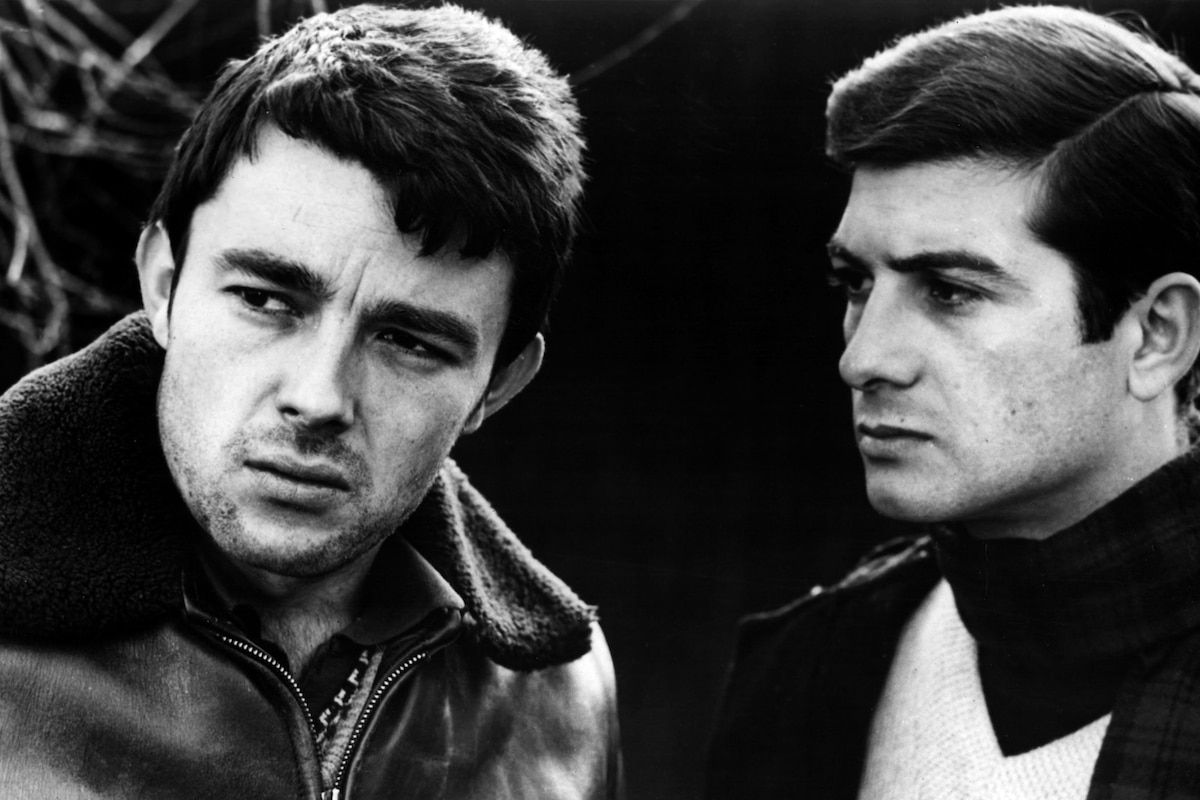
Le Beau Serge stars Jean-Claude Brialy as Françoise, a worldy student suffering from tuberculosis who has
returned to his hometown to recuperate in the quiet countryside. To his mounting horror, he discovers that the place
where he grew up is a festering cesspit of economic and moral decay. The place is so decrepit and demoralized, an act
of incestuous rape is treated with a "ho hum" indifference by all concerned. Only Françoise sees the state of affairs
as intolerable, and sets his mind to "fixing" things.
Specifically, his heroic attentions are focused on his childhood chum Serge, the handsome Serge of the title. Serge
was forced into a shotgun wedding with a teenage girlfriend, only to face the premature death of their child. He is
now underemployed and impoverished, not to mentioned haunted by nightmares of a dead child. His wife is now pregnant
again, and Serge fears the new baby will be as retarded as the one that perished. He buries his anxiety in endless
drinking--which isn't what anyone could consider a long-term solution to his troubles.
The role is played by Gérard Blain, in a sort of Frenchified James Dean mode. He doesn't want Françoise's help, and
bitterly resents the intrusion of his old friend. That hostility doesn't hold Françoise back--it merely pushes him into
Christ-like excesses of self-sacrifice and holier-than-thou enthusiasm.
For a film as influential and successful as Le Beau Serge was, it had something to turn off just about anyone.
Some were scandalized by the blunt treatments of sexual material, some were irked by the overt Catholic moralizing--and
the town of Sardent was given almost nothing in which to take any pride, for that matter. But set this nit-picking
aside--there is nothing else to be said but that Le Beau Serge is an astonishing debut. Francois Truffaut gushed
at the film's opening, "The film is as masterly as if Chabrol had been directing for ten years, though this is his
first contact with a camera." Truffaut cannot be said to be an impartial critic, but still.
That being said, it does call for some cinematic archeology to uncover Chabrol's future technique and obsessions in the
interstices of Le Beau Serge, much as early films like The Pleasure Garden offer little insight into the
artist Alfred Hitchcock was to become. The long takes, the neorealist emphasis on documenting small town life
(allegedly the first cut of the film ran a full hour longer, and consisted of straight-forward documentary sequences),
the unusually emotional and personal nature of the material--all of this stands out as atypical of the Chabrol-to-be.
We catch glimpses here and there--for example, in the opening sequence as Jean-Claude Brialy rides into town on a bus.
The bus stops, and the camera rises up into the air for a birds-eye view of things, as an angry sting of music stabs
into the scene. On second viewing, it can be discerned that the music is highlighting our first glimpse of Gérard
Blain, drunk and insensate. The music is underscoring the central conflict of the drama--but it does so in
anticipation of that understanding. If you've ever tried to watch for the first time a movie with a companion
who's seen it already, and who impatiently keeps nudging you "Hey pay attention here," and "You'll never
guess what's gonna happen next," then you have an idea of what watching a Chabrol film can be like--his technique is
self-consciously impatient with itself, desperate to move ahead, even while the pace is cold and deliberate. It can be
an effect both disorienting and intoxicating.
Another wry Chabrolian touch occurs when an otherwise ordinary scene is interrupted for no apparent reason by Chabrol
and Rivette, playing themselves, who wander into the movie to say hi to the characters. For an artist who seemed
committed to maintaining a scrupulously naturalistic attitude towards his subject, it's a strangely Monty Python-ish
kind of gesture.
In the decades to come, Chabrol would come to have the courage of his convictions, and relish the greater joy to be
found in defying conventions. For a first film by a young man venturing into a new medium, bereft of role models for
how to do what he had in mind, Le Beau Serge is almost beyond criticism.
Criterion Collection's presentation on DVD and Blu-Ray is suitably well-appointed. The film hasn't looked this good
since 1958, and the English subtitles are newly updated. Guy Austin, author of the BFI biography of Chabrol, provides
the audio commentary, while film critic Terrence Rafferty authored the printed liner notes. Also included are a
documentary on the making of the film and an excerpt from a vintage (1969) TV programme in which Chabrol revisited
Sardent (and no one attempted to lynch him).
For more information about Le Beau Serge, visit The Criterion Collection.
by David Kalat
Le Beau Serge - Claude Chabrol's 1958 Debut Feature on DVD
by David Kalat | August 11, 2011
SIGN UP FOR OUR NEWSLETTERS

CONNECT WITH TCM